How to Build an Automated Content Creation Workflow with Zero Risk

If you are reading this, you are likely wearing too many hats. You are the CEO, the lead strategist, the customer service rep, and—often to your dismay—the head of marketing. You know that producing high-quality content is non-negotiable if you want to build authority and attract high-paying clients. But when you are already spending 10+ hours a day juggling client delivery and business development, finding the time to write expert-level posts, articles, and newsletters feels impossible.
You don't lack ambition, and you certainly don't lack expertise. What you lack is leverage.
Many small business owners fall into the trap of believing they just need to "hustle harder" to compete with larger agencies or well-funded competitors. But the truth is, the big players aren't working harder than you—they just have better systems. They rely on automated processes that handle the heavy lifting, freeing up their best minds for high-level strategy.
The good news? You no longer need a massive budget or a dedicated marketing team to build those same systems. By implementing a strategic, automated content creation workflow, you can reclaim hours of your week, produce polished content reliably, and scale your business. And despite what your past experiences with clunky software might tell you, you can do this with zero risk to your brand’s reputation.
Here is the step-by-step guide to building a streamlined workflow that actually works.
Step 1: Audit Your Current Process (Find the Bottlenecks)
Before you can automate anything, you need to understand exactly where your time is bleeding out. Automation applied to an inefficient process will only generate bad results faster.
Take a moment to map out your current content creation cycle. Ask yourself:
How long does it take me to stare at a blank page before I finally settle on a topic?
Am I rewriting the same core concepts from scratch every time I post on LinkedIn or my blog?
How much time am I spending trying to "fix" generic AI outputs that sound robotic or out of touch with my industry?
For most ambitious solopreneurs, the biggest bottleneck isn't a lack of ideas—it’s the manual execution and the trial-and-error involved in getting those ideas onto the page. You might be testing new tools, but if those tools require hours of prompt-tweaking just to get a usable draft, they aren't saving you time; they are just changing how you spend it. Identify these friction points. Recognizing that your time is better spent on growth rather than formatting is the first step toward building a sustainable system.
Step 2: Build Your Tech Stack (Without the Bloat)
When small business owners decide it's time to automate, they often make a critical mistake: they overcomplicate their tech stack. It is easy to get lured in by flashy software promising to do everything from writing your copy to making your coffee. But complex tools lead to steep learning curves, which ultimately lead to abandoned software and wasted money.
To build an automated content creation workflow that you will actually use, you need to keep your toolkit lean, affordable, and focused on ROI. You only need three core components:
1. A Centralized Knowledge Hub: This is where your ideas, brand guidelines, and assets live. Tools like Notion, Trello, or even a simple Google Workspace setup work perfectly. This hub ensures you aren’t frantically searching for a client testimonial or a brand color hex code when it’s time to publish.
2. A Reliable AI Engine: You need a generative AI platform (like ChatGPT, Gemini, or Claude) to do the heavy lifting of drafting and structuring content. However, the AI is only the engine; it requires the right fuel to function properly.
3. A Scheduling and Distribution Tool: Once your content is polished, you need a way to distribute it without having to log into five different platforms every day. Tools like Buffer, Hootsuite, or Metricool allow you to batch-schedule your expertly crafted posts for the week or month ahead.
Notice what is missing from this list? Bloat. You do not need five different writing apps or complicated Zapier integrations to start seeing immediate time savings. By focusing on these three pillars, you build a resilient, easy-to-manage infrastructure. You keep costs down, reduce the cognitive load on yourself, and create a clear, straight line from an idea in your head to a published post on your feed.
Step 3: Implement Strategic AI Prompts (The Zero-Risk Secret)
Here is where most entrepreneurs hit a wall. You have the tools, you sit down to use your AI engine, and the output you get is... underwhelming. It sounds like a textbook, uses emojis aggressively, and completely lacks the professional credibility your brand relies on.
This is the exact reason many business owners remain skeptical of AI. They worry: Is the content quality high enough to represent my brand? Will this actually work in my specific industry? The answer is yes, but only if you stop treating AI like a magic 8-ball and start treating it like a junior copywriter who needs precise, strategic instructions. This is the zero-risk secret to an automated content creation workflow: Do not rely on generic, copy-and-paste prompts.
To get expert-level results, you need expert-level inputs. When you use strategically engineered, industry-specific prompts, you completely eliminate the trial-and-error phase. Instead of spending 45 minutes arguing with a chatbot to make a post sound "less robotic," you use a proven framework that instructs the AI on exactly what tone, structure, and industry nuances to include.
Think of it as the ultimate quality-control mechanism. By using a pre-built prompt that has been rigorously tested for your specific field—whether you are in consulting, marketing, or e-commerce—you guarantee that the output will be polished, authoritative, and aligned with your brand values. You bypass the risk of publishing mediocre content and immediately unlock the true time-saving power of AI. It is the difference between hoping for a good result and systematically engineering a great one.
Step 4: Automate, Review, and Refine (The Human-in-the-Loop Model)
With your tech stack in place and your strategic prompts ready, it is time to set the workflow into motion. But "automated" does not mean "unsupervised." To maintain the high standards of your brand, you must employ the "Human-in-the-Loop" model.
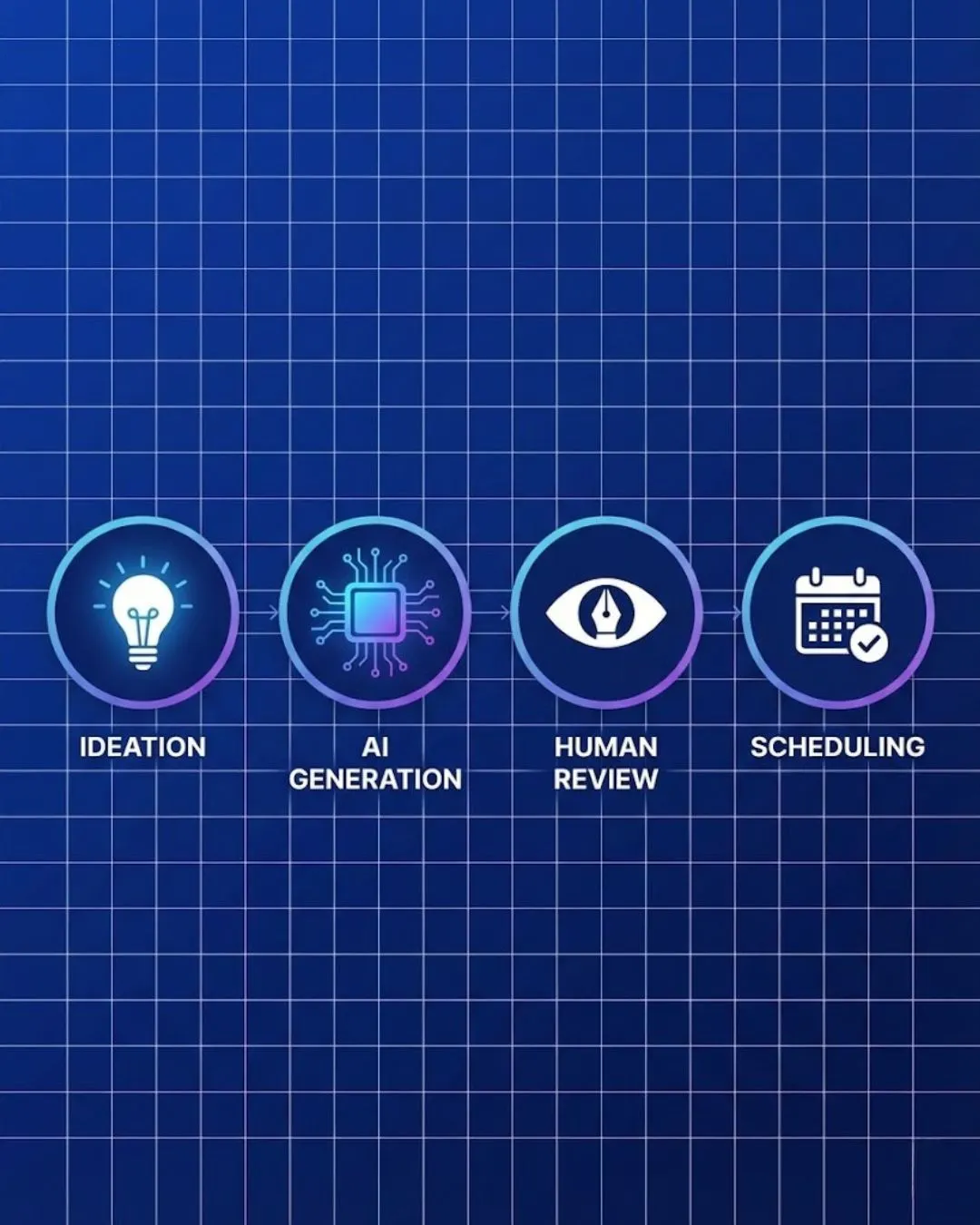
Here is what your new, streamlined weekly workflow looks like:
1. Ideation (10 Minutes): Pull a topic or a frequently asked customer question from your Centralized Knowledge Hub.
2. Generation (5 Minutes): Plug that topic into your AI engine using a proven, industry-specific prompt. Because the prompt is expertly crafted, the AI generates a near-perfect draft on the first try.
3. Review and Refine (10 Minutes): You step in as the Executive Editor. You aren't writing from scratch; you are simply reviewing the draft, injecting a personal anecdote, and ensuring the tone is perfectly aligned with your voice.
4. Distribution (5 Minutes): Drop the finalized content into your scheduling tool.
What used to take three agonizing hours now takes 30 minutes. You have successfully broken the bottleneck. You are producing consistent, expert-level content across platforms, giving you a stronger, more credible brand presence. More importantly, you have freed yourself from the day-to-day overwhelm, giving you the time and energy to focus on what actually matters: closing deals, serving clients, and scaling your business.
Stop Hustling, Start Scaling
Transitioning from an overworked operator to a confident strategist requires you to leverage systems that multiply your efforts. An automated content creation workflow is not about cutting corners; it is about working smarter so you can compete harder.
By auditing your processes, utilizing a lean tech stack, keeping a human in the loop, and—most importantly—relying on strategically engineered prompts, you can scale your brand's visibility with absolutely zero risk to your credibility.
Ready to stop spinning your wheels and start winning clients? You don’t have to build these systems from scratch.
Upgrade Your Workflow With Expert AI Prompts. Unlock 50 industry-specific, proven prompts designed to give you expert-level content in minutes. Scale smarter, grow faster, and reclaim your time today: