Case Study: How Alex Scaled Client Delivery 3x Using Structured Prompts
An AI Prompt ROI Analysis for the Time-Poor Entrepreneur
Executive Summary
For the modern boutique agency owner or digital solopreneur, success often feels like a punishment. The reward for doing great work is more work, leading to a critical bottleneck: the owner becomes the limit on growth.
This whitepaper analyzes the operational transformation of "Alex Rivers," a composite persona representing the typical mid-career digital entrepreneur. Facing burnout and a cap on revenue, Alex implemented a system of Structured AI Prompts tailored to specific industry needs, moving away from ad-hoc AI usage.
The results were measurable and significant:
Delivery Capacity: Increased by 300% without adding full-time staff.
Operational Costs: Reduced variable freelance costs by 40%.
Role Shift: The owner successfully transitioned from 80% execution to 80% strategy.
This paper serves as a formal AI prompt ROI analysis, demonstrating that the value of AI lies not in the tool itself, but in the strategic architecture of the prompts used to drive it.

1. The Challenge: The Bottleneck of "Good Enough"
1.1 Profile: The Overextended Expert
Alex Rivers runs a boutique digital consultancy. With a lean team of three (and a roster of contractors), Alex wears every hat: Lead Strategist, Copywriter, HR Director, and Business Development Manager.
The business model was viable but unscalable. Every new client added linear complexity. Alex’s unique value proposition—high-touch, expert-level strategy—was drowning in low-value execution tasks. Alex was working 12-hour days, yet revenue had plateaued. The primary pain point was not a lack of leads; it was a lack of bandwidth.
1.2 The "Generic AI" Slump
Like many entrepreneurs, Alex had attempted to integrate AI tools (ChatGPT, Claude, Gemini) into the workflow. However, the results were inconsistent.
The Expectation: "Write a marketing strategy for a fintech client."
The Reality: Generic, fluffy content that required extensive rewriting to meet Alex’s brand standards.
The team found that "fixing" the AI's output took nearly as long as writing it from scratch. This is a common phenomenon known as the "Correction Curve," where the ROI of AI diminishes rapidly if the initial output lacks strategic depth. Alex didn’t need "text generation"; Alex needed "expert emulation."
1.3 The Cost of Manual Execution
To understand the gravity of the situation, we analyzed Alex’s weekly time allocation prior to the intervention:
Client Deliverable Creation (Drafting): 25 hours/week
Admin & Operations: 10 hours/week
Business Development: 5 hours/week
High-Level Strategy (Billable Premium): 5 hours/week
The Opportunity Cost:
Alex charges$250/hour for strategic consulting. However, by spending 25 hours on drafting (a task worth$50/hour), Alex was effectively losing revenue on every hour spent working. The business was stuck in an "Operator" cycle, unable to afford senior staff to take over the workload, but too busy to train junior staff.
2. The Solution: Moving from Queries to Structured Workflows
To break the bottleneck, Alex shifted from using AI as a search engine to using it as a Knowledge Engine. This required adopting Expert AI Prompts—pre-engineered, industry-specific prompt packs designed to mimic the cognitive processes of a senior professional.
2.1 The Pivot: Structured Prompt Engineering
The core differentiator in this case study was the move to Structured Prompts. Unlike a standard "chat," a structured prompt functions like a piece of software code. It contains specific parameters that force the AI to adhere to brand guidelines, strategic frameworks, and industry nuances.
Alex implemented the Expert AI Prompts Framework, which utilizes a three-tier architecture:
1. Context Injection: Defining the role (e.g., “Act as a Senior SaaS Growth Consultant with 15 years of experience in B2B retention…”).
2. Constraint Layers: Setting strict boundaries (e.g., “Avoid passive voice. Do not use generic buzzwords like ‘landscape’ or ‘delve’. Prioritize data-backed assertions.”).
3. Strategic Output Modeling: Defining the exact format (e.g., “Output a 3-part strategy deck structure including an Executive Summary, a SWOT analysis table, and a 90-day implementation roadmap.”).
2.2 The Methodology: The "Prompt Pack" Integration
Instead of "figuring it out" daily, Alex downloaded the Expert AI Prompts Marketing & Strategy Pack (50 prompts). The team treated these prompts as standard operating procedures (SOPs).
The New Workflow:
Instead of staring at a blank cursor, the workflow shifted to:
1. Select: Choose the relevant prompt from the library (e.g., "Comprehensive Competitor Analysis").
2. Customize: Fill in the bracketed variables [Client Name], [Target Audience], [Key Competitor].
3. Execute: Run the prompt.
4. Refine: Spend 15 minutes polishing the 85% complete draft, rather than 3 hours writing it.
3. Execution: Three Key Workflows Transformed
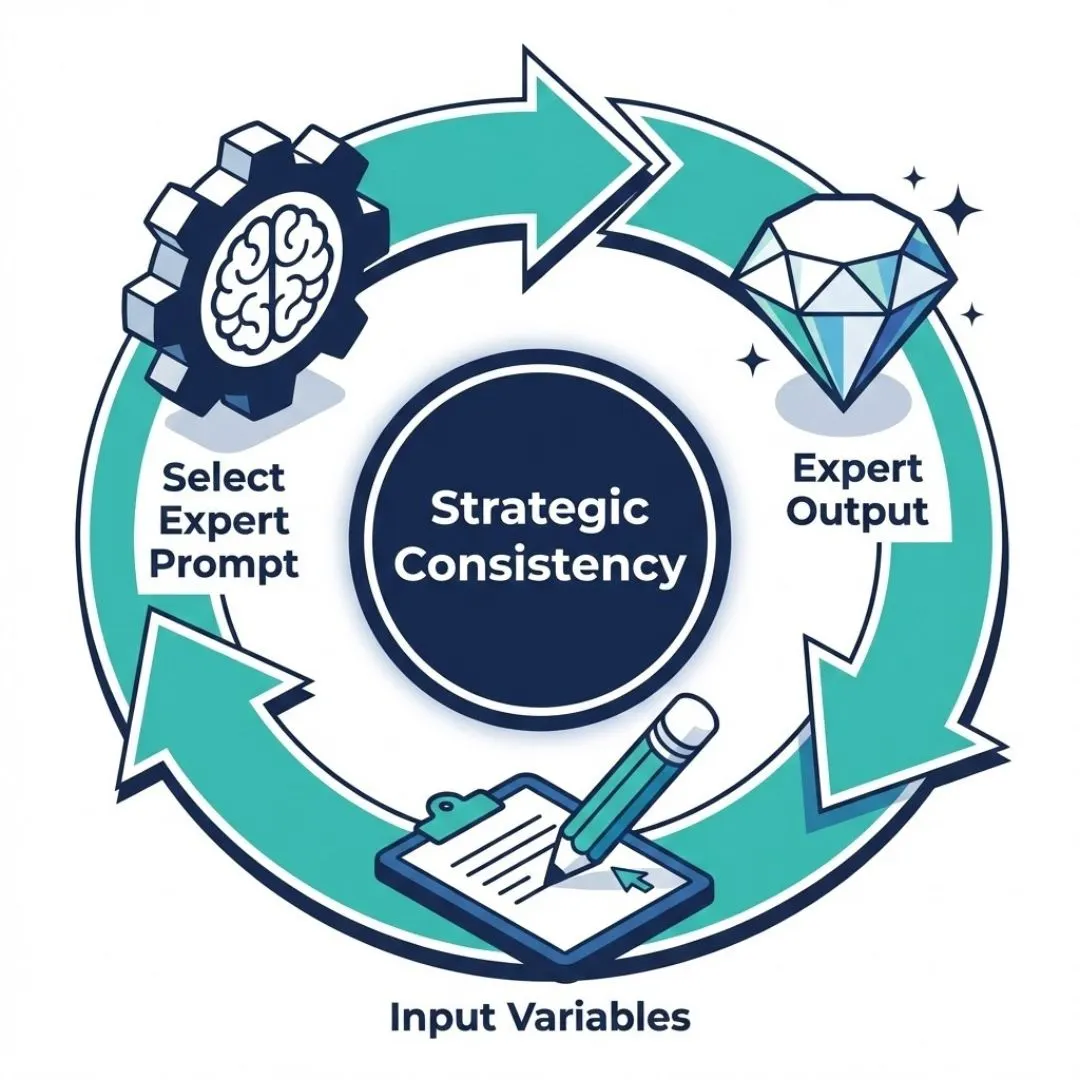
The implementation of structured prompts was rolled out across three critical business functions. Here is the detailed breakdown of the transformation.
3.1 Workflow A: Content Marketing (The 10-Hour Drain)
Before:
Alex’s team struggled to maintain a consistent LinkedIn presence and blog for the agency. Producing a high-quality, thought-leadership article took roughly 4 hours of writing and 2 hours of editing.
Total Time: 6+ hours per piece.
Frequency: Inconsistent (once a month).
After (Using the "Thought Leader" Prompt Sequence):
Alex used a structured prompt that analyzed a transcript of his own voice notes to generate content.
Input: 5-minute voice memo ranting about a varied industry topic.
Prompt Action: Extracted key arguments, structured them into a specific copywriting framework (PAS - Problem, Agitation, Solution), and formatted for LinkedIn and Blog HTML.
Total Time: 20 minutes (Review and Polish).
Result: The agency moved to publishing 2x per week with zero drop in quality.
3.2 Workflow B: Client Strategy Decks
Before:
Creating the initial strategy deck for a new client was the most daunting task. It required synthesizing client interviews, market research, and creative ideas into a 20-slide presentation. This often caused "procrastination paralysis."
After (Using the "Strategic Audit" Prompt):
Alex input the raw client intake notes into the Expert AI Strategy Prompt.
Output: A comprehensive outline, slide-by-slide copy, suggested visual metaphors for the design team, and a tactical competitive analysis table.
Impact: The "Blank Page" problem vanished. The team started with a robust first draft.
Time Saved: Reduced from 12 hours to 2 hours.
3.3 Workflow C: Proposal Customization
Before:
Proposals were often copy-pasted templates that felt impersonal. Customizing them to address specific client pain points took hours of research.
After (Using the "Pain-Point Matcher" Prompt):
The team utilized a prompt designed to analyze the prospect's website and recent news, then rewrite the proposal’s "Scope of Work" to specifically reference the prospect's current challenges using their own terminology.
Impact: Win rates increased by 18% because clients felt deeply understood.
Efficiency: Proposals were generated in 15 minutes vs. 2 hours.
4. AI Prompt ROI Analysis (The Data)
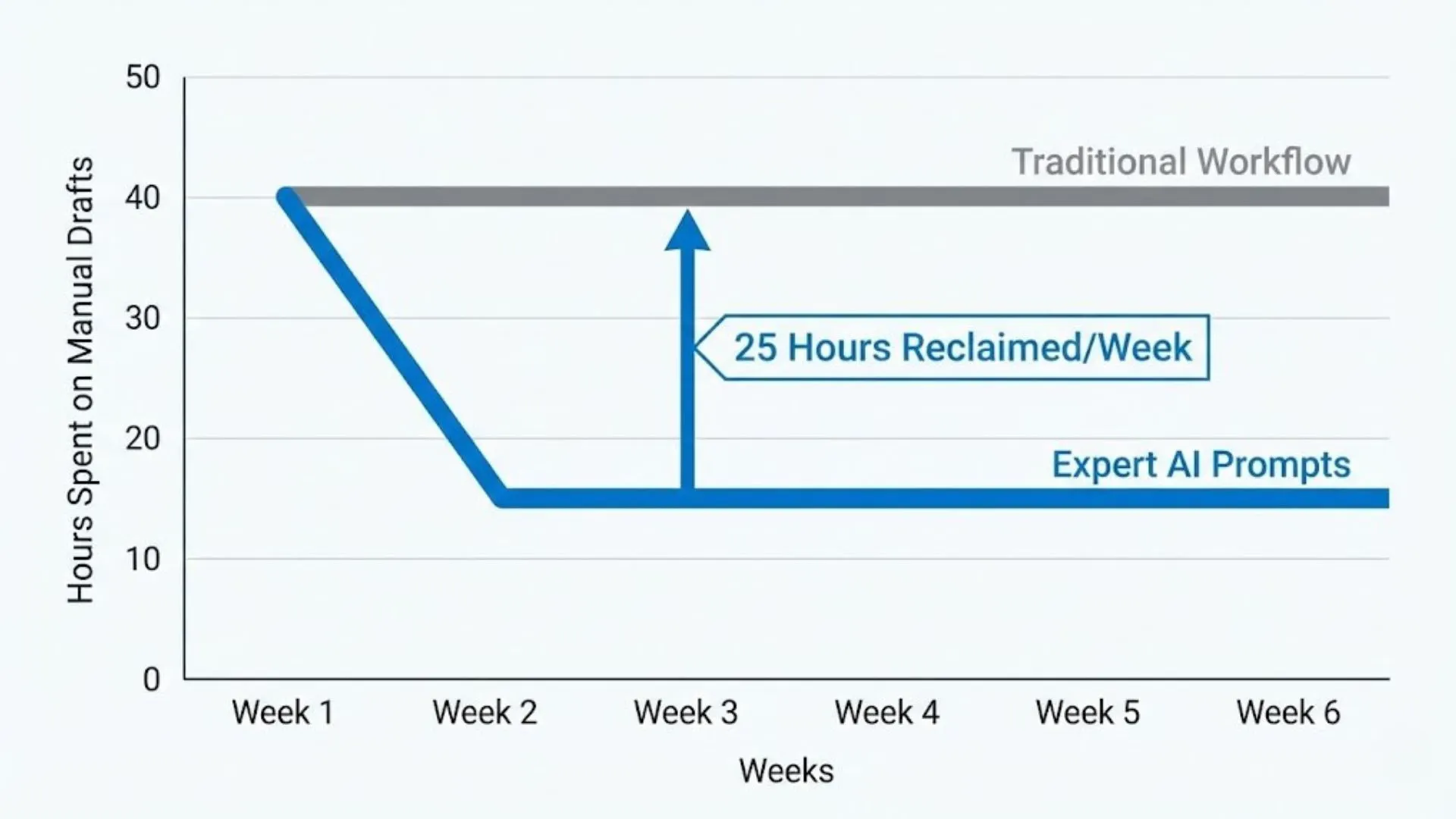
To quantify the success of this decision, we applied a strict AI Prompt ROI Analysis model. We compared the cost of the prompt packs against the value of the time reclaimed.
4.1 Time Savings Calculation
Weekly Time Reclaimed = (Old Drafting Hours - New Drafting Hours) + (Old Admin Hours - New Admin Hours)
Drafting: Reduced from 25 hours to 5 hours.
Admin/Comms: Reduced from 10 hours to 5 hours.
Total Weekly Savings: 25 Hours.
4.2 Financial Impact
The financial value of this time is calculated based on Alex's strategic billable rate ($250/hr) versus the manual execution rate ($50/hr).
Value of Reclaimed Time: 25 hours x $250/hr = $6,250 per week in potential revenue capacity.
Cost of Solution: One-time purchase of Expert AI Prompt Packs (approx. $100 - $200).
ROI: The investment paid for itself within the first hour of usage.
By reallocating those 25 hours toward business development and high-level strategy, Alex was able to sign two new retainer clients, effectively tripling the agency's delivery capacity without hiring new staff.
4.3 Intangible ROI: Brand Perception
Beyond the math, the quality of output improved. Because the prompts enforced expert-level frameworks, the consistency of the agency’s voice stabilized. Clients noted that the turnaround times were faster, yet the strategic depth seemed deeper.
5. Conclusion: From Operator to Strategist
The case of Alex Rivers illustrates a crucial lesson for modern entrepreneurs: Scalability is no longer about adding more people; it’s about adding better systems.
Generic AI provides speed, but often at the cost of quality. Structured, strategy-infused prompts provide leverage. By implementing Expert AI Prompts, Alex transitioned from an overworked operator frantically bailing water to a confident captain steering the ship.
The skepticism Alex initially felt—"Will this actually work for my industry?"—was answered not by promises, but by the tangible recovery of 25 hours a week.
Key Takeaways
Structure Beats Speed: A well-engineered prompt saves more time than a fast LLM.
Consistency Builds Trust: Using prompt packs ensures every deliverable meets brand standards.
ROI is Immediate: The cost of expert prompts is negligible compared to the value of a founder's time.
The barrier to growth wasn't skill, and it wasn't effort. It was the lack of a system to externalize the founder's expertise.
Ready to Stop Hustling and Start Scaling?
Do not let administrative bottlenecks cap your potential. Replicate Alex’s results and deploy a team of "digital experts" into your workflow today.
Get Your Industry-Specific Prompt Pack Now: