Chaos vs. Clarity: A Side-by-Side Comparison of Output Quality
We have all been there. You sign up for the latest AI tool, expecting it to solve your workload crisis instantly. You type in a request, hit enter, and wait.
The result? A generic, robotic wall of text that sounds nothing like you and provides zero strategic value.
For busy entrepreneurs like Alex Rivers, this is the moment AI becomes a burden rather than a blessing. You end up spending more time editing the "robot voice" out of the text than it would have taken to write it yourself.
The problem isn't the AI model; it's the input. This is the battle of structured vs unstructured prompts. Below, we break down exactly how a strategic prompt changes the game, turning chaotic inputs into clear, expert-level assets.
The Gallery: A Tale of Two Prompts
To prove the difference, let’s look at two common business tasks: writing a cold outreach email and developing a content strategy.
Scenario A: The Cold Outreach Email
The Goal: Connect with a potential partner without sounding spammy.
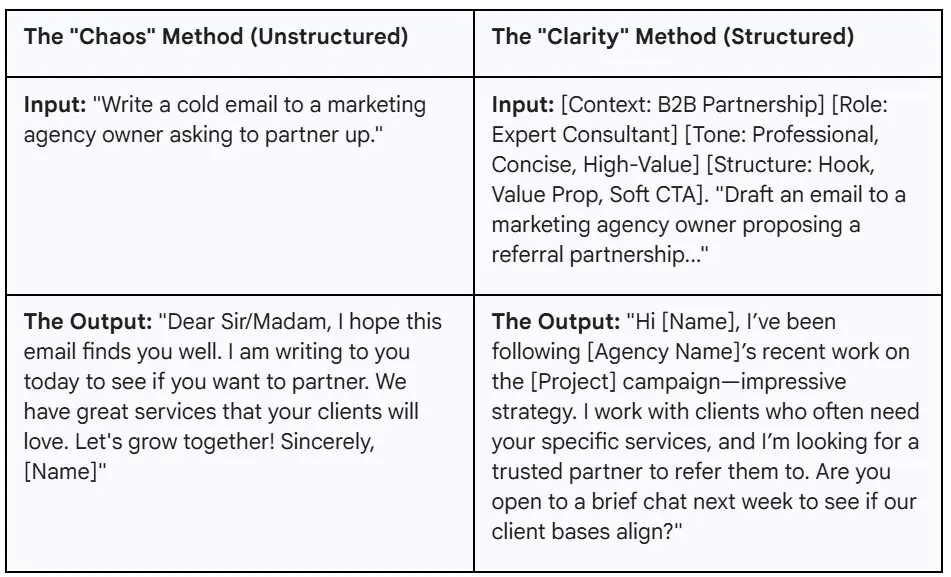
The Verdict: The unstructured prompt creates spam. The structured prompt creates a relationship.
Scenario B: Social Media Ideas
The Goal: Create content that actually engages your specific audience.
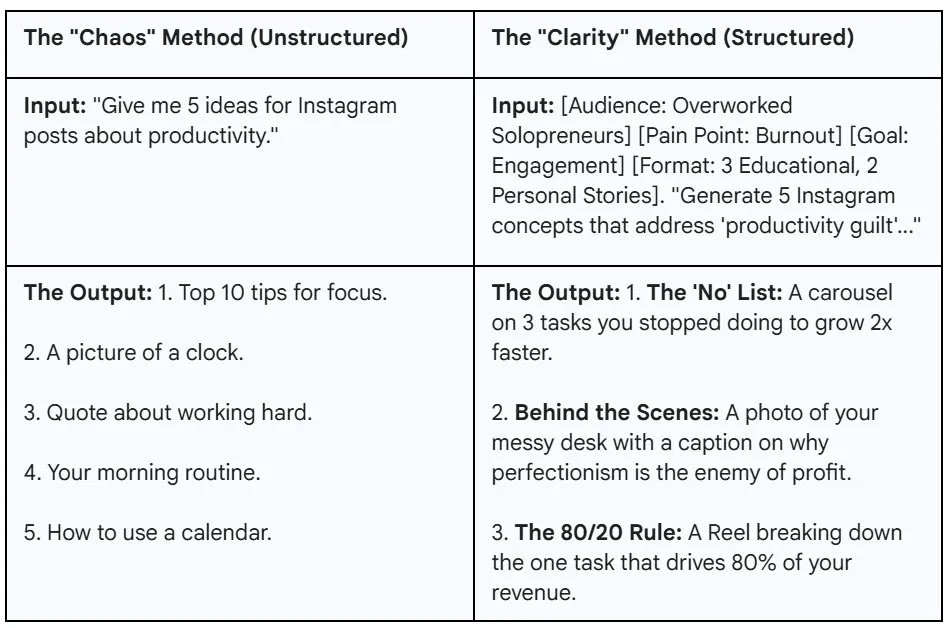
The Verdict: The unstructured prompt gives you clichés. The structured prompt gives you a content calendar that builds authority.
Why Structure Wins
When you use unstructured prompts, you are treating the AI like a mind reader. When you use structured prompts, you are treating it like a specialized employee.
Structured prompts provide the "creative brief" the AI needs. By defining the role, context, constraints, and goal, you force the AI to bypass the generic database answers and dig for specific, high-level solutions. This is the difference between an intern guessing what you want and a senior strategist delivering exactly what you need.
Stop Editing, Start Scaling
You don’t have time to rewrite bad AI content. To compete with larger players, you need tools that get it right the first time.
By shifting from unstructured guessing to structured engineering, you reclaim your time and protect your brand's credibility.
Ready to turn chaos into clarity?
Stop spinning your wheels with trial and error. Unlock 50 pre-built, expert-level prompts designed for your specific industry.