Don’t Buy Software Yet: Strategy First for Your Solopreneur Marketing AI System
Most solopreneurs build their AI marketing system backwards. They find a compelling tool, sign up for a free trial, and start using it before they’ve answered a single strategic question about what they actually need it to do. Three months later, they have a collection of subscriptions, a fragmented workflow, and the persistent feeling that AI is supposed to be helping more than it is.
This isn’t a tool problem. It’s a sequence problem.
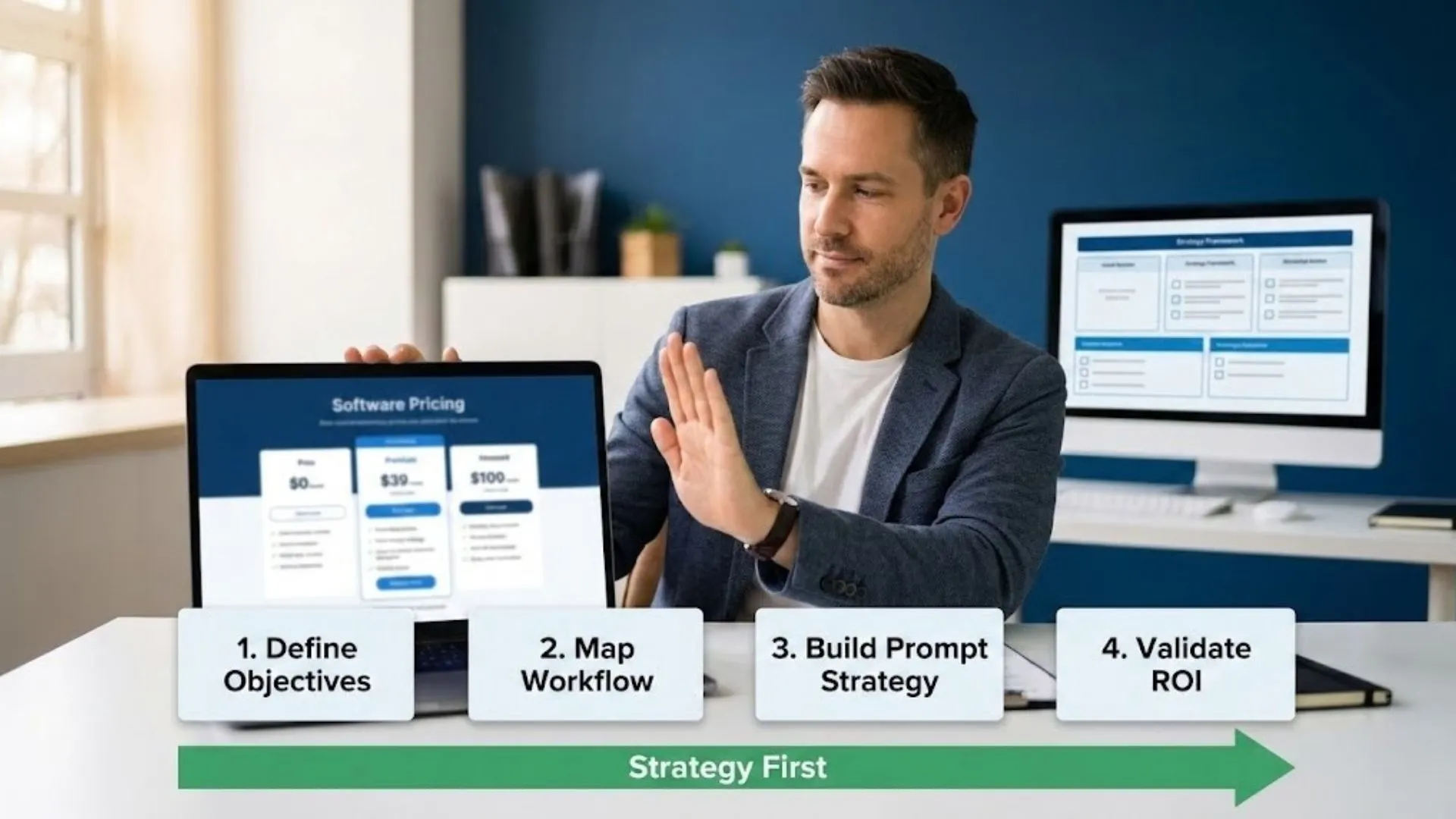
A solopreneur marketing AI system that works isn’t built by assembling the most impressive tools available. It’s built by making four strategic decisions before any software evaluation begins — and then choosing tools that serve those decisions, not the other way around. Here are the four warnings that every solopreneur needs to hear before opening another product page.
Warning #1: Buying Tools Without Defining Your Marketing Objectives First
Software vendors are exceptionally good at making their tools look like solutions to problems you haven’t articulated yet. The demos are polished. The use cases sound familiar. The pricing feels accessible. And none of that matters if you haven’t first answered three foundational questions:
• What specific marketing outcomes does my business need to produce in the next 90 days?
• Which stage of my marketing — awareness, nurture, conversion, or retention — is the highest-priority bottleneck right now?
• What does “success” look like in measurable terms for each outcome?
Without these answers, tool selection is guesswork. And guesswork-driven stacks produce a familiar pattern: the tool gets used for two weeks, the initial excitement fades, results are ambiguous, and the subscription quietly becomes overhead.
Objective clarity doesn’t just help you choose better tools — it eliminates most tools from consideration entirely. A solopreneur whose 90-day priority is content output volume needs different AI infrastructure than one whose priority is improving conversion rates. The software market won’t tell you this distinction. Your strategy has to.
Warning #2: Assembling a Stack Before Mapping Your Content Workflow
The second warning follows directly from the first: before you evaluate any tool, you need a documented map of how content actually moves through your business. Not how you wish it moved. How it actually moves today, including every bottleneck, handoff, and manual step.
A solopreneur marketing AI system needs to plug into a real workflow — not float above it. The four stages every complete content workflow needs to support are: ideation and strategy, creation and drafting, review and refinement, and distribution and repurposing. Each stage has different tool requirements, different prompt requirements, and different ROI potential from AI augmentation.
The operators who get the most from AI aren’t the ones using the most sophisticated tools. They’re the ones who mapped their workflow first, identified exactly where time and quality were being lost, and then chose AI tools to address those specific points. Everything else — the impressive feature lists, the integrations, the dashboards — is noise until you know where your actual leverage points are.
Workflow mapping takes 30 minutes. It prevents months of subscription waste and tool-switching cycles that solve nothing.
Warning #3: Choosing Software Before Establishing Prompt Strategy
This is the most underestimated warning — and the one with the highest ROI when addressed before tool selection.
Every AI tool in your solopreneur marketing AI system will perform at the ceiling of your prompt quality. A $50/month AI writing platform with strategic, industry-specific prompts will outperform a $200/month platform with generic inputs every single time. The tool is the engine. The prompt is the fuel. An advanced engine running on low-quality fuel does not outperform a simpler engine running on premium fuel.
Prompt strategy means establishing, before any tool evaluation, the framework your AI inputs will follow. This includes: the role context you’ll define for the AI, the audience parameters you’ll specify, the tone and brand voice constraints you’ll encode, the output format you’ll require, and the industry-specific context you’ll provide. Solopreneurs who build this framework first discover something important: their existing tools, run with strategic prompts, often deliver most of what they were planning to buy more software to achieve.
The implication for purchasing decisions is significant. When prompt strategy comes first, you need fewer tools — and you extract dramatically more value from the ones you keep.
Warning #4: Scaling Before Validating
The fourth warning is about timing. Even when objectives are clear, workflows are mapped, and prompt strategy is established, there’s a premature scaling trap that catches ambitious solopreneurs: investing in more AI infrastructure before the current system has demonstrated ROI.
Validation for a solopreneur marketing AI system has a clear minimum threshold: you should be able to identify, in measurable terms, what the current setup is delivering relative to what it costs — in both time and money. If you can’t answer “what is this reclaiming per week, and what is that worth?” then you don’t yet have enough data to justify scaling the investment.
Strategic AI prompt packs are the lean validation instrument that solves this problem. They’re low-cost, immediately deployable against real work, and produce measurable output quality improvements without requiring additional software infrastructure. They let you prove the system works at a foundational level before committing to the platform expansion that only makes sense once that proof exists.
Scale the strategy first. Then scale the stack.
Strategy Is the System. Software Is Just the Interface.
The solopreneurs who build marketing AI systems that compound in value over time aren’t the ones who bought the best tools earliest. They’re the ones who built the strategy first: clear objectives, mapped workflows, structured prompt architecture, and validated ROI before scaling.
That sequence isn’t the cautious approach. It’s the direct path to a solopreneur marketing AI system that actually reduces your workload instead of adding to it.
The complete AI marketing strategy guide gives you the full framework — objectives, workflows, prompt architecture, and validation checkpoints — before it ever points you toward a tool.
Build your solopreneur marketing AI system the right way — strategy first:
https://expertaiprompts.com/your-complete-ai-marketing-strategy-guide