How to Train Your Team to Use Expert AI Prompts for Consultants Effectively

If you are running a boutique consulting firm, your days are likely consumed by client delivery, business development, and endless operational tasks. You know you need to scale, but hiring another senior consultant is expensive, and adding more hours to your day is physically impossible. You have likely looked toward Artificial Intelligence as a lifeline. Yet, handing your team a generic AI tool without a system often leads to more frustration than freedom. Without a standardized process, your team wastes hours tweaking bad outputs, resulting in content that lacks the polish and credibility your brand demands.
To truly break through workflow bottlenecks and compete with larger players, you need more than just software. You need a system. This Standard Operating Procedure (SOP) guide is designed to help you train your team to use expert ai prompts for consultants effectively. By implementing this SOP, you will eliminate trial-and-error, ensure consistently high-quality outputs, and reclaim hours of your week.
Section 1: The Foundation – Preparing Your Team for AI Integration
Before your team types a single word into an AI interface, it is critical to align their mindset. Many professionals are either overly reliant on AI, expecting it to do 100% of the work, or highly skeptical, assuming it can only produce robotic, generic fluff. As a leader, your first job is to set the baseline: AI is not a replacement for your team's expertise; it is a leverage point to amplify it.
When we talk about expert ai prompts for consultants, we are not referring to simple commands like "write a blog post about marketing." We are talking about strategically engineered frameworks that incorporate industry context, desired formats, tone guidelines, and specific constraints. Your team must understand that the quality of the AI's output is directly proportional to the quality of the structure provided.
To ensure a smooth rollout, clearly define who owns what in this new workflow. Even in a small team of two to ten people, clarity is vital.
The Strategist (You): Identifies the core business objectives and approves the final deliverables.
The Operator: Uses the expert AI prompts, inputs the client-specific variables, and generates the draft.
The Editor: Reviews the output against your brand's quality standards, ensuring accuracy and credibility.
By establishing these roles and emphasizing the value of structured prompts, you transition your team from skeptical experimenters to efficient executors.
Section 2: The Core SOP – Step-by-Step Prompt Execution
Once your team understands the philosophy behind AI leverage, it is time to establish the operational workflow. This section outlines the exact steps your team must follow every time they use expert ai prompts for consultants. By standardizing this process, you eliminate the blank-page syndrome and guarantee that every output serves a strategic purpose.
Here is the standardized workflow for executing prompts:
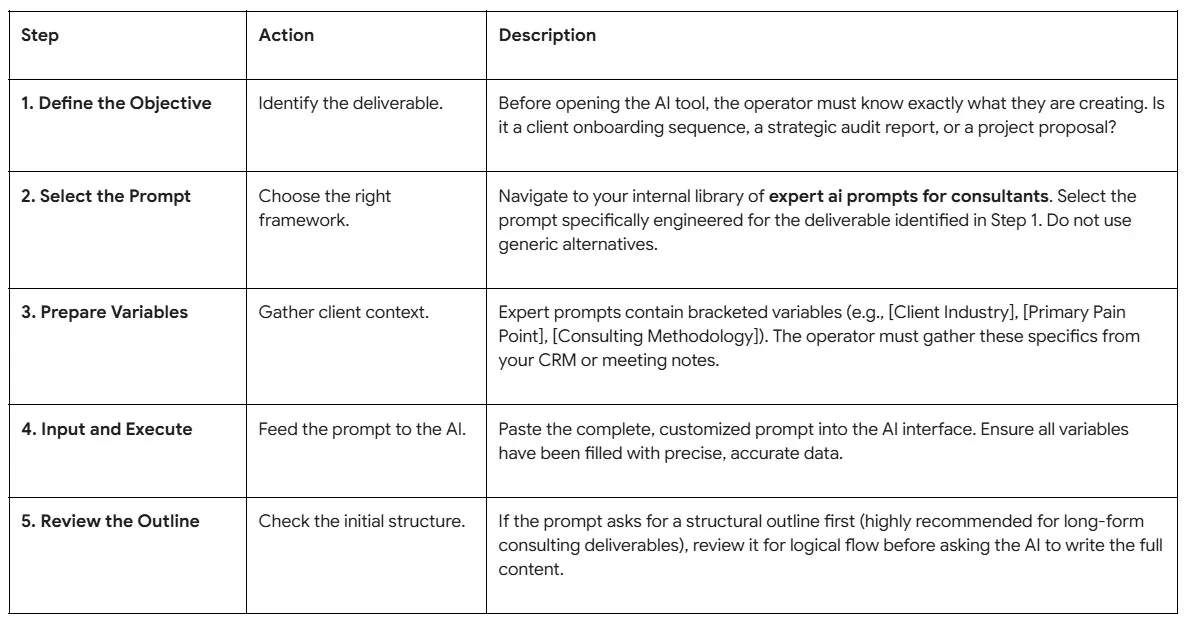
This process ensures that your team is not treating the AI as a search engine, but rather as a junior consultant following strict, strategic instructions. It prevents the common pitfall of aimless generating and brings immediate efficiency to your daily operations. When your team follows this exact sequence, you will start seeing polished drafts produced in minutes rather than hours, freeing you up to focus on high-level strategy and client relationships.
Section 3: Quality Control – Refining and Brand Alignment
Generating the content is only half the battle. For ambitious small business owners and consultants, credibility is the most valuable currency you possess. A single client report that sounds distinctly robotic or contains factual inaccuracies can severely damage your brand perception. Therefore, a rigorous Quality Assurance (QA) process is non-negotiable.
This phase is where the "Human-in-the-Loop" concept becomes vital. Your team must be trained to treat AI-generated text as a highly competent first draft, not a finalized deliverable ready for client presentation.
Implement the following QA checklist to ensure every piece of content meets your expert-level standards:
Fact-Checking and Hallucination Removal: AI models can confidently invent statistics or frameworks. The editor must verify every data point, metric, and industry claim against reliable, external sources.
Tone and Voice Alignment: Generic AI writing often defaults to a highly enthusiastic, verbose tone. Adjust the language to reflect your brand's confident, practical, and authoritative voice. Remove unnecessary adjectives and tighten the prose.
Strategic Nuance Insertion: AI lacks the lived experience of your consulting practice. The reviewer must inject your unique firm methodologies, specific past client anecdotes, or nuanced industry insights that an AI could never replicate.
Formatting for Scannability: Ensure the final output utilizes clear headings, logical spacing, and bolding to guide the reader's eye. Consulting clients value clarity and efficiency above all else.
By enforcing this strict refinement phase, you overcome the primary objection to AI integration: the fear of low quality. You prove to your clients—and to yourself—that you can scale your output without ever compromising the high-end credibility that defines your business.
Section 4: Scaling Operations – Building a Continuous Feedback Loop
The true power of integrating expert ai prompts for consultants into your business is not just immediate task completion; it is long-term operational scaling. To transition from a stressed operator to a confident strategist, your team needs a system for continuous improvement.
First, track your ROI. Require your team to log the time spent on deliverables using the new AI workflow versus the old manual process. Seeing tangible proof—such as a client proposal taking 30 minutes instead of three hours—validates the system and encourages higher adoption rates among skeptical team members.
Second, treat your prompt library as a living, breathing asset. As your team uses the prompts, they will discover specific phrasing or contextual additions that yield even better results. Create a centralized document where operators can log these successful variations. If an operator tweaks a prompt to produce a superior competitive analysis report, that refined prompt should become the new standard for the entire team.
This feedback loop ensures your business is constantly evolving. You are no longer just keeping your head above water; you are actively building an intellectual property asset that makes your consultancy faster, smarter, and more competitive every single day.
Conclusion
Scaling a small consulting firm does not have to mean working 80-hour weeks or taking on massive overhead. By moving away from generic tools and implementing a strict SOP for expert ai prompts for consultants, you empower your team to do the heavy lifting. You transform workflow bottlenecks into streamlined processes, allowing you to produce expert-level content reliably.
The transformation from overworked to outstanding begins with structure. When your team knows exactly how to generate, refine, and optimize AI outputs, you reclaim your personal time and secure the leverage needed to compete with industry leaders.
Stop spinning your wheels with trial and error. Upgrade your workflow and give your team the exact strategic frameworks they need to succeed.
Scale Smarter. Grow Faster. Begin Here: