Warning: 3 Ways Generative AI Can Destroy Your SEO Rankings (And How to Avoid Them)
Heading
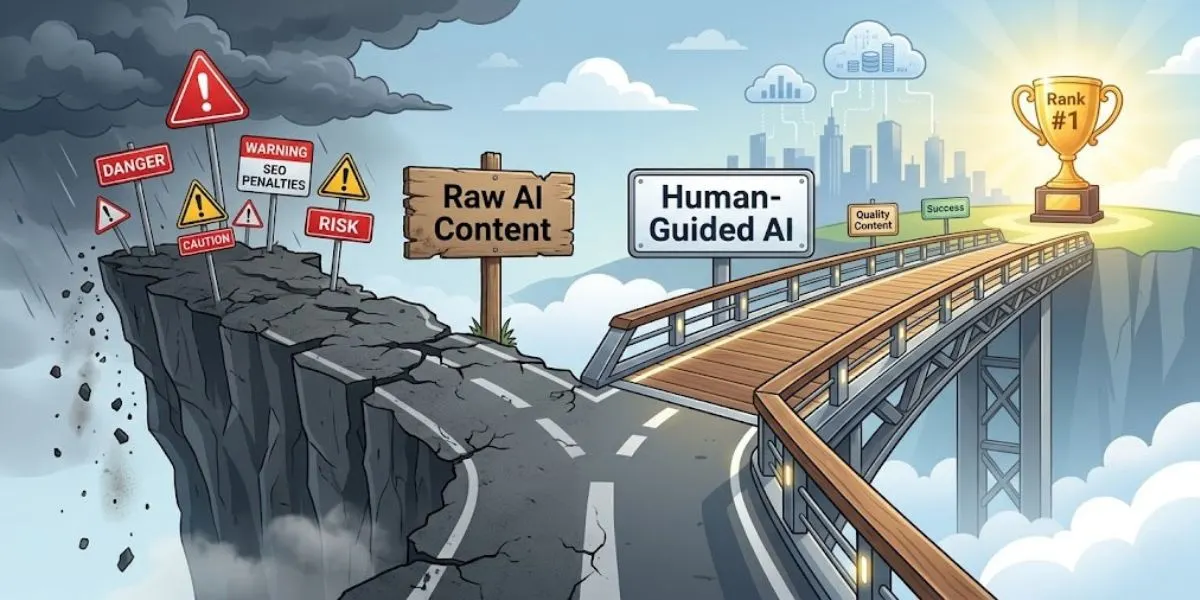
Introduction: The "Magic Button" That Can Backfire
You see the hype everywhere: "Use AI to create a year's worth of blog content in a day!" It sounds like a magic button for your SEO—a shortcut to the top of Google.
But here's the warning that most AI enthusiasts won't tell you: if you press that button the wrong way, it can do more harm than good, potentially destroying the search rankings you've worked so hard to build.
As part of our complete ROI-Driven Guide to AI for SEO, this article covers the three most critical risk factors when scaling AI-generated content.
Before you scale your ai content marketing, you need to understand the three biggest risks and how to avoid them. This is your guide to using the incredible power of AI safely and effectively.
A Quick Word from Google: "Helpful Content" is King
First, let's be crystal clear about one thing: Google does not hate AI. Google hates unhelpful, low-quality, spammy content, regardless of whether a human or a robot wrote it. Their entire system is designed to reward content that is helpful, credible, and human-centric. The following three mistakes are massive red flags that tell Google your content is the opposite of that.
Mistake #1: Publishing Raw, Unedited AI Output
The Danger: This is the most common and damaging mistake. You generate an article with AI and immediately hit "publish." The result is content that often lacks real-world experience, unique insights, or an authentic human voice. It fails Google's critical E-E-A-T (Experience, Expertise, Authoritativeness, Trustworthiness) standards. Even worse, your readers can spot it a mile away. It feels robotic, destroys the trust you've built, and leads to high bounce rates—a clear signal to Google that your page is not helpful.
The Safe Path: The "Human-First" Edit.
Always treat the AI's output as a 90% complete first draft, not a finished product. Your job is to be the editor-in-chief. Spend 15-20% of the total creation time on a "value-add" edit: weave in your personal stories, add your expert opinions, and polish the language to match your unique brand voice. Download the 1-Page Perfect Prompt Framework (free) — a structured guide that ensures your prompts require your input, expertise, and brand voice before the AI writes a word.
Mistake #2: Scaling "Thin," Repetitive Content
The Danger: It's incredibly tempting to use content scale ai to create hundreds of 300-word articles on slight variations of the same keyword (e.g., "best marketing tips for plumbers," "top marketing tips for plumbers," "great marketing tips for plumbers"). This is a classic spam tactic that Google's algorithms have been fighting for over a decade. It signals that your goal is to manipulate search rankings, not to create genuine value for users.
The Safe Path: Go Deep, Not Just Wide.
Instead of creating 10 shallow articles, use AI to help you create one comprehensive, 2,500-word pillar article that covers a topic in incredible depth. Use AI to research all the related sub-topics and questions a user might have and combine them into one authoritative resource. This signals to Google that you are an expert, not a spammer. Our guide to streamlining your entire SEO workflow with AI shows you exactly how to build this deep-content process step by step.
Mistake #3: Neglecting Factual Accuracy
The Danger: AI models can "hallucinate." This means they can invent facts, make up statistics, or create quotes that sound completely plausible but are entirely false. If you publish this incorrect information, you instantly destroy your credibility with your audience. For topics related to finance or health ("Your Money or Your Life"), this is a massive red flag for Google and can lead to severe ranking penalties.
The Safe Path: Verify, Then Trust.
Act as the final fact-checker. If the AI provides a statistic, ask it for the source, and then go verify it. If it makes a specific claim, do a quick search to confirm it's accurate. Treat the AI as your brilliant creative assistant, not as an infallible research expert. Your reputation is on the line. For a deeper look at this specific risk, read our advisory on AI hallucinations and credibility risk for consultants.
The Common Thread: Using AI as a Shortcut vs. a Supercharger
These three SEO-killing mistakes all stem from the same flawed approach: using generative ai in marketing as a lazy shortcut to bypass the hard work of creating valuable content.
The smart and safe approach is to use AI as a supercharger. It's a tool that helps you do the strategic work of research, outlining, and drafting at 10x the speed, freeing you up to focus on the human elements—expertise, storytelling, and fact-checking—that Google and your readers truly value.
"Expert AI Prompts": Your Built-in "Safety Net"
The best way to avoid these pitfalls is to use a process that encourages quality from the very start. The SEO Prompt Power AI Toolkit is built specifically for this purpose — every prompt is structured to produce expert-level, E-E-A-T-aligned SEO content from the start. Our prompts are designed to be your safety net. Unlike simple commands, each of our prompts is a strategic brief. They are structured to require your unique input—your audience, your expertise, your brand voice—before the AI writes a word. They are designed for creating deep, authoritative content, not thin, repetitive articles. This makes our toolkit the safest, most effective way to scale your content. See how structured AI prompts delivered measurable, risk-free content results in our AI Prompt ROI Analysis: Scaling Delivery case study. Start with our Expert AI Prompts Free Offers Hub — grab free strategic AI prompts and experience the quality difference before you commit to a full toolkit.
Conclusion: Use AI with Wisdom, Not Just Speed
AI is an undeniably powerful tool for SEO. But like any power tool, it must be used with skill, respect, and a focus on safety. By avoiding these common mistakes, you can harness its incredible speed without risking your hard-earned rankings.
Don't risk your business on a lazy shortcut. Get the strategic toolkit that helps you scale the right way with Expert AI Prompts.
Compare all 30 industry-specific prompt packs and see one-time pricing at the Expert AI Prompts Pricing Catalog.
Ready to learn the complete safe and effective system? Read our The ROI-Driven Guide to AI for SEO.
Further Reading
SEO in 2026: Why You Need Strategic Prompts to Rank on Google
Can AI Write SEO Content That Actually Ranks?
How "Answer Engines" Are Killing Traditional SEO
Fear of the Robot: Ensuring Your AI Content Still Sounds Human
Best AI SEO Tools for Small Business: 2025 Review
Human Strategy + AI Execution: The Winning SEO Formula