ENTERPRISE AI CASE STUDY · CASE 1 OF 5
Home > Enterprise AI Solutions > Enterprise AI Case Studies > Expert AI Prompts
From Solo Operator to Enterprise-Grade AI System: How Expert AI Prompts Built a Fully Automated, Multi-Industry AI Platform in Under 12 Months
Organisation: Expert AI Prompts · Sector: AI Strategy / Multi-Industry · Operator: Solo (1 FTE) · Timeline: June 2025 – Present · Published: April 2026 · Status: LIVE
Executive Summary

Proof beats theory. A live, revenue-generating AI system built by a single operator in 12 months is the most credible signal an AI Strategy Leader can bring to an executive interview or board briefing. — Matthew Bulat
The Challenge: Generic AI Produces Generic Results at Scale
The fundamental problem Expert AI Prompts was designed to solve is one every enterprise AI leader faces at scale: generic AI usage produces generic results. Across 30+ industries, business leaders were adopting AI tools without AI strategy — generating content that sounded robotic, workflows that created dependency instead of leverage, and outputs that failed to build brand authority or competitive advantage.
The strategic opportunity was in the gap between access and expertise. Every business had access to the same AI tools. Few had the domain-specific prompt architecture, the workflow design, and the deployment discipline to convert that access into genuine competitive advantage. Expert AI Prompts was built to codify that expertise and make it deployable across 30+ industry contexts by people with no prompt engineering background.
The Internal Constraint: Scale Without Headcount
The secondary challenge was architectural: could a single strategist design, build, and operate a multi-product AI platform at enterprise quality — without scaling headcount? This is the same question every Chief AI Officer faces: how do you achieve AI-driven productivity at scale without proportional cost?
The answer was not to hire more people. It was to design a system that compounded rather than accumulated. Each workflow system built had to reduce the operational overhead of the next one. Each prompt had to be structured for reuse across multiple use cases, not optimised for a single deployment. The architecture had to produce leverage — not labour.
The AI Strategy Approach: Four Decisions That Determined the Outcome
Before any tool was selected, the architecture was designed. The sequence was deliberate: strategy first, methodology second, tooling third. The four strategic decisions made before the first line of content was produced or the first workflow was built determined everything that followed.
Strategy 1: Architect for Leverage, Not Labour
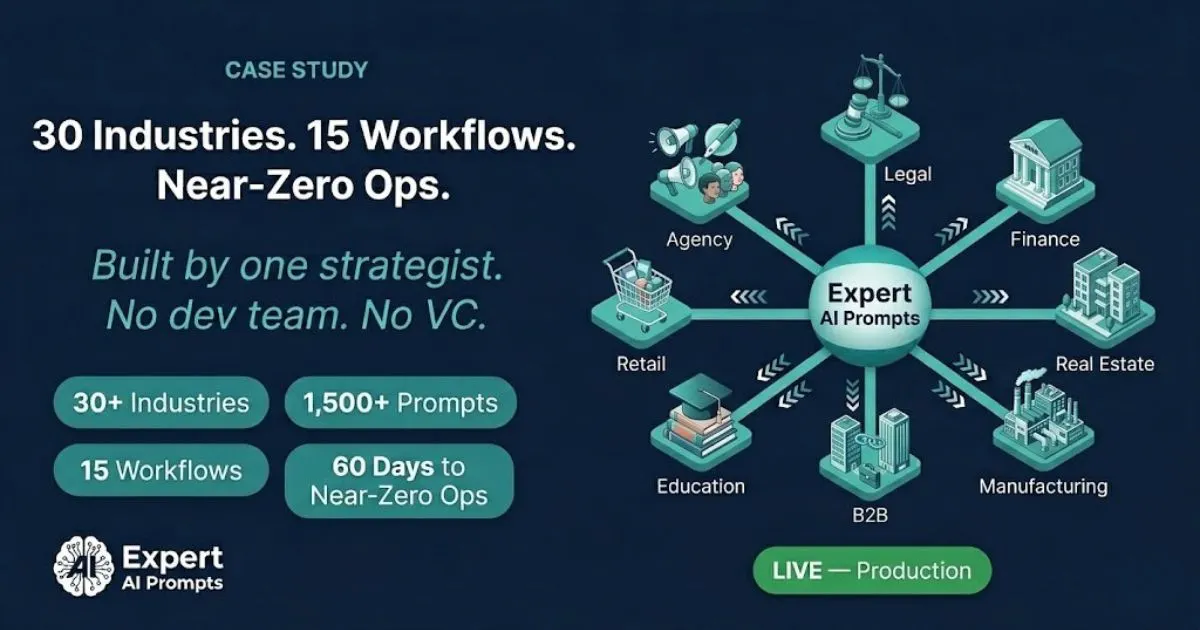
Rather than building one product, Matthew designed a modular prompt engineering architecture: 1,500+ domain-specific prompts organised into 30+ industry toolkits. Each toolkit follows a proprietary four-component structure: role assignment (the expertise context the model should apply), context injection (domain-specific background knowledge), output specification (format, structure, and quality criteria), and iteration protocol (how to refine the output for the specific use case).
This structure makes each prompt reusable, auditable, and deployable by non-technical users as a strategic asset — rather than requiring a prompt engineer to adapt it for each use. The prompt library is the foundation layer of the architecture. Everything built on top of it inherits its precision and domain specificity. Without the library, the workflows produce generic outputs. With it, they produce domain-expert-level content at scale.
The five-component enterprise prompt structure and the production lifecycle that governs every entry in the Expert AI Prompts library is covered in Enterprise Prompt Engineering at Scale.
Strategy 2: Automate the Entire Growth Stack
Fifteen integrated AI workflow systems were built and deployed, covering the entire operational stack: content creation, LinkedIn outreach, sales pipeline management, product delivery, and customer onboarding. The tools selected were Claude (Anthropic) for content generation and reasoning, ChatGPT for specific output formats, Canva AI for visual production, and LinkedHelper for outreach automation. These were orchestrated as a single automated engine rather than deployed as independent applications.
The result: daily operational intervention dropped to near-zero within 60 days of launch. Not because the workflows were simple — because they were designed as a compound system, where the output of one workflow fed the next. Content generated in the first workflow fed the LinkedIn sequence in the second; conversion data from the sales pipeline informed the content strategy of the first. The systems were not independent. They compounded.
The same compounding logic applies at enterprise scale: AI workflow systems that feed each other produce compounding returns. AI workflow systems deployed independently produce linear returns. The architecture decision is made before the first workflow is built.
Strategy 3: Productise Expertise at Enterprise Scale
Each digital product was built to answer the specific question enterprise buyers ask: how does AI create measurable value in my specific context? Products span healthcare, legal, real estate, finance, e-commerce, education, and manufacturing — each containing 50+ precision-engineered prompts calibrated for that sector's language, regulation, and business model.
The productization discipline is the same discipline that enterprise AI leaders should apply to every AI deployment: identify the specific domain knowledge that creates the value, encode it in a reusable, auditable structure, and design for deployment by the people who actually do the work — not just by the experts who designed the system.
The scaling architecture that converts individual prompts into a governed enterprise prompt library is covered in Industrialising Prompts: How SMB Tactics Scale into Enterprise AI Architecture.'
Strategy 4: Build a Content Architecture That Compounds
A structured content strategy was built from the first month, targeting high-volume, high-intent keywords: 'enterprise AI case study' (246,000 monthly searches), 'generative AI case study' (49,500), 'AI transformation' (1,300), and 'AI cost savings' (1,600). Every blog post, product page, and LinkedIn article was engineered to rank — turning content into a compounding organic acquisition asset rather than a one-off publication.
The content architecture also serves a second function: it is the live demonstration of the prompt library in action. Every piece of content produced through the Expert AI Prompts platform demonstrates the domain specificity, output quality, and operational scale that the platform is designed to enable. The content is simultaneously the marketing and the proof of concept.
Implementation Decisions: What Was Chosen and Why
The strategy established the direction. The implementation required specific choices that were not obvious at the outset and were revised as the system developed. Two decisions are worth documenting in detail because they produce the most common questions from enterprise leaders replicating the architecture.
Tool Selection: Why Four Tools Instead of One Platform
The decision to use four specialised tools (Claude, ChatGPT, Canva AI, LinkedHelper) rather than a single integrated AI platform was deliberate. No single platform in 2025 produced best-in-class outputs across all four operational requirements: long-form domain-specific reasoning (Claude), structured short-form output formats (ChatGPT), visual production (Canva AI), and LinkedIn outreach automation (LinkedHelper).
The trade-off was integration complexity versus output quality. Managing four tools required the orchestration layer to be designed as a model-agnostic system from the start — the workflow logic was kept separate from the model serving layer, so individual tools could be swapped as better options emerged. This is the model-agnostic architecture principle applied in practice: the intelligence layer (prompt library, workflow logic) was kept independent of the serving layer (specific tools).
Sequencing: Why the Prompt Library Was Built Before the Workflows
The prompt library was the first thing built and the last thing considered complete. Every workflow system was designed with the assumption that the prompt library was the input — not that prompts would be written to fit the workflows. This sequencing decision was the single most important implementation choice made.
Enterprise AI teams consistently reverse this sequence: they design workflows first and write prompts to fit the workflow logic. The result is prompts that are tightly coupled to a specific workflow's requirements, not reusable across multiple workflows, and not improvable without rebuilding the workflow that uses them. Starting with the prompt library means the workflows inherit the library's quality and flexibility, rather than constraining it.
Sequence: prompt library first, then workflows. The library is the foundation. Workflows built on an ad hoc prompt base will reflect the weakness of that base in every output they produce.
Measured Results
All results documented against the pre-launch baseline (June 2025). All figures are from live platform operation. No projected or modelled outcomes are included.
RESULT AREA
OUTCOME
BASELINE (PRE-LAUNCH)
Product Scale
30+ digital products across 30 industries live within 11 months
0 products. Product architecture in design.
Prompt Engineering
1,500+ domain-specific prompts across healthcare, legal, finance, real estate, and 26 other sectors
0 prompts. Prompt library architecture designed but not populated.
Workflow Automation
15 integrated AI workflow systems operating with near-zero daily intervention: content creation, LinkedIn outreach, sales pipeline, product delivery, customer onboarding
0 workflow systems. All operations requiring direct manual execution.
Daily Operational Load
Near-zero daily intervention achieved within 60 days of launch. Full pipeline from content generation to product delivery automated.
Estimated 4-6 hours daily manual operational work for equivalent output volume.
Audience Growth
2,100+ targeted LinkedIn connections via AI-driven Sales Navigator + LinkedHelper outreach system
0 connections from the Expert AI Prompts account.
Operational Cost
Enterprise-grade platform built without developer teams, VC capital, or headcount scaling. All systems designed, built, and operated by one person.
Equivalent capability from a traditional build: estimated 3-5 developer FTEs + content/marketing team.
Market Validation
Inbound approach from Net2Source (global workforce solutions) for AI Strategy Leader role at $300K+ USD base + performance bonus + equity. Unsolicited. Via the platform's own market presence.
No executive-level inbound interest for strategy roles.
The Enterprise Scaling Map: Expert AI Prompts to Enterprise Deployment
The Expert AI Prompts architecture is a direct proof of concept for the enterprise AI transformation methodology. The same three-layer architecture — governed prompt library, connected workflow systems, and compounding operational model — scales to enterprise with three structural adaptations: governance layers added, CoE infrastructure added, and regulated access controls added. The core logic is identical.
Expert AI Prompts (Validated at SMB Scale)
Enterprise Equivalent
Bridge Decision
1,500+ prompts × 30 industries
Enterprise prompt library: categorised by function, access-governed by role, version-controlled through CoE
Industrialise: prompts become governed assets with lifecycle, testing standard, and CoE ownership
15 integrated AI workflow systems
Enterprise workflow operating system: CoE sets standards, business units own implementations
Federate: CoE governs the architecture; functions own domain-specific content within it
Solo operator, near-zero daily ops
Enterprise programme, 80%+ adoption, 4x speed with quality benchmark (Phase 5)
Scale: same compounding model with BCG 10-20-70 change management added
4-component prompt structure
Enterprise 5-component structure adds Constraint Layer for governance compliance
Govern: add Constraint Layer to all prompts deployed at enterprise scale
Model-agnostic orchestration (4 tools)
Model-agnostic enterprise AI platform (model abstraction layer + MCP-compatible connectors)
Architect: abstraction layer protects intelligence layer from model vendor lock-in
Inbound $300K+ AI Strategy Leader role
Live market proof of methodology value at senior executive standard
Validate: the platform IS the credentials — enterprise deployment IS the case study
The enterprise deployment of this methodology simply adds the governance layers, CoE infrastructure, and regulated access controls that large-scale, multi-function, regulated organisations require. The core principle remains the same: build AI systems that encode your organisation's unique intelligence, and they become competitive assets that compound over time rather than costs that depreciate.
The five-phase enterprise deployment architecture — and how the Expert AI Prompts methodology maps to each phase — is in the Enterprise AI Transformation Playbook.
Strategic Implications for Enterprise AI Leaders
This case study is not primarily a business success story. It is a working proof-of-concept for three principles that enterprise AI leaders consistently debate — and that this platform has now demonstrated in live production.
Principle 1: Prompt Engineering Is Enterprise Infrastructure
In the Expert AI Prompts platform, the prompt library is infrastructure in the same sense that a software architecture is infrastructure: it is the system that everything else runs on. A well-architected prompt library is repeatable (every use of the same prompt produces outputs that meet the same quality standard), auditable (every prompt has a version history, a use case classification, and a performance record), and scalable (adding a new workflow that uses an existing prompt costs nothing in quality overhead).
The enterprise implication: the governed prompt library is not a productivity tool. It is the primary Firm Sovereignty asset that makes every subsequent AI deployment more capable than it would be without the library. Every prompt added to a governed library increases the value of every workflow that uses any prompt in the library. That is the compound mechanism that produces the 4x speed with quality benchmark.
Implication: Start building the governed prompt library before any other AI asset. It is the only AI investment that compounds in both directions: it improves the performance of new workflows, and it makes the team that maintains it better at AI strategy with every iteration.
How to build the governed prompt library that produces this compound mechanism is covered in Enterprise Prompt Engineering at Scale.
Principle 2: AI Strategy Must Precede AI Tooling
The Expert AI Prompts platform was designed as a system before any tool was selected. The architecture — what layers the system needed, how they would connect, what outputs each layer would produce, and how quality would be maintained across 30+ industry contexts — was defined first. Tools were selected because they were the best available option for a specific, already-defined function. They were not selected and then a use case found for them.
Every enterprise AI programme that has produced sustained, measurable results has followed the same sequence: strategy (what are we trying to achieve?), methodology (how will we get there?), tooling (which specific tools serve the methodology?). Every enterprise AI programme that has stalled in pilot purgatory has reversed this sequence: tools selected first, use cases found second, strategy deferred to a future phase that never arrives.
Implication: The tool selection decision is downstream of the strategy and methodology decisions. If the strategy has not been defined, selecting tools is not progress — it is the accumulation of inventory that will need to be redesigned once the strategy is clear.
The failure mode this principle prevents is documented in Escaping Pilot Purgatory: Why 78% of Enterprise AI Pilots Never Reach Production.
Principle 3: Automation Compounds
In the Expert AI Prompts system, each workflow built reduced the operational overhead of the next. The content workflow produced the assets that the LinkedIn workflow needed. The LinkedIn workflow produced the qualified audience that the sales pipeline needed. The sales pipeline produced the customer data that informed the content strategy. Each system fed the next, and the cumulative effect was a platform that approached autonomous operation rather than requiring proportional manual intervention as it grew.
Enterprise AI programmes that deploy workflow systems independently — without designing the connections between them — produce linear returns: each system does its job, and the total value is the sum of its parts. Enterprise AI programmes that design the connections between workflow systems produce compounding returns: each system amplifies the value of every system it connects to. The compound architecture is a design decision made before the first workflow is built.
Implication: Design the connections between AI workflow systems before designing the individual systems. The connection architecture determines whether the programme produces linear or compounding returns. This is the decision that separates Phase 3 programmes (multiple isolated deployments) from Phase 5 programmes (an AI operating system).
The CoE structure that governs connected workflow systems at enterprise scale is covered in the AI Centre of Excellence guide.
The organisations that treat AI as a strategic architecture decision produce outcomes that compound. The organisations that treat it as a technology procurement decision produce outcomes that depreciate.
What Would Be Done Differently
This is the most transferable section of any case study — the retrospective. Apply these three learnings.
• Start Firm Sovereignty asset documentation earlier. The governed prompt library was built systematically from Month 1, but the documentation of which prompts constituted Firm Sovereignty assets — the ones encoding domain knowledge that competitors could not replicate from generic AI — was not formalised until Month 6. Earlier classification would have accelerated the compounding effect and made the asset inventory clearer for external validation. At enterprise scale, Firm Sovereignty classification should happen at prompt entry, not retrospectively.
• Introduce performance measurement at the prompt level from Day 1. Individual prompt performance was tracked informally through output quality review, but a structured prompt performance measurement framework — accuracy rate, revision cycle rate, adoption rate by use case — was not formalised until Month 4. The data that would have been generated in the first three months was not captured. At enterprise scale, the prompt library is a living asset that degrades without measurement. Start measuring from the first day of production deployment.
• Design the Enterprise Scaling Map as an artefact, not as a section of a case study. The explicit mapping from the SMB-scale Expert AI Prompts architecture to the enterprise-scale deployment architecture — what stays the same, what gets added, what gets governed differently — was implicit for most of the first year of operation. Making it explicit earlier would have accelerated both the enterprise positioning and the methodology documentation. The scaling map is now a formal output of the Expert AI Prompts framework.
The one decision that would be made exactly the same: building the prompt library before the workflows, and designing strategy before selecting tools. These two sequencing decisions determined the quality of everything that followed.
What to build after the prompt library is formalised as Firm Sovereignty assets is covered in Firm Sovereignty: Building an AI Moat.
Apply the Framework to Your AI Programme
The Expert AI Prompts methodology is available as a complete enterprise deployment framework across three pillar pages, eight gap asset documents, and the AI Maturity Assessment. The AI Strategy Session applies it directly to your specific initiative.
Matthew Bulat — CAIO / AI Strategy Leader / Founder, Expert AI Prompts
20+ year technology and AI strategy executive. Former CTO, Federal Government Technical Operations Manager (20 cities, 4,000 users), and 8+ year University Lecturer at CQUniversity.
MACS CP · M.Eng.Tech · Founder, Expert AI Prompts · AI Strategy Leader