How to Build Your "AI Stack": Combining the Best AI Tools for a Streamlined Workflow
Introduction: From a Pile of Tools to a Powerful System
You’ve invested in some of the best AI software for business. You have a great AI writer, an amazing AI image generator, and maybe even a personal AI assistant to manage your schedule. But if they don't work together, you don't have a system—you have a pile of expensive digital bricks. The real magic of AI happens when you create a streamlined workflow where these tools seamlessly connect.
If you are still building your shortlist of tools, start with the best AI tools for small business in 2025 — a curated guide to every category your stack will need. This is your "AI Stack"—your personalized blueprint for putting your business's repetitive tasks on autopilot. Building one might sound technical, but it’s not. It's a strategic exercise that any business owner can do. This guide will give you a simple 3-layer framework for effective AI implementation, turning your collection of apps into a powerful engine for growth.
The 3 Layers of a High-Performance AI Stack
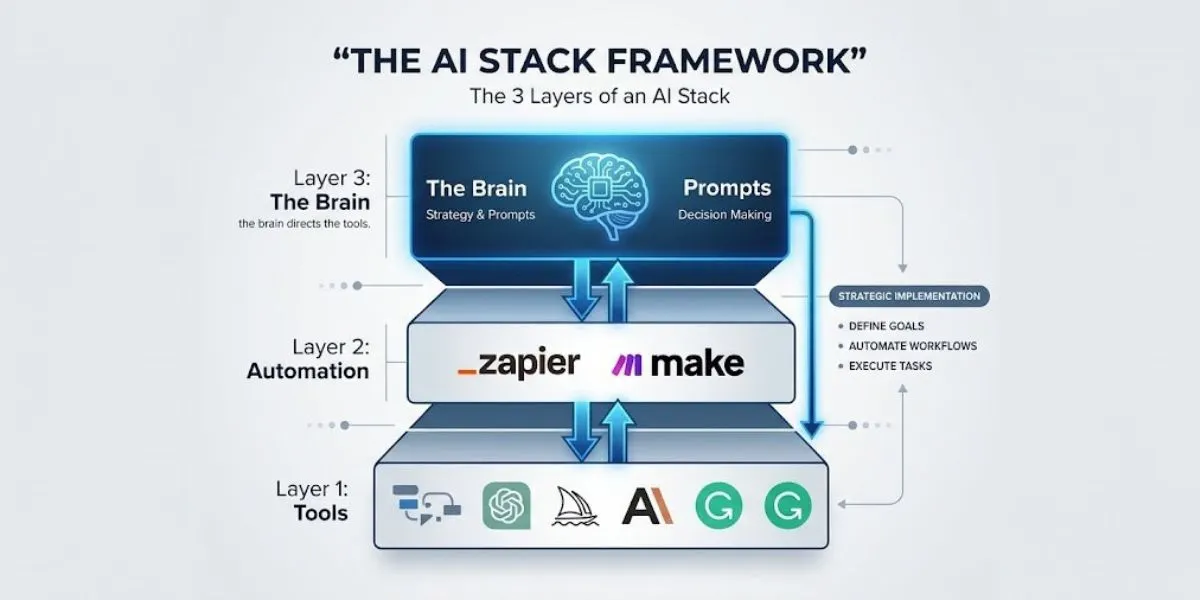
Forget complex flowcharts. Think of your AI Stack in three simple layers, one built on top of the other.
Layer 1: The "Doer" Layer (Your Specialist Tools)
This is the foundation. The "Doers" are the individual business AI tools that execute specific tasks brilliantly. This is where you put your best-in-class apps for writing, design, research, and administration. Your "Doer" layer is the raw power of your stack.
Examples include:
- An AI writer like Jasper to draft your blog posts.
-An AI image generator like Midjourney to create stunning visuals.
- An AI assistant like Motion to organize your tasks.
This layer is made up of The best AI writing tools and other Specialized AI websites for design and video.
Layer 2: The "Connector" Layer (Your Automation Engine)
This middle layer acts as the plumbing. The "Connectors" are automation platforms like Zapier or Make that allow your "Doer" tools to talk to each other. They work on simple "if this, then that" logic and eliminate manual steps from your processes.
Example: When you upload a new video to YouTube (Doer 1), a Connector can automatically trigger a task in your project manager (Doer 2) for your assistant to create social media clips.
For ready-made integration templates and workflow blueprints, explore the Implementation Workflows and How-To Guides hub.
Layer 3: The "Brain" Layer (Your Strategy & Prompts)
This is the most important layer, and the one most people miss. Your stack can be full of powerful tools and clever automations, but without a guiding strategy, it's just busywork. The "Brain" layer tells every tool what to do and why. It ensures that every output is on-brand, high-quality, and aligned with your business goals.
This is the role of Expert AI Prompts. Our pre-built, strategic prompts are the "Brain" of your stack. They are the expert-level instructions you feed into your "Doer" tools to guarantee you get expert-level results, every single time. Download the free Perfect Prompt Framework Guide — a one-page cheat sheet that shows you exactly how to structure any prompt for maximum output quality. To go deeper on the strategy behind high-performance prompting, read the Entrepreneur's Playbook for Prompt Engineering — the complete guide to using AI prompts as a business growth system.
Mini-Guide: Building Your First AI Workflow Stack (Example)
Let's make this real. Here's how to build a stack to solve a common problem: creating a high-quality blog post in under an hour.
The Goal: Publish a strategic, SEO-optimized blog post.
Step 1 (The Brain): Select Your Strategic Prompt
Don't start with a blank page. Start with strategy. Select an Expert AI Prompt for a "Competitor-Analysis SEO Blog Post." This prompt will guide the AI to not only write well but to do so in a way that is designed to outrank a specific competitor for a target keyword.
Step 2 (The Doers): Execute with Your Specialist Tools
Feed the detailed outline from your strategic prompt into your favourite AI writer (Layer 1). Now, instead of a generic article, you get a strategically crafted piece. Then, use another prompt to instruct your AI image generator (Layer 1) to create a custom hero image that visually represents the article's core concept.
Step 3 (The Connectors): Automate Promotion
Set up a simple automation in Zapier (Layer 2): "When a new blog post is published, automatically create a draft social media post in Buffer with the blog's title and a link."
Not sure where to start? Use the AI readiness checklist for small business to identify which workflows are ready to automate before you build your stack.
Your Simple AI Implementation Checklist
[ ] Start with ONE key workflow you want to improve (e.g., Content Creation).
[ ] Choose ONE core "Doer" tool for that workflow.
[ ] Use ONE strategic Expert AI Prompt to ensure you get the highest quality output.
[ ] THEN, and only then, look for a "Connector" to automate the next step.
This thoughtful approach is the key to successfully leveraging the The best AI tools for business without getting overwhelmed.
Conclusion: Your Business, Now Operating on Autopilot
An AI Stack is more than just software; it's a new way of operating. By layering your specialist tools, automations, and a central strategy "brain," you create a system that works for you, freeing you up to be the visionary your business needs. Stop just using tools. Start building your stack. Begin today with one of our free AI resources — explore the Free Offers Hub for prompts, templates, and guides you can plug into your stack right now.
Ready to power the Brain layer of your stack with industry-specific expert prompts? Browse all prompt packs and pricing and find the pack built for your business.