Expert AI Prompts · AI Case Study · Civil Construction · Compliance
AI Compliance Documentation in Practice
— The Redstone Civil Case Study
62 Documents · 7 Hours · 12 Gaps Closed · 4.875/5 Quality · 3 Applications
AI compliance documentation is where the Australian productivity crisis meets its practical solution. The Australian Productivity Commission confirmed in March 2026 that national labour productivity fell 0.6% while hours worked rose 2.2%. The $110 billion annual red tape burden is a primary cause — and for trade and service businesses, that burden is most acute at the compliance documentation layer.
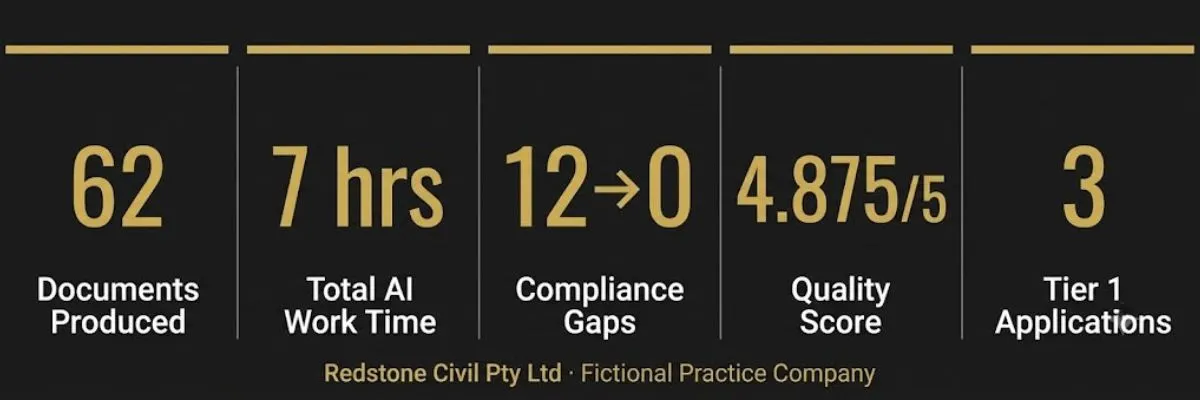
This case study demonstrates what happens when AI is precisely engineered for a specific industry sector rather than deployed generically. Applied to Redstone Civil Pty Ltd — a fictional North Queensland civil earthmoving contractor built to demonstrate the methodology — the Expert AI Prompts sector-specific system produced 62 compliance documents, closed twelve regulatory gaps, and assembled three Tier 1 applications in approximately seven hours of AI-assisted work.
[FICTIONAL NOTICE] ★ Redstone Civil Pty Ltd is a fictional practice company created to demonstrate the CDD 7 Tools and Expert AI Prompts methodology. All outcomes are illustrative.
Australia Is Working Harder and Producing Less
The Productivity Commission's March 2026 data is a diagnostic, not a surprise. Hours worked rose 2.2% year-on-year. Labour productivity fell 0.6% in the same quarter. National output now sits below the March 2023 baseline — the economy has been unable to break free from the productivity levels settled into after the post-pandemic correction. The government has commissioned five separate inquiries.
For businesses, this is not an abstract statistic. It is the experience of every operator who spends Tuesday night writing a WHS policy that should have been finished six months ago.
The $110 Billion Documentation Bottleneck
The Business Council of Australia estimates the national red tape burden at $110 billion per annum. The Queensland construction sector specifically lost 9% of its productivity over the past eight years — with compliance documentation, duplicative reporting requirements, and tender application burden identified as primary contributors.
For small and medium trade businesses, this burden is disproportionate. The same compliance documentation threshold that a Tier 1 contractor meets with a dedicated compliance team must be met by a seven-person earthmoving operation whose director is also its estimator, site supervisor, and payroll administrator.
Tier 1 Procurement Does Not Visit Sites
Procurement managers at Tier 1 contractors and government agencies make subcontractor assessments from portal screens, not site visits. The evaluation criteria are documents: WHS management systems, psychosocial risk registers, insurance certificates, capability statements, project references in STAR format, prequalification portal submissions. If those documents are not current, structured, and compliant with the portal's specific requirements, the contractor does not progress — regardless of their operational capability.
The Business That Could Not Prove What It Could Do
FICTIONAL NOTICE CALLOUT: ★ Redstone Civil Pty Ltd is a fictional NQ civil earthmoving contractor.
ABN 52 143 867 291. All details are illustrative and for training purposes only.
The Paper Ceiling — A Profile of Redstone Civil
Redstone Civil Pty Ltd represents the most common profile of a capable, established trade business that is commercially invisible to the procurement processes that would grow it. Seven staff. Eight plant items valued at $2.14 million. Revenue of $2.4 million. Thirteen years of NQ civil earthmoving delivered without a borrowed cent. Projects completed early. Repeat work from Townsville City Council.
None of that appears in a prequalification portal. The portal sees documents — and Redstone Civil had none.
Twelve Compliance Gaps That Blocked Tier 1 Access
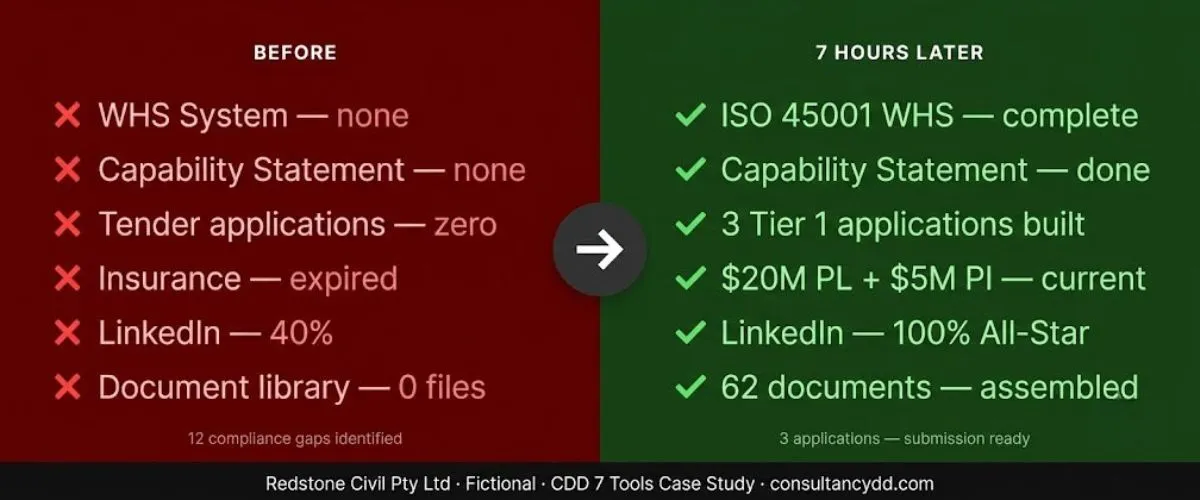
The starting compliance audit identified twelve gaps:
No formal WHS Management System. Public Liability insurance expired. No Professional Indemnity held. Two of eight plant items uninsured. No Capability Statement. No Capacity Statement. LinkedIn profile at 40% with no photo. No company page. No prequalification panel registrations. No Google Business Profile. No Brand Identity documentation. Zero documents in any formal library.
Every one of these gaps was a direct blocker for Tier 1 prequalification, government tender submission, or grant application. The paper ceiling was not one document short. It was a library short.
Why Generic AI Fails at Compliance Work
Generic AI compliance documentation fails for a single architectural reason: the AI has no verified business context to draw from. When an operator types "write me a WHS policy," the AI produces a document that is grammatically correct, structurally plausible, and completely unsuitable for submission to a CQMS Raize prequalification portal. It contains no company-specific details, no regulatory clause references, no project history, and no voice.
The output is generic because the input was generic. This is not a model capability problem. It is a context architecture problem.
Context Stacking — Four Layers of Precision
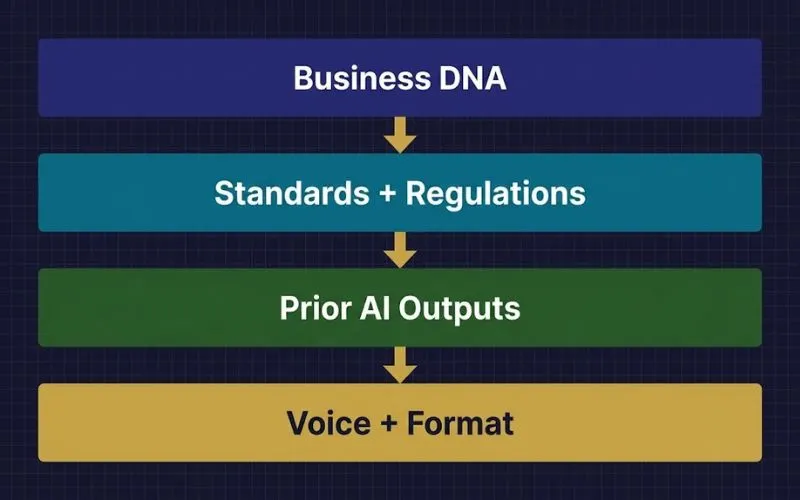
Context stacking is the Expert AI Prompts methodology that solves this at the architecture level. Rather than asking the AI to produce a document from a blank prompt, context stacking assembles four structured information layers before any generation begins:
Layer 1 — Business DNA Block: The verified company profile — team, plant, projects, compliance status, goals. Built once, reused in every session. No re-briefing required.
Layer 2 — Standards and Regulatory Framework: The specific compliance standards the output must satisfy. For civil construction: ISO 45001:2018, ISO 45003:2021, QLD WHS Amendment Regulations 2023, CQMS Raize portal requirements.
Layer 3 — Prior AI Outputs: Every document already produced feeds the next session as structured context. The WHS policy overview becomes context for the WHS policy statement. The capability statement becomes context for the tender response.
Layer 4 — Voice and Format Constraints: Word counts, section headings, tone directives, and portal-specific format requirements that prevent generic structure.
Sector Adaptation — Civil Construction as the Test Case
The four layers of context stacking remain constant across all industry sectors. What changes is the content of Layer 2 — the standards and regulatory framework specific to the sector and jurisdiction. Civil construction in Queensland has a well-defined compliance vocabulary: ISO standards, CQMS Raize portal criteria, WHS regulation clause references, TMR and TCC tender format requirements. Loading this vocabulary into Layer 2 before any document is produced means the AI generates output calibrated to that specific environment — not a generic workplace safety template.
Building the Civil Construction Compliance Layer
ISO 45001:2018 — WHS Management System Documentation
Queensland's 2023 WHS Amendment Regulations introduced explicit psychosocial hazard management obligations. ISO 45003:2021 is the international standard governing this area. Most NQ contractors — and most compliance consultants — were not aware that their existing WHS documents were materially deficient under this amendment.
The context stacking methodology identified this gap before any WHS document was produced, because the WHS Deep Research workflow was run first. The Psychosocial Risk Register produced for Redstone Civil was specifically aligned to ISO 45003:2021 and the QLD 2023 amendment — a level of regulatory precision that generic AI would not have achieved from an unstructured prompt.
Deep Research — Intelligence Before Application Drafting
One of the most commercially significant aspects of the methodology is the Deep Research workflow — three structured AI research sessions run before any application drafting begins. Each session produces a research reader: a synthesised intelligence document that informs positioning strategy, identifies compliance requirements, and maps the relevant competitive landscape.
For Redstone Civil, three Deep Research readers were produced: Tender Deep Research (Haughton Pipeline Stage 2 supplier panel — procurement structure, evaluation criteria, recommended positioning), Grant Deep Research (CSQ workforce training, BBRF, Works for Queensland — eligibility, quantum, application strategy), and WHS Deep Research (full NQ civil earthmoving regulatory framework including ISO 45001, ISO 45003:2021, and the QLD 2023 amendments — with a prioritised 30-day sprint plan). Applications were drafted with full knowledge of the evaluation environment — not in isolation from it.
The Results — What Seven Hours Produced
62 Documents Built From Zero
The CDD 7 Tools system, powered by the Expert AI Prompts context stacking methodology, produced:
→ WHS Policy Overview (ISO 45001:2018, 8 policy areas)
→ Psychosocial Risk Register (ISO 45003:2021, QLD Amendment Reg 2022)
→ Compliance Standards Map — full NQ civil regulatory framework
→ 3 project case studies (STAR format, verified dollar values)
→ Capabilities Statement and Capacity Statement
→ Brand Identity, Business Model Canvas, Customer Journey Map
→ LinkedIn All-Star profile package (Mark Redstone: 40% → 100%)
→ Google Business Profile copy
→ 7 staff CVs (Director through to Labourer)
→ Insurance Register, Plant and Equipment Register
→ Accountant Letter (financial capacity for $3.5M tender)
→ Application Readiness Checklist (7 sections, 31 documents)
→ 3 Deep Research Readers (Tender · Grant · WHS)
→ Daily Rates Schedule, D2 First Contact Message, Discovery Call Guide
Total: 62 documents. Average quality score: 4.875 out of 5. Total AI-assisted work time: approximately 7 hours.
Three Tier 1 Applications Assembled Simultaneously
The full document library was assembled into three complete, submission-ready packages: CSQ Workforce Training Grant — $23,440 application across 6 staff, four-phase workflow (eligibility, narrative, financial QA, final polish), lodgement-ready.
TCC Infrastructure Tender TCW00639 — Lansdown Eco Industrial Precinct intersection upgrade, V2 with confirmed single-figure rates, full four-phase tender response.
McConnell Dowell Prequalification — 7 sections answered, 25 attachment documents indexed, zero hard blockers at assembly.
Data Privacy by Design — Local AI for Financial Data
All prompts containing sensitive financial data — revenue figures, hourly rate structures, financial capacity calculations — were routed through Qwen, an AI model deployed locally via LM Studio. Sensitive business data never touched a public cloud server or a third-party AI service. This is a built-in design principle of the methodology, not an optional feature.
Beyond Civil Construction — Any Sector, Same Methodology
The Redstone Civil case study uses NQ civil construction as the proof-of-concept environment because it is one of the most compliance-intensive sectors in Australia — ISO standards, CQMS Raize, WHS regulation, TMR procurement protocols, union-backed industrial regulations. If the methodology works here, it works anywhere.
The Four Layers Stay Constant — The Sector Layer Changes
In every industry application, the Business DNA layer, the prior-outputs chaining layer, and the voice-and-format layer remain structurally identical. What changes is Layer 2 — the standards and regulatory framework specific to the sector and jurisdiction. A healthcare operator loads AHPRA requirements, infection control standards, and Medicare billing compliance criteria. A legal practice loads trust accounting obligations, professional indemnity requirements, and Law Society reporting standards. A real estate agency loads agent licensing criteria, disclosure obligations, and REIQ training requirements.
30 Industry Toolkits Already Built
Expert AI Prompts currently operates 30 industry-specific prompt toolkits spanning coaching, real estate, events, B2B, agency, freelance, social media, SEO, course creation, and more. Each toolkit is engineered with the same four-layer context stacking architecture — sector vocabulary, compliance terminology, and procurement language pre-loaded into Layer 2. The civil construction methodology demonstrated through Redstone Civil is one application of a system that scales across any industry where compliance documentation creates a commercial barrier.
About the Methodology and Matthew Bulat
The context stacking methodology and the CDD 7 Tools system were designed by Matthew Bulat — Chief Technology Officer of Consultancy Done Differently and founder of Expert AI Prompts. Matthew's background spans twenty years of hands-on government technology infrastructure management, including Technical Operations Manager at NEC Australia (Federal Government Department of Human Services, 18 sites, 4,000 users, 99.5% uptime SLA) and Project Manager at Townsville City Council. Eight years as a Lecturer and Tutor at CQUniversity, teaching fifteen IT subjects from Enterprise Software Development to Workflow Analysis, underpins the pedagogical rigour of the methodology framework.
The AI systems he builds are not generic productivity tools. They are compliance-aware, sector-specific, data-private architectures built by someone who has managed government compliance from the inside.
Apply This to Your Business or Industry
Book a 30-minute AI Strategy Session to map how sector-specific context stacking applies to your compliance environment.
The full Redstone Civil case study — 62 documents, every prompt stage, all deliverables — is published and free to access.
Frequently Asked Questions
What is sector-specific AI compliance documentation?
Sector-specific AI compliance documentation uses prompt architectures pre-loaded with the regulatory standards, procurement terminology, and compliance vocabulary of a specific industry. Unlike generic AI, which produces templated output, sector-specific prompts generate documents that meet the precise requirements of industry portals, audit criteria, and government evaluation frameworks.
How does context stacking improve AI compliance output quality?
Context stacking assembles four layers of information before any AI generation begins: a Business DNA block, a regulatory standards framework, prior AI outputs, and voice and format constraints. This eliminates the guesswork that produces generic output. The Redstone Civil case study achieved an average quality score of 4.875 out of 5 across 62 documents using this architecture.
What compliance documents did the Redstone Civil AI system produce?
The system produced 62 documents including a WHS Policy Overview (ISO 45001:2018), Psychosocial Risk Register (ISO 45003:2021), Compliance Standards Map, three STAR-format project case studies, Capabilities Statement, seven staff CVs, Insurance Register, Plant Register, Accountant Letter, and three complete Tier 1 applications — CSQ grant, TCC tender, and McConnell Dowell prequalification.
How long does it take to produce a full compliance document library using AI?
The Redstone Civil demonstration produced 62 documents in approximately seven hours of AI-assisted work across all seven tools. The Business DNA block takes 30–60 minutes to build initially. Each subsequent session typically takes 20–45 minutes. The total time compresses what would traditionally require six to eight weeks of manual preparation.
Is it safe to use AI for compliance documentation that contains financial data?
The Expert AI Prompts methodology routes all prompts containing sensitive financial data — revenue figures, rate structures, financial capacity details — through Qwen, an AI model deployed locally via LM Studio. Sensitive data never leaves the local device or touches a public cloud server, providing a compliance-safe pathway for regulated industries.
Can this AI methodology be applied to industries other than civil construction?
Yes. The four-layer context stacking methodology is industry-agnostic. The Business DNA, chaining, and format layers remain structurally identical across all sectors. Only Layer 2 — the standards and regulatory framework — changes to reflect the specific compliance vocabulary of each industry. Expert AI Prompts currently operates 30 industry-specific toolkits.
Is Redstone Civil a real company?
No. Redstone Civil Pty Ltd (ABN 52 143 867 291) is a fictional practice company created specifically to demonstrate the CDD 7 Tools and Expert AI Prompts methodology. All figures, documents, compliance outcomes, and application results are illustrative. The full document library is published at consultancydd.com/results/redstone-civil/ as a training reference.