Home > Enterprise AI Solutions > AI Governance Framework > Governance Template
AI Governance Framework Template — Board-Ready, Compliance-Mapped, Editable DOCX
The 10-section template that implements the Enterprise AI Governance Framework in your organisation — covering EU AI Act, Australian Privacy Act APP 1.7, SOC 2, risk classification, Shadow AI, and the AI Centre of Excellence.
Covers both regulatory deadlines: AU Privacy Act APP 1.7 (10 Dec 2026) · EU AI Act Annex III (2 Dec 2027) · plus SOC 2 alignment (continuous)
10 sections, fully editable — replace [Organisation Name] placeholders and deploy
Built on 20+ years of enterprise technology and AI strategy leadership
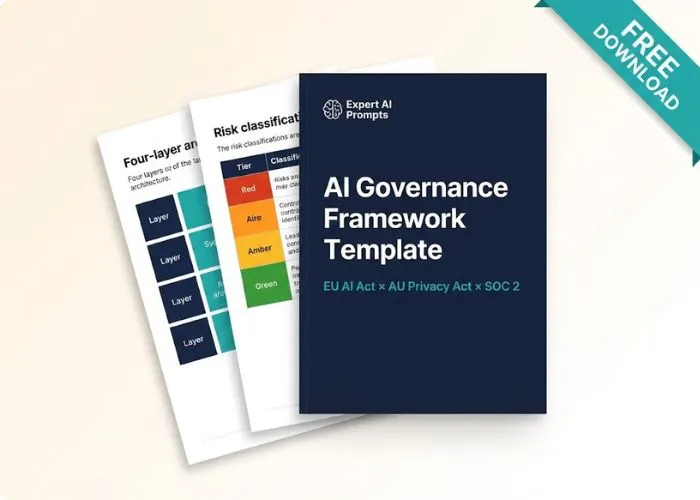
What the Template Contains: 10 Ready-to-Deploy Sections
1. AI Governance Charter Purpose statement, governance principles, risk appetite definition, board accountability structure, executive sponsorship model
2. AI System Inventory and Risk Classification Matrix Pre-formatted inventory table with EU AI Act risk tier, APP 1.7 trigger assessment, and SOC 2 TSC exposure columns
3. Four-Layer Governance Architecture Editable layer-by-layer accountability template: Governance Committee → CoE → AI Product Managers → AI Champions
4. Cross-Framework Compliance Mapping Side-by-side mapping: EU AI Act obligation → Australian Privacy Act equivalent → SOC 2 TSC control
5. Technical Documentation Template (Annex IV Aligned) 6-section technical documentation package for high-risk AI systems — Annex IV compliant
6. APP 1.7 Privacy Policy Disclosure Template Ready-to-adapt privacy policy section satisfying the Australian automated decision-making transparency requirements that commence on 10 December 2026
7. AI Acceptable Use Policy Template Employee-facing policy covering approved tools, prohibited uses, data handling, incident reporting, and disciplinary process
8. Incident Classification and Response Protocol 4-tier classification system with response timelines, escalation chains, and regulatory notification requirements
9. Quarterly AI Governance Dashboard Template 5-metric board reporting template: Production Count, Value Realised, Compliance Status, Shadow AI, Adoption Rate
10. 12-Month Implementation Roadmap 4-phase implementation plan designed to meet both the 10 December 2026 APP 1.7 date and the 2 December 2027 EU AI Act Annex III date
10 sections. Fully editable DOCX. Replace [Organisation Name] placeholders. Delivered to your inbox immediately on form submit.
Why You Need This Before 10 December 2026
The Australian Privacy Act activates APP 1.7 automated decision-making transparency obligations on 10 December 2026. The EU AI Act’s Annex III high-risk obligations follow on 2 December 2027, deferred from 2 August 2026 by Regulation (EU) 2026/1744; its Article 50 transparency duties were not deferred and have applied since 2 August 2026. US SOC 2 audit scrutiny of AI systems requires continuous, evidence-based control demonstration throughout the year. Three frameworks. One 12-month window. Organisations that are not governance-ready before 10 December 2026 face penalty exposure and commercial risk simultaneously.
This template is not a theoretical framework — it is an operational deployment tool. Every section is pre-structured to the relevant regulatory standard, with placeholders for your organisation's specific details. A compliance and legal team can adapt and review it in a single working session. The risk classification matrix, the Annex IV technical documentation template, and the APP 1.7 privacy policy disclosure are the three highest-priority sections for organisations approaching the 10 December 2026 APP 1.7 deadline.
Penalty exposure without governance documentation: EU AI Act — up to EUR 35 million or 7% of worldwide annual turnover, for prohibited practices. Australian Privacy Act — up to AUD 50 million or 30% of adjusted turnover under s13G for serious interference with privacy; an APP 1.7 disclosure failure is s13H, 2,000 penalty units. The cost of building governance documentation is a fraction of a percent of either penalty threshold.
Who This Template Is Built For
AI STRATEGY LEADERS AND CAIOs Building the governance architecture from the ground up. This template provides the structural foundation — charter, classification, four-layer design — that can be deployed immediately.
LEGAL, COMPLIANCE AND RISK OFFICERS Preparing for the 10 December 2026 Australian Privacy Act APP 1.7 obligations and the 2 December 2027 EU AI Act Annex III deadline. The compliance mapping matrix and APP 1.7 disclosure template are the priority sections.
CTOs AND TECHNOLOGY EXECUTIVES Building the AI Centre of Excellence and establishing governance infrastructure before scaling AI deployment. The four-layer architecture template and acceptable use policy are the priority sections.
About the Author
Matthew Bulat is the Founder of Expert AI Prompts and a 20+ year technology and AI strategy executive. Former CTO, Federal Government Technical Operations Manager across 20 cities and 4,000 users, and 8+ year University Lecturer in IT and engineering at CQUniversity. The governance architecture in this template is the same framework applied in the live Expert AI Prompts platform — 30 industries, 1,500+ prompts, 15 AI workflow systems.
Former CTO · Federal Government Technical Operations Manager | CQUniversity Lecturer, IT (8+ years) | Founder, Expert AI Prompts | AI Strategy Leader — inbound $300K+ USD role interest

What Comes Next — Continue Building Your Governance Programme
Enterprise AI Governance Framework The full pillar page: four-layer model, Shadow AI containment, firm sovereignty, board reporting. Read the Full Framework
Enterprise AI Readiness Checklist 25 questions before you deploy anything — includes the full Governance dimension assessment. Free PDF. Download Free
Book a 30-Minute AI Strategy Session Direct session with Matthew Bulat — specific, actionable next step for your governance programme. Book Now