Enterprise AI Solutions > AI Buy vs Build Framework > Scorecard
Download the AI Buy vs Build Decision Scorecard — 12-Factor Weighted Scoring Model
Every AI investment decision is a four-path choice: Build, Buy, Partner, or Hybrid. Most organisations make it with the wrong data, in Year 1 only, and discover the consequences in Year 3.
12-Factor weighted scoring across Build, Buy, Partner, and Hybrid — all four paths, every initiative
3-Year Total Cost of Ownership model — all cost categories including the five hidden ones most business cases miss
5-Layer Vendor Lock-In Assessment — with 10 pre-contract questions and 3 mandatory contract clauses
Decision Summary auto-populated from Scoring Matrix — one recommendation, fully auditable
Excel workbook (7 worksheets) + PDF Companion Guide (6 pages)
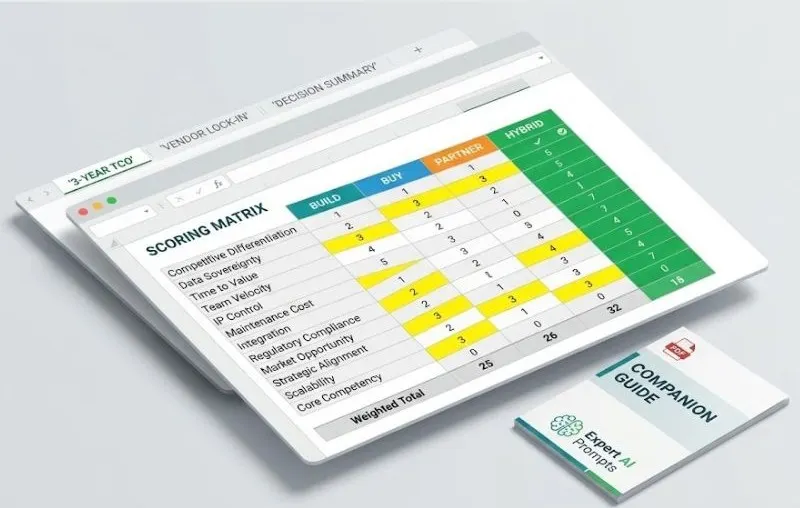
What’s Inside the Scorecard — 7 Worksheets
Every worksheet is connected. The Scoring Matrix drives the Decision Summary. The TCO model informs Factor 5. The Vendor Lock-In Assessment protects against what the TCO model doesn’t show.
Tab
Colour
Description
Key Feature
WELCOME
NAVY
Navigation guide, step-by-step instructions, and colour key. Yellow cells = your inputs. All other cells are formulas — do not edit.
Start here. Takes 3 minutes to read. Saves 30 minutes of confusion.
SCORING MATRIX
TEAL
12-factor weighted scoring model across all four paths. Set factor weights (1–3) based on your organisation’s strategic context. Score each path (1–5) per factor. Weighted totals auto-calculate. Recommendation auto-populates.
Critical failure flag: any factor scoring 1 on any path is highlighted red and that path is eliminated regardless of total score.
3-YEAR TCO MODEL
BLUE
Full cost comparison across Build, Buy, Partner, and Hybrid — Year 1, Year 2, Year 3. All cost categories including the five that most business cases miss: maintenance, governance overhead, scale-up pricing, exit cost, and data quality remediation.
Compare the Year 3 cumulative row — not Year 1. The decision that looks obvious in Year 1 looks different by Year 3.
VENDOR LOCK-IN
ORANGE
5-layer lock-in risk assessment (Model, Orchestration, Data, Governance Evidence, Organisational Knowledge) + 10 pre-contract vendor questions. Each question has a Yes/No/TBC dropdown and an action required note.
A ‘No’ answer to any of the 10 questions is a contractual negotiation requirement before signature.
3C QUICK-TRIAGE
GREEN
Fast directional decision for lower-investment initiatives: Capability, Complexity, Criticality. Answer three questions via dropdown. Result is directional only — for investments over $500K, run the full Scoring Matrix.
Takes under 5 minutes. Produces a directional Buy / Build / Partner / Hybrid recommendation.
CONTRACT CLAUSES
PURPLE
Three mandatory contract clauses with exact required language: Data Portability, IP Ownership of Fine-Tuned Models, and Regulatory Access. Copy directly into your MSA or legal brief. Status tracking dropdowns included.
Any vendor that refuses to include these three clauses has disclosed their lock-in intention.
DECISION SUMMARY
RED
Auto-populated from the Scoring Matrix: recommended path, weighted scores for all four paths, percentage of maximum, and a 6-item pre-commitment checklist. Present this tab to the AI Governance Committee for sign-off.
All formula-driven. This tab requires no manual entry. It reflects every input in the Scoring Matrix.
Yellow cells are your inputs. All other cells calculate automatically. The Decision Summary auto-populates from the Scoring Matrix — present that tab directly to the AI Governance Committee.
Why This Decision Is the Most Consequential One You’ll Make Before Any AI Initiative
The buy vs build decision is not a technology choice. It is the strategic choice that determines what every technology choice after it costs. Most enterprises make it with a Year 1 cost comparison, a binary Build-or-Buy question, and no formal assessment of vendor lock-in risk. By Year 3, the consequences are fully visible — but the budget is already committed and the dependencies are already built.
The seven-factor framework in the AI Buy vs Build Decision Framework is the structured process for making this decision correctly. The scorecard is the practical implementation of that framework: a tool you apply to each AI initiative, not once to the programme. Different use cases score differently. The framework reaches different conclusions for different contexts. That is not a flaw — it is the point.
67% vs 22%
Purchased AI success rate vs internal builds
MIT NANDA 2025 — when the decision is made with a structured framework
42%
of enterprise AI initiatives scrapped in 2025
S&P Global 2025 — up from 17% the year prior
The organisations in the 67% success cohort are not smarter or better resourced. They made the investment decision correctly, before deployment. This scorecard is that decision process.
Who This Scorecard Is Built For
The AI Buy vs Build Decision Scorecard is designed for enterprise leaders who are responsible for an AI investment decision right now — not for those at the start of their AI journey.
Chief AI Officers, CTOs, and CAIOs evaluating a specific AI initiative against the four investment paths
CFOs and Finance Directors who need a structured financial framework for AI investment proposals
AI Governance Committees reviewing AI investment recommendations before approval
Enterprise Architects assessing vendor lock-in risk before a production AI deployment
Procurement teams responsible for AI vendor contract negotiation
Strategy leads who have an AI business case in front of them and need a structured challenge process
This scorecard is not for organisations at the exploration or pilot stage. If you are still selecting your first AI use case, the Enterprise AI Readiness Checklist is the right starting point.
Not sure where you are? Take the AI Maturity Assessment →

About Matthew Bulat
Matthew Bulat is the Founder of Expert AI Prompts and a 20+ year technology and AI strategy executive. Former CTO, Federal Government Technical Operations Manager for national infrastructure across 20 cities and 4,000 users, and 8+ year University Lecturer in IT and engineering at CQUniversity.
The AI Buy vs Build Decision Scorecard is derived from the same seven-factor framework applied in every Expert AI Prompts enterprise deployment — 30 industries, 1,500+ domain-specific prompts, 15 AI workflow systems. Expert AI Prompts is the live proof-of-concept of the methodology you are downloading.
Former CTO · Federal Government Technical Operations Manager
CQUniversity Lecturer (8+ years) · MACS CP · M.Eng.Tech
Founder, Expert AI Prompts — 30 industries · 1,500+ prompts · 15 AI workflow systems
What Comes Next — Apply the Framework
The scorecard is the practical tool. The pillar page is the full strategic context. The strategy session is the direct implementation path.
The seven-factor framework, four investment paths, worked examples, and decision authority matrix in full.
The governance architecture that protects every AI investment decision you make with this scorecard.
Apply the seven-factor framework to your specific AI initiative with direct expert input.