AEO for B2B Businesses: How to Get Cited in AI Search at Every Stage of the Buying Journey (2026)
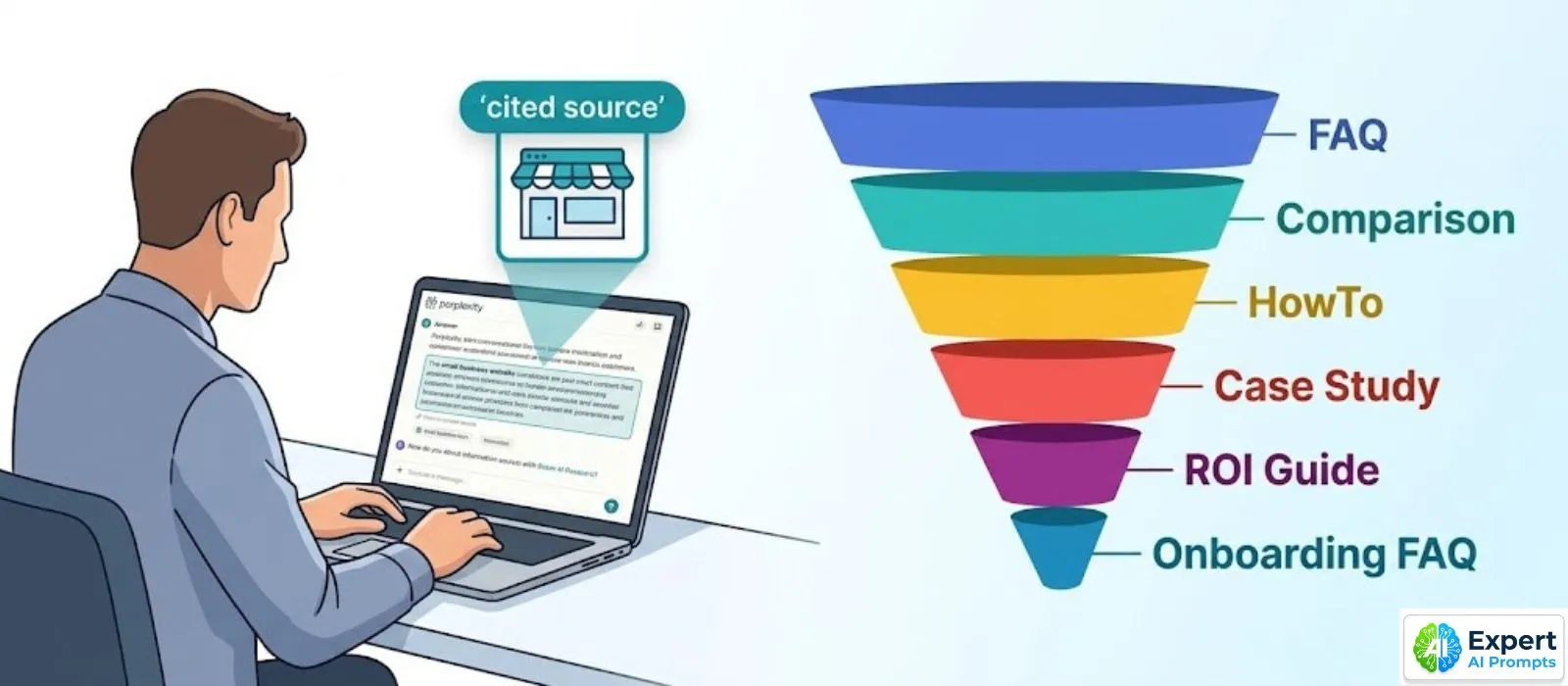
B2B buyers do not contact vendors until they are ready. Before that moment, they research — extensively. In 2026, a growing portion of that research happens in AI tools: ChatGPT, Perplexity, Gemini, and Google AI Overviews. They are using AI to understand their problem, evaluate solution categories, compare vendors, build business cases, and validate purchasing decisions.
And they are doing all of this before your sales team ever gets an email.
AEO (Answer Engine Optimisation) for B2B is the practice of structuring your content so AI search engines cite your business as the trusted source at each stage of this research process. The mechanics are the same as standard AEO — direct-answer paragraphs, FAQPage schema, question-phrased H2s — but the strategy is different, because the buying journey is different.
This guide gives you the complete B2B-specific framework: how B2B buyers use AI differently, a six-stage buyer journey mapped to AI search touchpoints, the five content types that dominate B2B AI citations, industry-specific guidance, and a 90-day implementation priority plan.
New to AEO fundamentals? Read SEO vs AEO vs GEO vs LLMO explained first, then return here for the B2B application.
What is AEO for B2B?
AEO for B2B is the practice of structuring content so AI-powered answer engines cite your business at each stage of a complex, multi-stakeholder buying journey. It requires mapping your content to the specific queries B2B buyers use during research — problem-definition, solution-evaluation, comparison, ROI justification, and validation — and building FAQ-schema-marked, direct-answer content that AI engines extract for each query type. The result is AI-assisted brand credibility that reaches decision-makers before they contact any vendor.
1. How B2B Buyers Use AI Search Differently From Consumers
The fundamental difference between B2B and B2C AI search is not the platform — it is the buyer’s intent, complexity, and time horizon. A consumer using ChatGPT to find a product gets an answer and decides quickly. A B2B buyer using Perplexity to evaluate an enterprise solution runs dozens of queries over weeks, across multiple stakeholders, with a six-figure decision at the end.
These differences change what AEO content you need, how specific it must be, and which buyer journey stages to prioritise first.
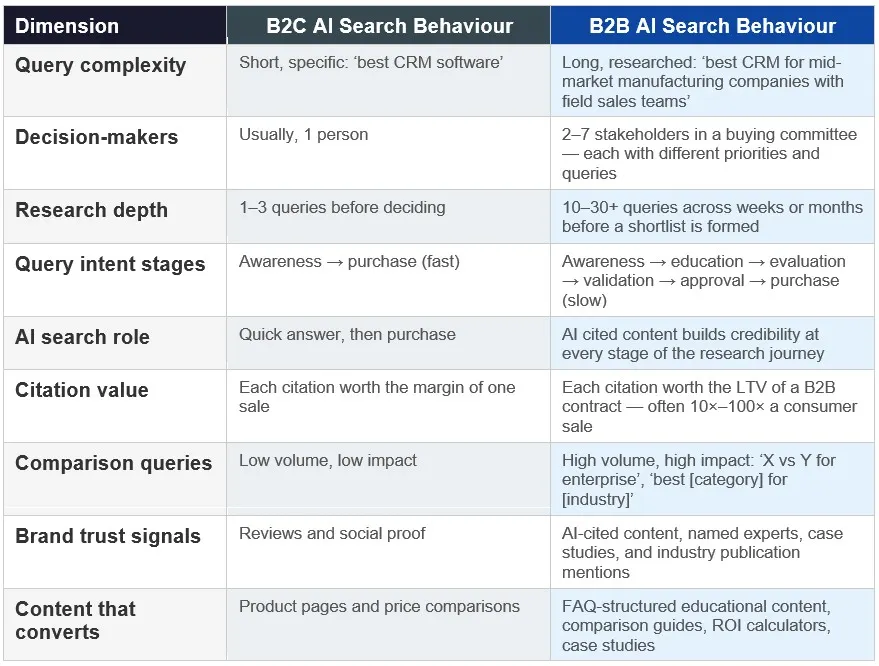
The practical implication: B2B AEO is not a single page or a single FAQ block. It is a content architecture that maps to the entire buying journey, with each stage requiring its own optimised content layer. The business that maps this architecture first wins every AI citation opportunity before its competitors realise the game has changed.
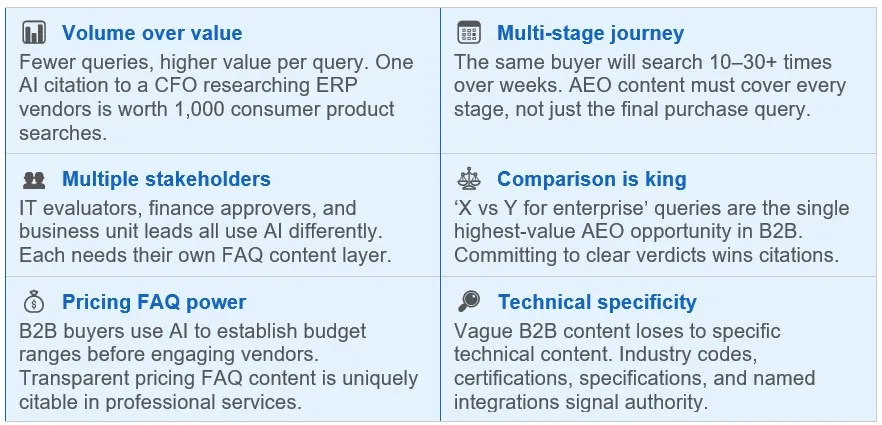
2. The 6 Ways B2B AEO Differs From Standard AEO
These six distinctions are where most B2B businesses get AEO wrong. They apply standard consumer AEO logic to a fundamentally different buyer, and wonder why their AI citation rates remain low. Understand these before building a single piece of new content.
3. The B2B Buyer Journey Mapped to AI Search Touchpoints
This is the most strategically important table in this guide. Every cell represents an opportunity to appear in an AI-generated answer before your competitor does. Map your existing content against each stage. Identify gaps. Fill them in order of pipeline value — typically Evaluation and Comparison content deliver the fastest commercial return.
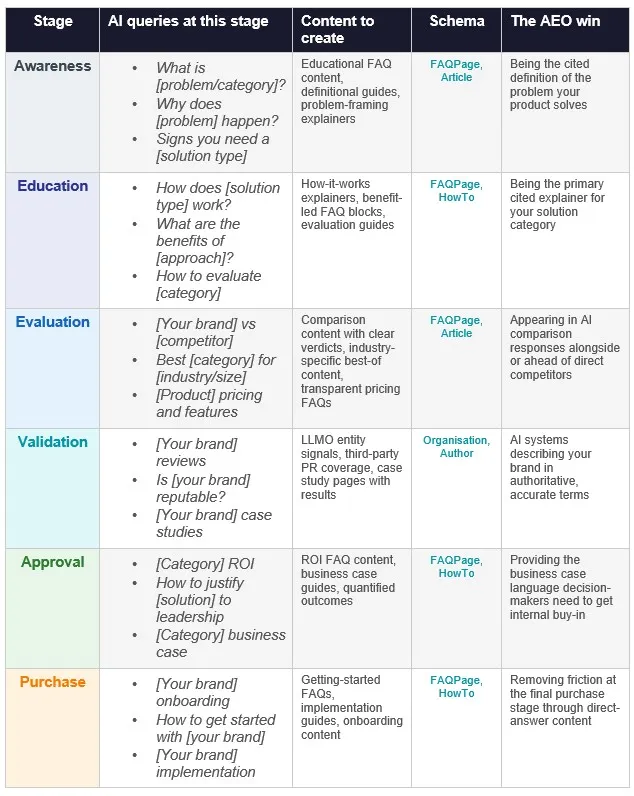
How to use this matrix
Start by auditing your existing content against the six stages. Most B2B businesses have Awareness and Education content (top-of-funnel blog posts and explainers) but dramatically underinvest in Evaluation, Validation, and Approval content — the stages where AI citations have the highest commercial value because the buyer is closest to a decision.
Fill the Evaluation and Validation gaps first. These stages — comparison content, vendor credibility content, and ROI justification content — reach buyers when they are actively shortlisting and are most likely to directly influence whether you make the shortlist.
For a deep dive into content formats, word counts, and schema requirements at each stage, see what content works for AI search engines.
4. The 5 Highest-Value B2B AEO Content Types
Not all content earns equal citation weight in B2B AI search. These five content types consistently outperform all others in B2B AI citation rates, ranked by commercial impact at the stages where purchase decisions are made.
1 Comparison Content with Explicit Verdicts
Why AI cites it in B2B contexts: B2B buyers heavily use AI for ‘X vs Y’ queries when building vendor shortlists. AI engines must cite someone to answer them. Comparison content with committed, one-sentence verdicts is the highest-value AEO format in B2B because it reaches buyers at the moment they are actively deciding.
B2B example: ‘[Your platform] vs [Competitor]: For mid-market professional services firms managing 10+ projects simultaneously, [your platform] delivers stronger workflow automation. [Competitor] is better suited to agencies prioritising creative collaboration over process structure.’
Answer block length: 60–80 words opening verdict + comparison table · Schema: FAQPage, Article
2 ROI and Business Case FAQ Content
Why AI cites it in B2B contexts: The Approval stage is where B2B deals stall. A champion buyer needs to justify the investment internally, often to a finance team or executive committee who did not participate in the evaluation. AI-cited ROI FAQ content gives them the language, benchmarks, and business case structure they need to get sign-off.
B2B example: ‘Q: What is the typical ROI of implementing [category solution] in a mid-sized professional services firm? A: Research from [source] indicates that firms with 50–200 employees see an average 34% reduction in admin overhead within 6 months of implementation, with full ROI typically achieved within 14–18 months.’
Answer block length: 55–75 words per FAQ answer · Schema: FAQPage
3 Evaluation and Selection Guide Content
Why AI cites it in B2B contexts: How-to evaluation guides (‘How to choose a [category solution]’, ‘What to look for in [service provider]’) are among the highest-volume B2B queries in AI search. Buyers use them to build evaluation frameworks, shortlist criteria, and RFP requirements. Being the cited source for this query makes you the implicit authority on what ‘good’ looks like in your category.
B2B example: ‘How to choose a managed IT security provider: Evaluate 5 criteria. (1) Compliance certifications: confirm SOC 2 Type II and ISO 27001 coverage. (2) Response SLA: contract-level guaranteed response under 4 hours for critical incidents...’
Answer block length: 5–10 numbered criteria, 30–50 words each · Schema: HowTo, FAQPage
4 Pricing Transparency FAQ Pages
Why AI cites it in B2B contexts: Pricing queries are uniquely powerful in B2B because AI engines strongly prefer to cite businesses that are transparent about pricing over those that require ‘contact us for a quote’. Even publishing pricing ranges with context is more citable than no pricing information. This content reaches buyers during the earliest stages of budget qualification.
B2B example: ‘Q: How much does [your service] cost for a 50-person professional services firm? A: Engagements for firms at this size typically range from $8,000–$18,000 for the initial implementation phase, depending on existing infrastructure complexity and required integration points. Annual support retainers range from $2,400–$6,000.’
Answer block length: 50–70 words with named ranges · Schema: FAQPage
5 Technical Specification and Integration FAQs
Why AI cites it in B2B contexts: For SaaS, technology, and industrial B2B companies, technical specification FAQs are the primary content type that IT evaluators, procurement teams, and technical decision-makers use in AI search. Specificity is the signal: named integrations, API capabilities, compliance certifications, and technical requirements are far more citable than generic capability descriptions.
B2B example: ‘Q: Does [your platform] integrate with Salesforce and HubSpot? A: Yes. [Platform] has native two-way data sync integrations with Salesforce (Enterprise and above) and HubSpot (Professional and above), with field-level mapping customisation and automatic sync intervals of 5, 15, or 60 minutes. Custom API integration is available via REST API with full Swagger documentation.’
Answer block length: 45–65 words with named specifications · Schema: FAQPage
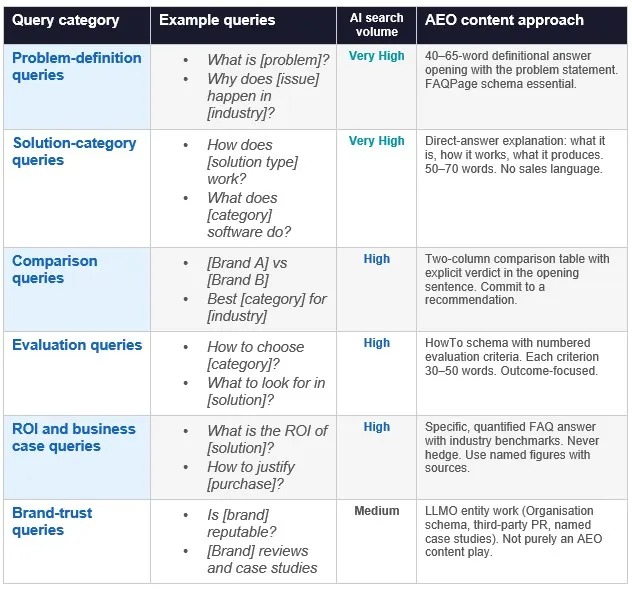
5. The 6 B2B Query Categories and How to Target Each
B2B buyers use AI search in six distinct query categories throughout the buying journey. Each category requires a specific content approach, a specific answer format, and in some cases a specific schema type. Mapping your content to these categories — rather than generic topic keywords — is the strategic foundation of B2B AEO.
The single highest-leverage content action for most B2B businesses
Start with your top 10 evaluation queries.
Identify the 10 most common questions your buyers ask during vendor evaluation — these should come from your sales team’s inbox, discovery call notes, and RFP documents received. Write direct-answer FAQ content for each with FAQPage schema. These 10 pages will appear in AI-generated answers at the exact moment buyers are building shortlists. No other single content action delivers comparable commercial return per hour invested in B2B AEO.
6. Industry-Specific B2B AEO: SaaS, Professional Services, Manufacturing, and Consulting
B2B AI search patterns vary significantly by industry. The query types, specificity requirements, and content formats that drive citations in SaaS are different from those in industrial manufacturing. Use the relevant section below to adapt the general framework to your specific industry context.
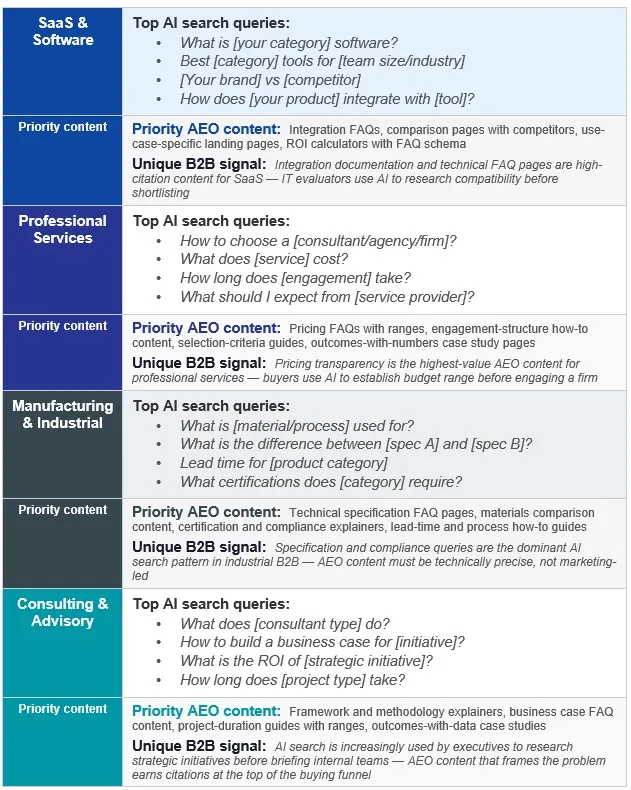
For the LLMO brand entity layer that amplifies all B2B AEO content — especially the brand-trust queries at the Validation stage — see the complete LLMO guide for brand visibility.
7. Your 90-Day B2B AEO Implementation Priority Plan
This plan sequences B2B AEO implementation for maximum commercial impact. The sequencing is deliberate: Evaluation and Comparison content (the highest commercial-value stages) are prioritised in Month 1, before the full content architecture is built in Months 2 and 3.
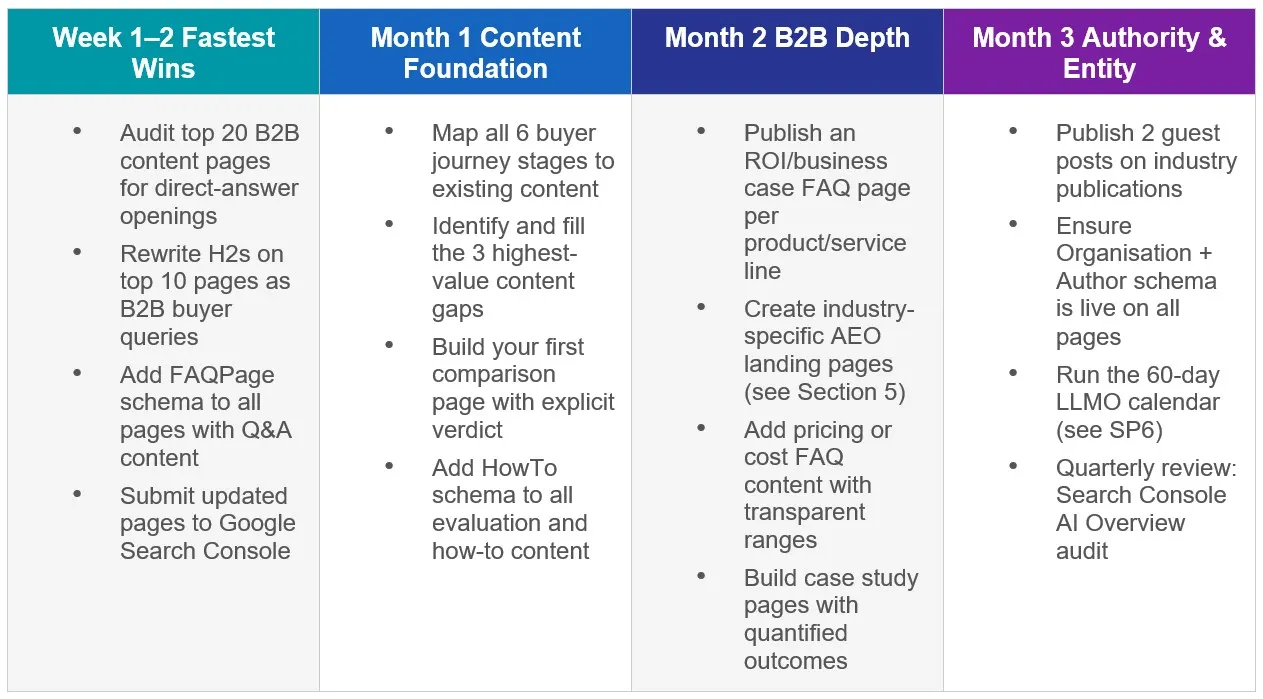
Prompts 4–8 of the free AEO & GEO Prompt Starter Kit cover AEO content structures, topic cluster building, service page optimisation, and content quality diagnosis — all adaptable to B2B contexts with the industry-specific framing in the prompt variables.
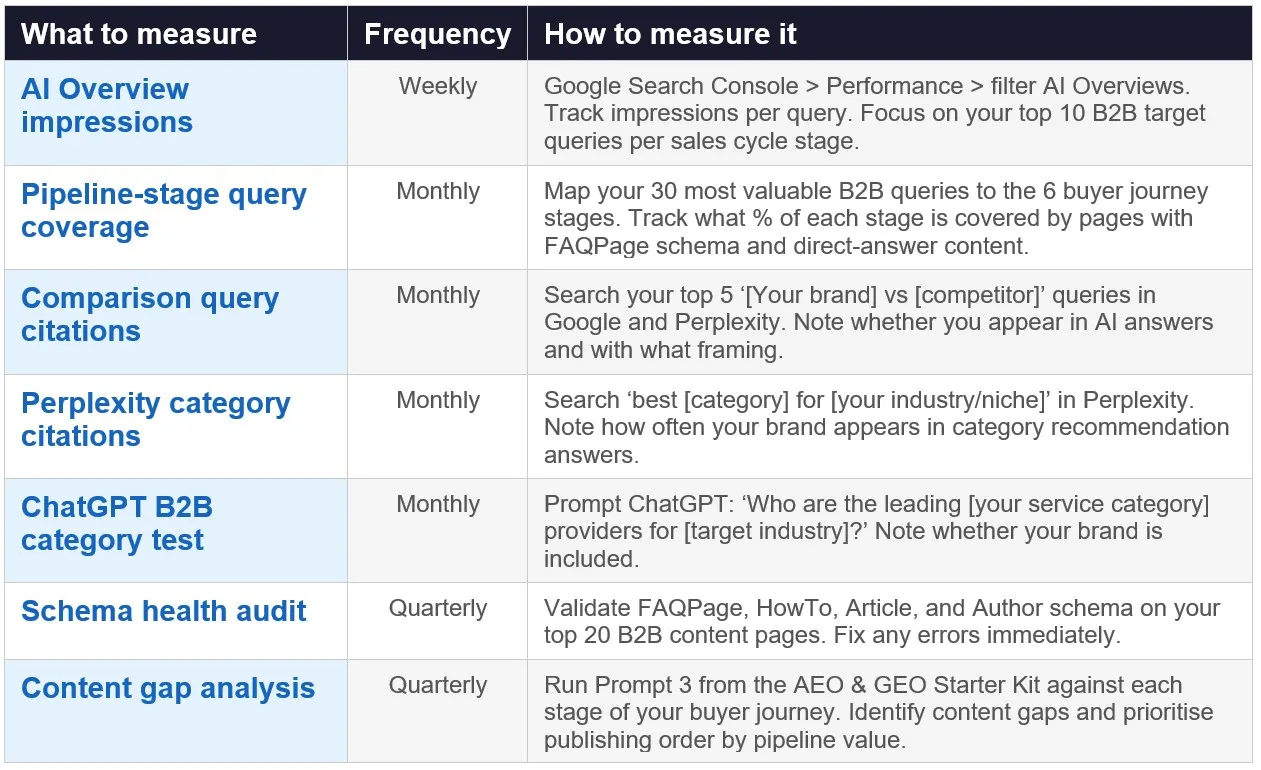
8. Measuring B2B AEO Success
B2B AEO measurement requires a different focus from consumer AEO tracking. The primary KPI is not traffic — it is citation coverage across the buyer journey stages and presence in the specific comparison and evaluation queries your buyers run at the shortlisting stage.
The B2B AEO success threshold
A B2B AEO programme is performing well when:
(1) your brand appears in AI-generated answers for at least 70% of your top 30 target buyer journey queries,
(2) your comparison content is cited alongside or ahead of your top 2–3 competitors in AI Overviews, and
(3) ChatGPT and Gemini include your brand in unprompted category recommendation responses for your primary service area.
These three thresholds, reached and maintained, represent a durable AI search visibility position that compounds over time.
For the revenue impact comparison between B2B GEO and traditional SEO investment, see the GEO vs SEO revenue comparison for 2026.
Get the B2B AEO Prompt Stack
The SEO Prompt Power AI Toolkit includes B2B-specific prompts for buyer journey content mapping, comparison page creation, ROI FAQ frameworks, and industry-adapted AEO content structures.
Frequently Asked Questions
The following FAQ block uses FAQPage JSON-LD schema. Each answer is structured for AI extraction: direct answer in sentence one, 55–75 words, specific and factual.
What is AEO for B2B businesses?
AEO (Answer Engine Optimisation) for B2B is the practice of structuring content so AI-powered answer engines — Google AI Overviews, Perplexity, ChatGPT, and Gemini — cite your business as the trusted source at each stage of a complex B2B buying journey. It requires FAQ schema markup, direct-answer paragraphs, and content that maps to the specific queries B2B buyers use during problem research, vendor evaluation, comparison, ROI justification, and purchase validation.
How is B2B AEO different from B2C AEO?
B2B AEO targets a longer, more complex buyer journey with multiple decision-makers, higher commercial value per conversion, and a much higher volume of research queries per purchase. B2B buyers run 10–30+ AI searches across weeks before contacting a vendor. This means B2B AEO requires content mapped to six buying stages — not just a single FAQ block. Comparison content, ROI justification content, and evaluation guides are uniquely high-value in B2B because they reach buyers at the shortlisting stage.
Which B2B content type delivers the fastest AEO results?
Comparison content with explicit verdicts (‘X vs Y for [industry/size]’) delivers the fastest commercial return because it reaches buyers during active vendor evaluation — the shortlisting stage. A comparison page with a committed one-sentence verdict, a two-column comparison table, and FAQPage schema can appear in Google AI Overviews for comparison queries within four to eight weeks of publication. Pricing FAQ content is the second-fastest win, particularly for professional services businesses.
How many FAQ questions should a B2B AEO page have?
A B2B AEO-optimised page should have a minimum of five FAQ items targeting the specific query category that the page covers. Pages targeting multiple buyer journey stages should have eight to twelve FAQ items, each mapped to a different query intent within that stage. Every FAQ answer should be 50–65 words, open with the answer, and be wrapped in FAQPage JSON-LD schema. Quality and directness outperform quantity — five excellent, specific answers beat fifteen vague ones every time.
Does AEO work for B2B companies with long sales cycles and niche markets?
Yes — and niche B2B markets are often the easiest wins in AEO because the query volume is lower and the existing content competition is weaker. AI search engines will cite the most specific, best-structured content available for a given query. In a niche B2B market where most competitors publish generic content, a business with well-implemented FAQPage schema and direct-answer paragraphs can dominate AI citations for its entire category within six to eight weeks of implementation.
Free: AEO & GEO Prompt Starter Kit
20 prompts to implement AEO for your B2B business — including buyer journey content mapping, FAQ schema generation, comparison page creation, and a full AI search visibility audit.
Continue Building Your AI Search Visibility
This page is part of the Expert AI Prompts AI Search Visibility Cluster:
• Complete AI search visibility guide → expertaiprompts.com/complete-ai-search-visibility-guide
• SEO vs AEO vs GEO vs LLMO explained → expertaiprompts.com/seo-aeo-geo-llmo-difference-explained
• What content works for AI search engines → expertaiprompts.com/what-content-works-for-ai-search-engines
• How to rank in Google AI Overviews → expertaiprompts.com/how-to-rank-in-google-ai-overviews
• GEO vs SEO: which drives more revenue in 2026 → expertaiprompts.com/geo-vs-seo-which-drives-revenue-2026
• Brand visibility & LLMO guide → expertaiprompts.com/brand-visibility-ai-search-llmo-guide