SEO vs AEO vs GEO vs LLMO: What’s the Difference and Why It Matters in 2026
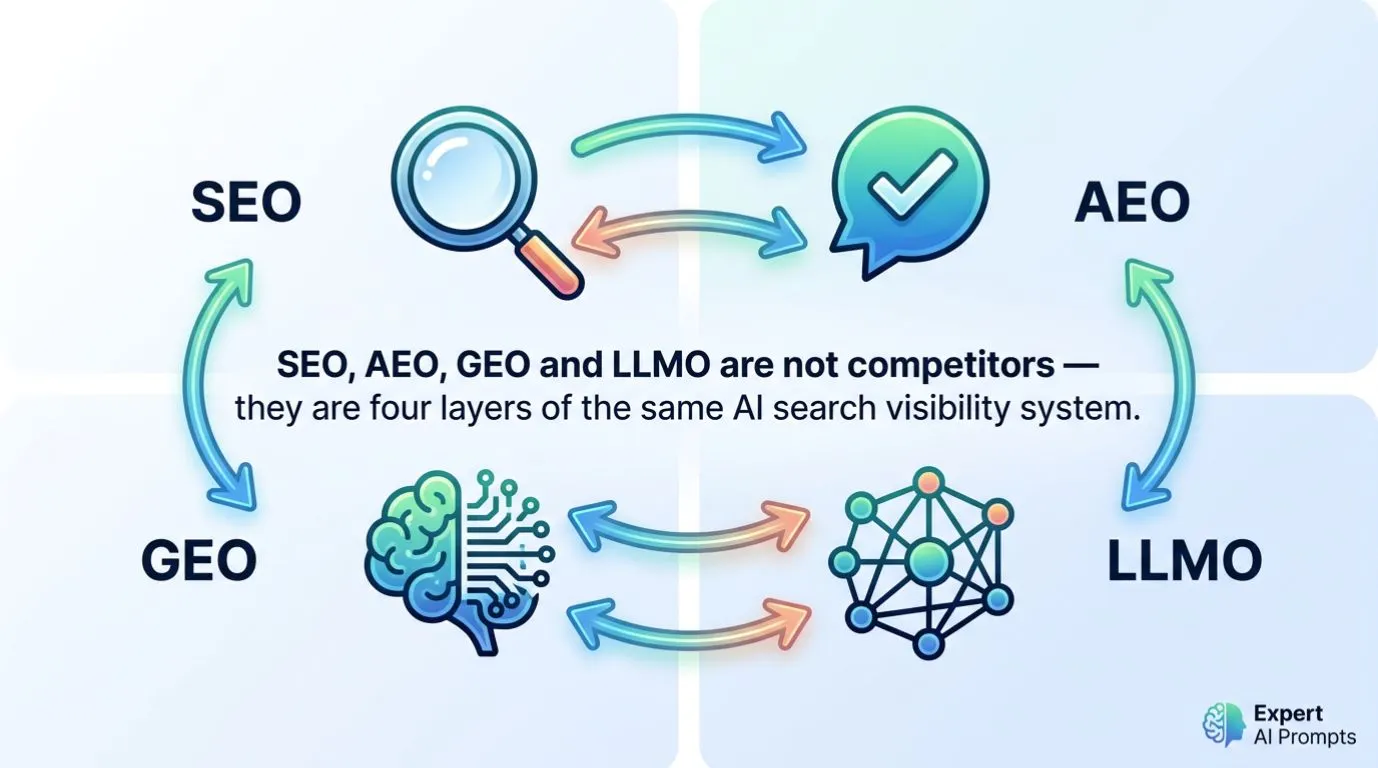
If you have been doing SEO for years and suddenly hear terms like AEO, GEO, and LLMO thrown around in the same sentence, you are not alone. These are not replacements for each other. They are four distinct disciplines that, together, determine whether your business gets found, cited, and recommended by both traditional search engines and the AI systems that are now rewriting the rules of online discovery.
This page cuts through the noise. By the end, you will know exactly what each term means, where they overlap, which platforms each targets, and how to prioritise them as a small business owner in 2026.
Already familiar with the basics and want the full strategy? Start with the complete AI search visibility guide.
Quick Reference: The 4 Disciplines at a Glance
SEO (Search Engine Optimisation) — Rank in Google blue links
AEO (Answer Engine Optimisation) — Get cited in AI Overviews and answer engines
GEO (Generative Engine Optimisation) — Have your content quoted by ChatGPT and Perplexity
LLMO (Large Language Model Optimisation) — Build your brand as a recognised entity across all AI systems
1. SEO — Search Engine Optimisation
What it is
SEO is the practice of optimising your website to rank higher in traditional search engine results pages (SERPs) — primarily Google, but also Bing. It is built on three pillars: technical health (site speed, indexability, mobile performance), on-page content (keyword relevance, content quality, internal linking), and off-page authority (backlinks, brand mentions, E-E-A-T signals).
What it targets
• Google Search blue link results
• Google Shopping and Maps listings
• Bing organic results
• Traditional featured snippets (Position Zero)
Why it still matters in 2026
Despite the rise of AI-generated answers, Google still processes over 14 billion searches per day. A significant portion of those still result in clicks to websites — particularly commercial and transactional queries where buyers are ready to act. SEO is the non-negotiable foundation. Without it, the other three disciplines have nothing solid to build on.
Key weakness
SEO alone no longer guarantees visibility. AI-generated answers now intercept informational queries before users reach your blue link. That is exactly where AEO and GEO come in.
2. AEO — Answer Engine Optimisation
What it is
AEO is the practice of structuring your content so that AI-powered answer engines — primarily Google AI Overviews, but also Perplexity and Bing Copilot — extract and display your content as the cited answer to a user’s query. The critical word here is structured. AEO is not just about having the right information; it is about presenting it in a format AI engines can parse, extract, and trust.
What it targets
• Google AI Overviews (formerly SGE)
• Perplexity AI cited results
• Bing Copilot answers
• Featured snippets (the bridge between SEO and AEO)
Core techniques
• FAQPage JSON-LD schema on every page with Q&A content
• Direct-answer paragraph structure: lead with the answer in sentence one
• 40-65 word answer blocks that AI can extract cleanly
• HowTo schema for process-based content
• H2 headings that mirror natural question phrasing
Why AEO is your fastest win right now
Google AI Overviews now appear for approximately 50% of queries in competitive niches. Small businesses with well-structured AEO content are appearing alongside — and sometimes instead of — national brands with significantly larger domain authority. Structure and relevance beat raw authority in AI-generated answers.
For B2B businesses with longer sales cycles, the AEO opportunity is even more specific. See the dedicated AEO for B2B guide.
3. GEO — Generative Engine Optimisation
What it is
GEO is the practice of creating content that large language models (LLMs) — specifically ChatGPT, Claude, Gemini, and Perplexity — actively quote and cite when generating responses for users. Where AEO focuses on extraction (pulling your existing content into answers), GEO focuses on citation: making your content the preferred source an AI chooses to reference because it is more original, specific, and authoritative than what is already in the model’s training data.
What it targets
• ChatGPT (GPT-4o and later) with Browse enabled
• Perplexity AI (real-time web search citations)
• Google Gemini Advanced
• Claude with web search
• Bing Copilot
What makes content GEO-ready
• Original data, statistics, or research not found elsewhere
• Quotable definition sentences (15-20 words, factual, precise)
• Structured sub-points that AI can extract as list items
• Comparison content with clear verdicts (“X is better than Y when...”)
• 2026-forward trend statements that newer models will prefer over dated sources
The GEO vs AEO distinction that matters
AEO optimises for AI engines reading your existing site. GEO requires you to write differently from the ground up — creating citation-grade content that is more specific, more original, and more structured than the generic information the AI already knows. GEO content is not about adding keywords; it is about becoming the source an AI cannot improve on.
For a deep dive into what content signals AI search engines reward, see what content works for AI search engines.
4. LLMO — Large Language Model Optimisation
What it is
LLMO is the practice of ensuring that AI systems — not just search-adjacent tools, but the core LLMs themselves — accurately recognise, represent, and recommend your brand. Where SEO, AEO, and GEO focus on individual pages and queries, LLMO operates at the brand entity level. The goal is for ChatGPT, Gemini, Perplexity, and Claude to have a consistent, accurate, and favourable understanding of who you are and what you do, regardless of which user asks or how they phrase the question.
What it targets
• ChatGPT (OpenAI)
• Google Gemini
• Anthropic Claude
• Perplexity AI
• Microsoft Copilot
• Any LLM-powered tool trained on web data
Core LLMO tactics
• Entity consistency: identical brand name, description, and positioning across all platforms
• Third-party validation: guest posts, PR, podcast appearances, media mentions on authoritative sites
• Organisation and Author schema on every page
• A Wikipedia-style brand description published consistently on website, LinkedIn, and Google Business Profile
• Knowledge graph optimisation: NAP consistency, structured brand facts, founder schema
Why LLMO is the long game
LLM training data moves slowly. Changes you make today will not appear in model outputs for weeks or months. But that compounding lag also works in your favour: brands that build consistent entity signals now will have a significant advantage over those who start later. LLMO is not the fastest discipline, but it builds the most defensible brand moat of the four.
For the full LLMO implementation strategy, see the complete LLMO guide for brand visibility.
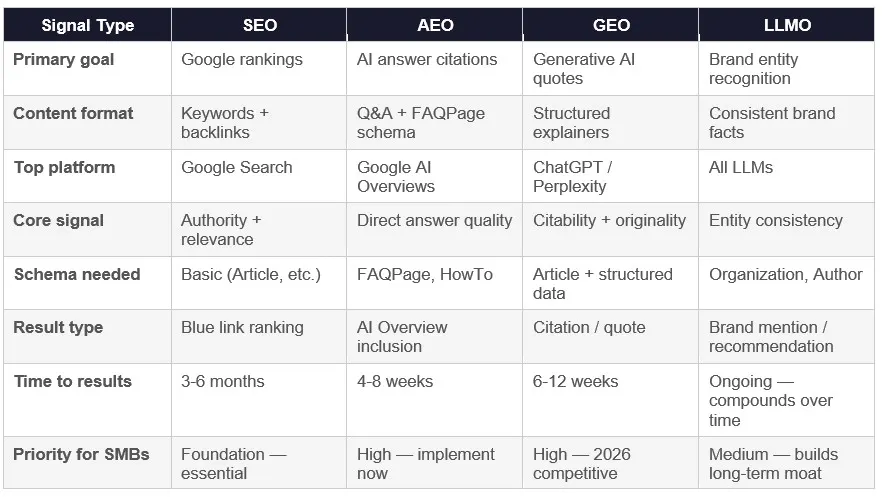
Side-by-Side Comparison: SEO vs AEO vs GEO vs LLMO
Use this table as a quick-reference guide when briefing your team or planning your content strategy.
5. They Are Not Competitors — They Are a System
The biggest mistake small business owners make with these four disciplines is treating them as alternatives. They are not. Each one targets a different layer of the same visibility problem, and they reinforce each other:
• Strong SEO makes your pages indexable and authoritative — the foundation every other discipline builds on.
• AEO structures your content for extraction — so AI Overviews pull from your pages, not your competitors’.
• GEO makes your content citation-worthy — so ChatGPT and Perplexity choose to quote you rather than paraphrase generic information.
• LLMO builds your brand entity — so all AI systems have a consistent, accurate understanding of who you are when users search by brand name or category.
A page optimised for AEO and GEO will reinforce your LLMO signals. Strong LLMO entity recognition increases the probability that AI systems cite your content in AEO and GEO contexts. The system compounds.
How to Prioritise as a Small Business Owner
You do not need to implement all four simultaneously. Here is the sequencing that delivers results fastest:

1. Fix your SEO foundation first. If your site has indexability issues, page speed problems, or thin content, no AI optimisation will compensate.
2. Layer AEO next. Add FAQPage schema, restructure your top 5 pages with direct-answer paragraphs, and ensure H2 headings mirror question phrasing. This is the fastest path to AI Overview inclusion.
3. Create GEO-optimised content in parallel. Each new piece of content you publish should be written with citability in mind — original, structured, and specific enough that AI prefers it over generic sources.
4. Build LLMO signals as an ongoing practice. Entity consistency is not a project; it is a standard. Make consistent brand description and third-party validation part of your regular marketing cadence.
For a detailed breakdown of how GEO specifically affects your revenue versus traditional SEO, see the GEO vs SEO revenue comparison.
Ready to Implement the Full System?
The SEO Prompt Power AI Toolkit gives you 50+ expert prompts across SEO, AEO, GEO, and LLMO — structured, tested, and plug-and-play.
Frequently Asked Questions
The following FAQ block uses FAQPage JSON-LD schema. Each answer is structured for AI extraction.
What is the difference between SEO and AEO?
SEO (Search Engine Optimisation) focuses on ranking in traditional Google blue link results through keywords, backlinks, and technical site health. AEO (Answer Engine Optimisation) focuses on getting your content cited inside AI-generated answers — such as Google AI Overviews — through structured FAQ content, direct-answer paragraphs, and FAQPage schema markup. In 2026, you need both: SEO for transactional traffic, AEO for informational visibility.
What does GEO mean in SEO?
GEO stands for Generative Engine Optimisation. It is the practice of creating content specifically designed to be quoted and cited by generative AI tools like ChatGPT, Perplexity, Google Gemini, and Claude. GEO content must be original, structured, and specific — providing insights, data, or definitions that AI engines cannot find in generic sources. It differs from AEO in that GEO focuses on making your content citation-worthy to LLMs, not just extractable by Google.
What is LLMO and do small businesses need it?
LLMO (Large Language Model Optimisation) is the practice of building your brand as a recognised entity across all major AI systems — ChatGPT, Gemini, Claude, Perplexity, and Copilot. It involves entity consistency (same brand description everywhere), Organisation schema, third-party validation through PR and guest posts, and knowledge graph signals. Small businesses do need LLMO because AI-driven recommendations increasingly influence purchase decisions — and brands not recognised by LLMs simply won’t be recommended.
Should I do SEO or AEO first?
Fix SEO first, then layer AEO. A technically sound website with indexable pages is the prerequisite for AI engines to extract and cite your content. Without solid SEO foundations — correct indexation, fast load times, clean URL structure — your AEO efforts will be invisible. Once your technical SEO is in order, AEO delivers results faster than any other discipline: well-structured FAQ content with FAQPage schema can appear in Google AI Overviews within four to eight weeks.
What is the easiest way to start AEO and GEO as a small business owner?
The fastest starting point is the free AEO & GEO Prompt Starter Kit from Expert AI Prompts. It gives you 20 structured prompts across AI search audit, AEO content structures, GEO content creation, LLMO brand visibility, and schema markup — all designed for business owners without technical SEO knowledge. Run Prompts 1-3 first to diagnose your current AI search position before building anything new.
Free: AEO & GEO Prompt Starter Kit
20 prompts to optimise your visibility in AI search — ChatGPT, Perplexity, Google AI Mode, and Gemini. Plug-and-play. No technical knowledge required.
Continue Building Your AI Search Visibility
This page is part of the Expert AI Prompts AI Search Visibility Cluster. Explore the full system:
• Complete AI search visibility guide → expertaiprompts.com/complete-ai-search-visibility-guide
• How to rank in Google AI Overviews → expertaiprompts.com/how-to-rank-in-google-ai-overviews
• AEO for B2B businesses → expertaiprompts.com/aeo-for-b2b-businesses
• What content works for AI search engines → expertaiprompts.com/what-content-works-for-ai-search-engines
• Brand visibility & LLMO guide → expertaiprompts.com/brand-visibility-ai-search-llmo-guide
• GEO vs SEO: which drives revenue in 2026 → expertaiprompts.com/geo-vs-seo-which-drives-revenue-2026