What Content Works for AI Search Engines? The Complete Answer for 2026
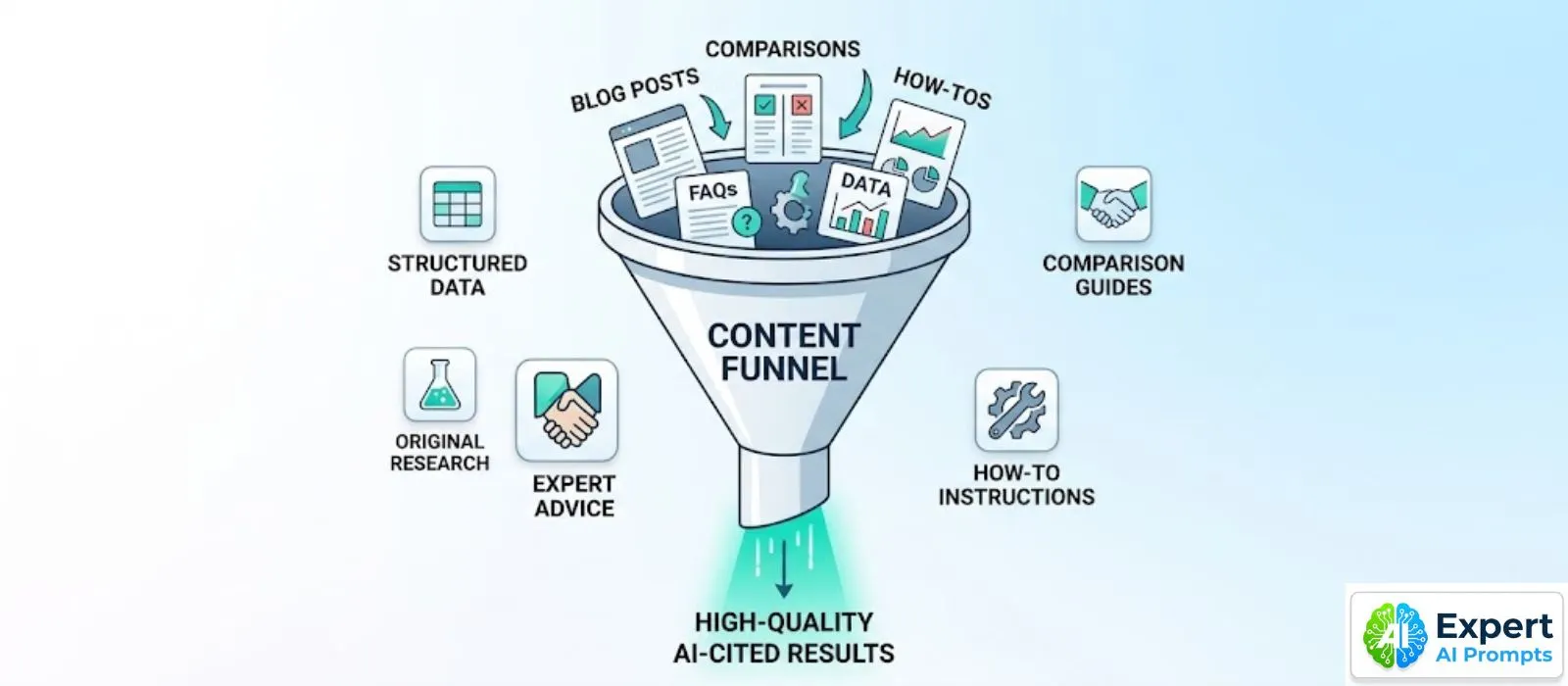
The content that ranks in Google and the content that gets cited by AI search engines are not the same thing. This is the single most important distinction that small business owners are missing in 2026.
Google rewards authority and relevance. AI search engines — ChatGPT, Perplexity, Google AI Overviews, Gemini — reward structure, specificity, and citability. A page can rank on page one of Google and still be completely invisible in AI-generated answers. The two systems use different evaluation criteria, and most websites are only optimised for one of them.
This guide tells you exactly what content AI search engines extract, quote, and cite — and what they skip over entirely. You will also find a quick-wins audit table you can use on your existing pages today.
Not yet clear on the differences between AEO, GEO, and LLMO? Start with SEO vs AEO vs GEO vs LLMO explained, then return here for the content deep-dive.
The short answer: What content works for AI search engines?
AI search engines consistently cite content that is direct, structured, specific, and original. The five formats they extract most reliably are: (1) direct-answer paragraphs, (2) FAQ-structured content with schema, (3) comparison content with clear verdicts, (4) structured how-to content, and (5) original data and research. Content that is vague, keyword-stuffed, or structured for human reading rather than machine extraction is routinely skipped.
1. The 5 Content Types AI Search Engines Prioritise
Not all content is citable. AI engines make rapid decisions about which text blocks are worth extracting. These five content formats consistently outperform everything else in AI-cited results.
1 Direct-Answer Paragraphs
What it is: A standalone paragraph that opens with a complete, factual answer to a specific question — in the first sentence. 40–65 words. No preamble, no scene-setting, no ‘in this article we will discuss.’
Why AI cites it: AI engines are built to extract the shortest, cleanest, most complete answer to a query. A direct-answer paragraph is precisely the unit they’re looking for. It mimics the format AI systems are trained to produce, which makes it the format they prefer to cite.
Example: ‘AEO (Answer Engine Optimisation) is the practice of structuring content so AI-powered answer engines extract and display it as the cited answer to a user query. It relies on FAQPage schema, direct-answer paragraphs, and H2 headings that mirror natural question phrasing.’
2 FAQ-Structured Content with FAQPage Schema
What it is: Question-and-answer blocks that mirror the exact phrasing users type into search and AI tools. Each answer is 50–65 words, opens with the answer, and is wrapped in FAQPage JSON-LD schema markup.
Why AI cites it: FAQPage schema is a direct handshake between your content and AI engines. It tells the system exactly which text is a question, which text is the answer, and that the pairing has been explicitly identified by the content owner. Schema-marked FAQ content is extracted at significantly higher rates than unstructured Q&A.
Example: ‘Q: What is the difference between AEO and GEO? A: AEO structures existing content for AI extraction. GEO creates citation-grade content that LLMs actively choose to quote because it is more original than generic sources.’ (with FAQPage JSON-LD applied)
3 Comparison Content with Clear Verdicts
What it is: Head-to-head comparisons of two or more options, structured with: a one-sentence opening verdict, a comparison table, dimension-by-dimension analysis, and a ‘who should choose what’ section.
Why AI cites it: Users constantly ask AI tools comparative questions (‘Which is better, X or Y?’). AI engines must cite someone to answer them. Comparison content with a clear, structured verdict is far more citable than hedging prose that refuses to commit to an answer. Tables are extracted first.
Example: ‘GEO vs AEO: For businesses publishing new content, GEO delivers higher long-term citation value. For businesses with existing pages, AEO delivers faster results. Both are required for a complete AI search visibility strategy.’
4 Structured How-To Content with HowTo Schema
What it is: Step-by-step process content in which each step is numbered, clearly labelled, and actionable. HowTo JSON-LD schema marks up the step structure. Steps are 30–50 words each.
Why AI cites it: How-to queries (‘how do I...’, ‘how to...’) are among the highest-volume query types in AI search. An AI engine generating a how-to answer prefers to cite a structured numbered list over prose description — because the structure maps directly onto the answer it needs to produce. Example: ‘How to add FAQPage schema in 4 steps: (1) Write 5 Q&A pairs with 50-65 word answers. (2) Generate JSON-LD using Google’s Structured Data Markup Helper. (3) Paste the script tag into your page . (4) Validate at schema.org/validator.’
5 Original Data, Research, and Proprietary Insights
What it is: Statistics, survey findings, benchmarks, original analysis, or proprietary research that cannot be found in existing AI training data. Even small-scale surveys (50–100 respondents) qualify if the findings are specific and named. Why AI cites it: AI engines have a strong preference for citing sources that contain information they cannot already generate from training data. A generic explanation of a concept is low-citation content — the AI already knows it. An original statistic or proprietary benchmark forces the AI to cite you rather than paraphrase itself. Example: ‘According to Expert AI Prompts’ 2026 AI Search Visibility Survey of 214 small business owners, 71% had no FAQPage schema on any page of their site, and 84% had never audited their brand’s representation in ChatGPT.’
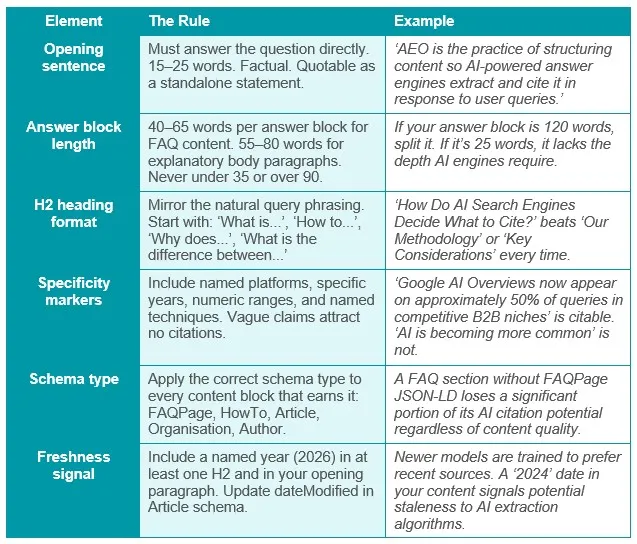
2. The Anatomy of AI-Citable Content
Understanding the content types is the strategic layer. Understanding the anatomy of each piece is the execution layer. These are the structural rules that determine whether AI engines extract your content or skip it entirely.
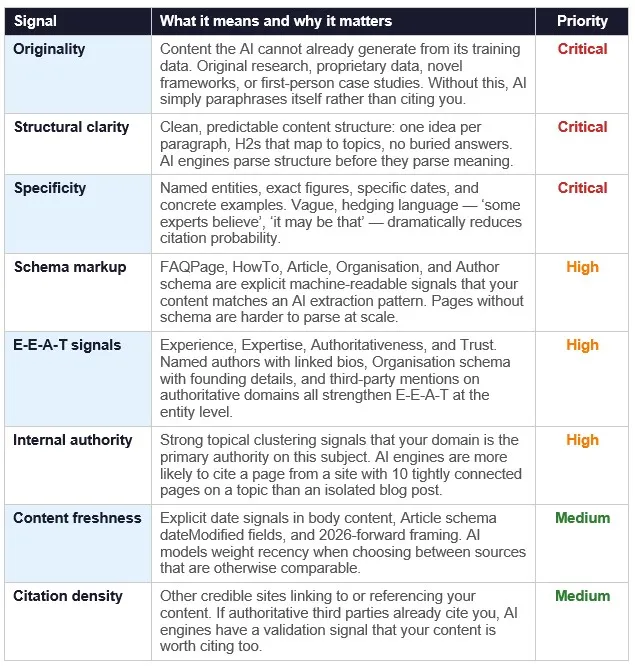
3. Content Signals AI Engines Reward (and Why)
Beyond content type and anatomy, AI engines evaluate a set of signals at the page level that influence citation probability. These are not ranking signals in the traditional SEO sense — they are trust and extraction signals that determine whether your content is considered a reliable source.
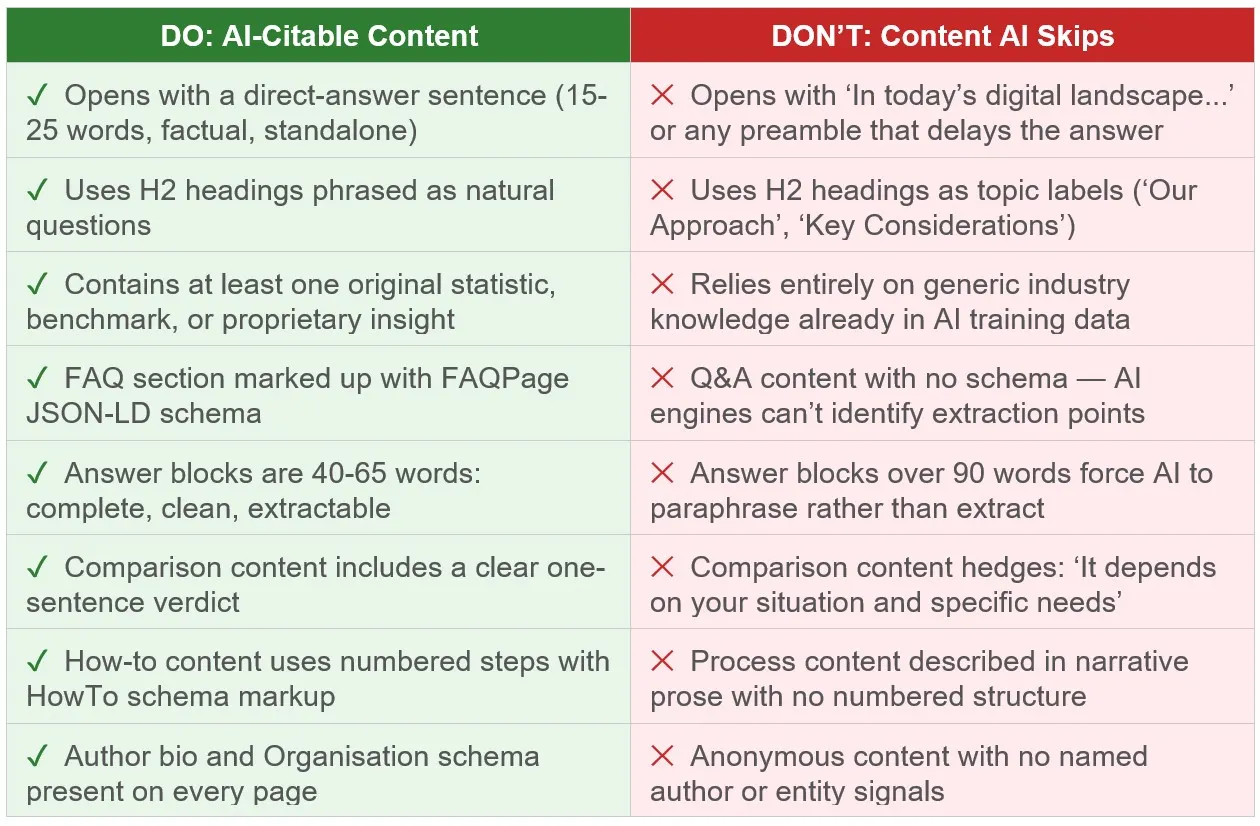
4. Content That Gets Cited vs Content That Gets Skipped
The fastest way to apply this framework is to audit your existing content against these two columns. Every page you publish should pass every ‘DO’ check before it goes live.
5. How Content Layers Compound Your AI Visibility
The most important strategic insight about AI search content is that it compounds. A single well-structured page is a starting point. A cluster of tightly connected, mutually reinforcing pages is what builds lasting AI citation authority.
The compounding content stack:
Layer 1 — Foundation: A pillar page with 10–15 direct-answer paragraphs, full schema, and strong topical authority signals. This establishes the domain as the primary source on the topic.
Layer 2 — Reinforcement: 6–8 support pages each targeting a specific question cluster, internally linked to the pillar. Each support page adds answer blocks that AI engines can cite for long-tail queries.
Layer 3 — Entity signals: Consistent brand entity schema (Organisation, Author), third-party mentions, and a Wikipedia-style brand description published across all platforms. This tells AI engines who is behind the content cluster.
Layer 4 — Original data: At least one piece of original research or proprietary data per cluster. This creates a citation anchor that competitors cannot replicate and that AI engines are forced to attribute.
For the full system view — how AEO, GEO, and LLMO layers work together — see the complete AI search visibility guide.
Quick-Wins Content Audit: Fix These 8 Gaps on Your Existing Pages
Before you create any new content, audit your existing pages against this table. Most small business sites can unlock significant AI citation improvement by fixing structure — not by publishing more.
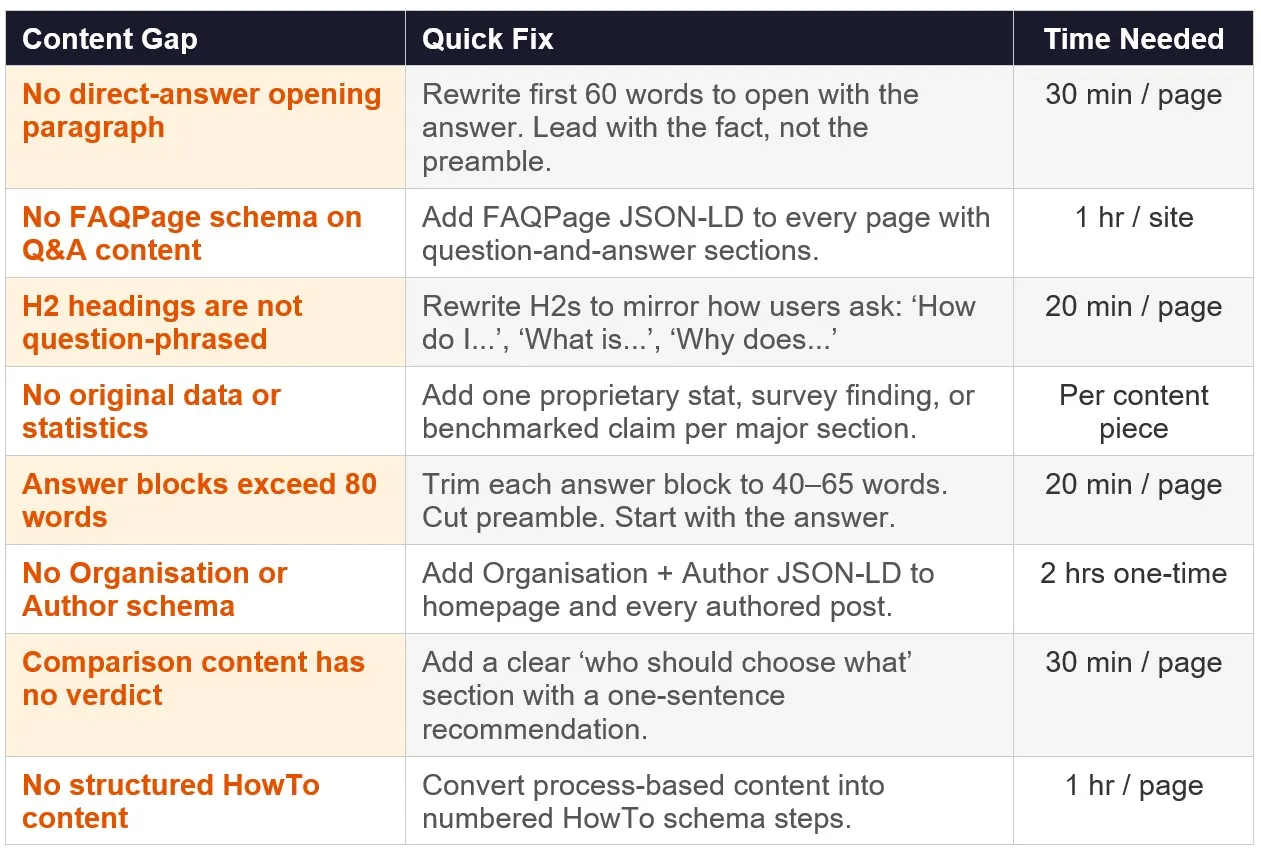
For step-by-step prompts to execute each of these fixes in under an hour, download the free AEO & GEO Prompt Starter Kit. Prompts 3–8 cover every item in this table.
Ready to Create AI-Citable Content at Scale?
The SEO Prompt Power AI Toolkit gives you 50+ expert prompts — structured, tested, and plug-and-play — for AEO, GEO, LLMO, and every content type covered on this page.
Frequently Asked Questions
The following FAQ block uses FAQPage JSON-LD schema. Each answer is structured for AI extraction.
What type of content do AI search engines like ChatGPT and Perplexity prefer to cite?
AI search engines consistently prefer to cite content that is direct, structured, and specific. The five formats they extract most reliably are: direct-answer paragraphs (40–65 words opening with the answer), FAQ sections with FAQPage schema, comparison content with explicit verdicts, numbered how-to content with HowTo schema, and original data or research not available in their training data. Generic, keyword-stuffed, or unstructured content is routinely bypassed.
How long should content be to get cited in AI Overviews?
Answer blocks for AI Overviews should be 40–65 words: complete enough to stand alone as an answer, but short enough for clean extraction. Full pages should be 1,500–2,000 words with multiple extractable answer blocks — not one long block of continuous prose. Each H2 section should function as an independent answer unit. Google AI Overviews typically pull from the first 60 words of a section, so leading with the answer is non-negotiable.
Does schema markup really affect whether AI engines cite your content?
Yes. FAQPage and HowTo schema are machine-readable declarations that tell AI engines exactly where the questions and answers are on your page. Without schema, AI engines must infer structure from layout and formatting, which is less reliable. Pages with FAQPage JSON-LD schema consistently show higher AI Overview inclusion rates than equivalent content without it. Organisation and Author schema also build entity trust signals that increase overall citation probability across the site.
What makes content ‘original enough’ for AI search engines to cite it?
Content is AI-citable in the originality sense when it contains information the model cannot produce from its existing training data. This includes: proprietary survey data or benchmarks, first-person case study results with specific numbers, unique frameworks or terminology you have coined, and explicit 2026-dated trend analysis. You do not need a full academic study. A survey of 50–100 customers with 3–5 specific findings is sufficient to create a citable data asset.
How is content for GEO different from content for AEO?
AEO content optimisation focuses on restructuring existing pages so AI engines can extract clean answer blocks from them — primarily through direct-answer paragraphs, FAQ schema, and question-phrased H2s. GEO content must be created differently from the ground up: it must be more original, more specific, and more authoritatively structured than what the AI already knows. GEO prioritises citation-grade content that LLMs choose to quote rather than paraphrase. Both are necessary in 2026.
Free: AEO & GEO Prompt Starter Kit
20 prompts to create, audit, and optimise content for AI search visibility — ChatGPT, Perplexity, Google AI Mode, and Gemini. Plug-and-play. No technical knowledge required.
Continue Building Your AI Search Visibility
This page is part of the Expert AI Prompts AI Search Visibility Cluster. Explore the full system:
• Complete AI search visibility guide → expertaiprompts.com/complete-ai-search-visibility-guide
• SEO vs AEO vs GEO vs LLMO explained → expertaiprompts.com/seo-aeo-geo-llmo-difference-explained
• AEO for B2B businesses → expertaiprompts.com/aeo-for-b2b-businesses
• GEO vs SEO: which drives revenue in 2026 → expertaiprompts.com/geo-vs-seo-which-drives-revenue-2026
• How to rank in Google AI Overviews → expertaiprompts.com/how-to-rank-in-google-ai-overviews
• Brand visibility & LLMO guide → expertaiprompts.com/brand-visibility-ai-search-llmo-guide