The Complete Guide to AI Search Visibility: How to Get Your Business Cited in ChatGPT, Perplexity, and Google AI Overviews (2026)
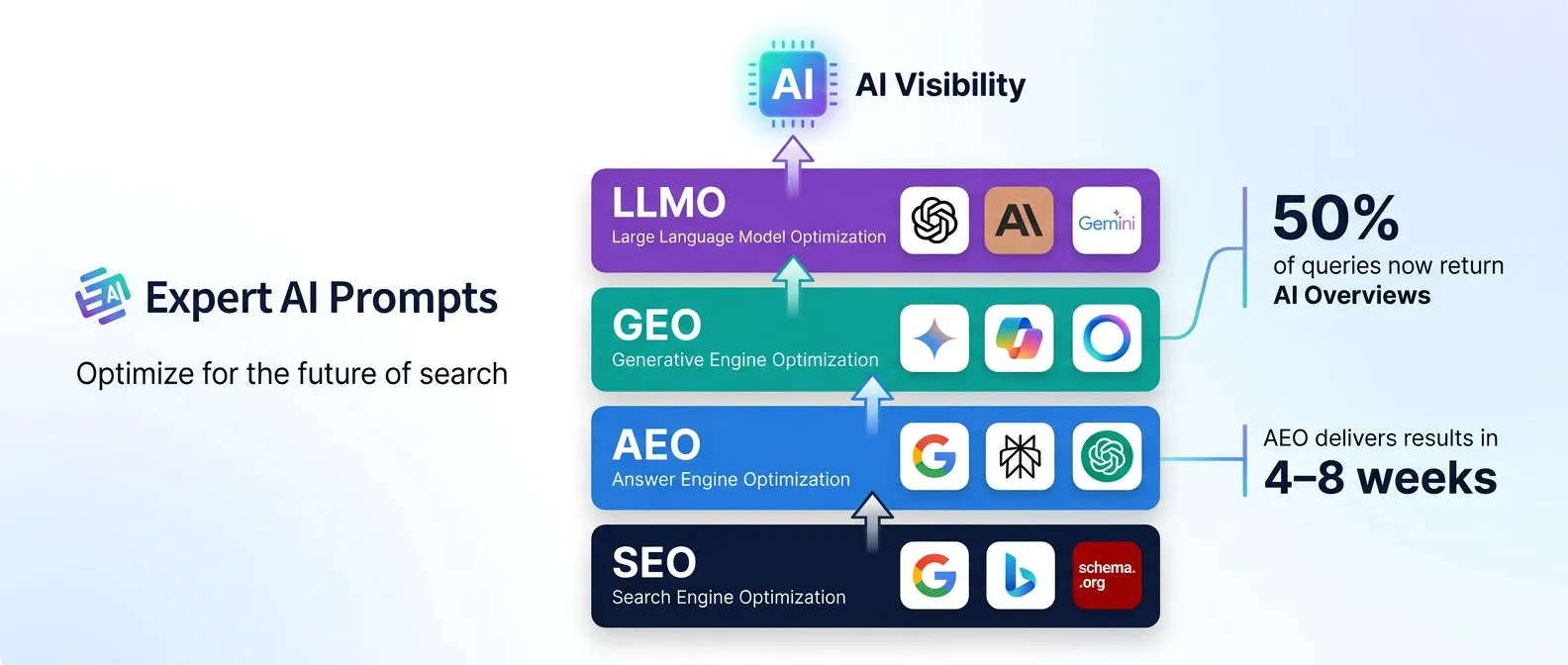
AI search has rewritten the rules of online visibility. Fifty per cent of Google queries now return an AI-generated Overview before a single blue link. ChatGPT and Perplexity answer questions directly, citing three to five sources — and if your business is not one of them, your potential customers never reach your website.
This is not a future problem. It is happening now, to your competitors’ advantage.
The good news: AI search visibility is learnable, implementable, and achievable for small businesses without large teams or agency budgets. It requires a different strategy from traditional SEO — but not a more complex one. It requires the right structure, the right signals, and a systematic approach that compounds over time.
This guide covers everything. By the end, you will have a clear understanding of the four-layer AI search visibility system, what to implement first, how to create content AI engines cite, how to build your brand as a recognised AI entity, and how to measure progress. Every section links to a dedicated deep-dive guide for readers who want to go further.
What you will learn in this guide:
• The four-layer AI search visibility system: SEO, AEO, GEO, and LLMO
• Exactly what content formats AI engines extract, cite, and quote
• How to implement AEO for fast AI Overview inclusion (4–8 weeks)
• How to create GEO-optimised content ChatGPT and Perplexity choose to cite
• How to build your brand as a recognised entity across all major LLMs
• A complete schema implementation guide and priority checklist
• How to measure AI search visibility and track your progress
• The 6 most common mistakes — and the exact fixes
• A 90-day AI search visibility roadmap you can start implementing today
1. What Is AI Search Visibility — and Why Does It Matter Now?
AI search visibility is the probability that your business, website, or content appears in AI-generated answers when a potential customer asks a relevant question in ChatGPT, Perplexity, Google AI Overviews, Gemini, or any LLM-powered search tool.
It is distinct from traditional search visibility in three critical ways.
Three ways AI search visibility differs from traditional SEO:
1. No click required. In traditional SEO, a high ranking means the user sees your listing and can click through. In AI search, the AI answers the question directly. If you are not the cited source, there is no listing to click, no visit to your website, and no opportunity to make a first impression.
2. Structure beats raw authority. Traditional SEO rewards domain authority and backlink volume. AI search rewards structure, directness, and specificity. A small business with a well-structured FAQ page and schema markup can appear in AI Overviews ahead of a national brand with ten times the domain authority.
3. Brand-level recognition compounds. In AI search, your brand entity — the consistent, accurate picture that all AI systems have of who you are and what you do — becomes a durable competitive asset. Every entity signal you build today compounds into a stronger position over time.
The shift is already well underway. Google AI Overviews now appear for approximately 50% of queries in competitive niches. Perplexity processes over 100 million queries per month. Microsoft Copilot is integrated into Office 365, a tool used by hundreds of millions of business professionals. ChatGPT’s Browse capability means GPT-4o is actively citing live web content in real time. Businesses that build AI search visibility now will compound that advantage for years. Businesses that wait are ceding ground to competitors who are already implementing.
2. The Four-Layer AI Search Visibility System
AI search visibility is not a single discipline. It is a system of four interlocking layers, each targeting a different aspect of how AI systems find, evaluate, and cite your business.
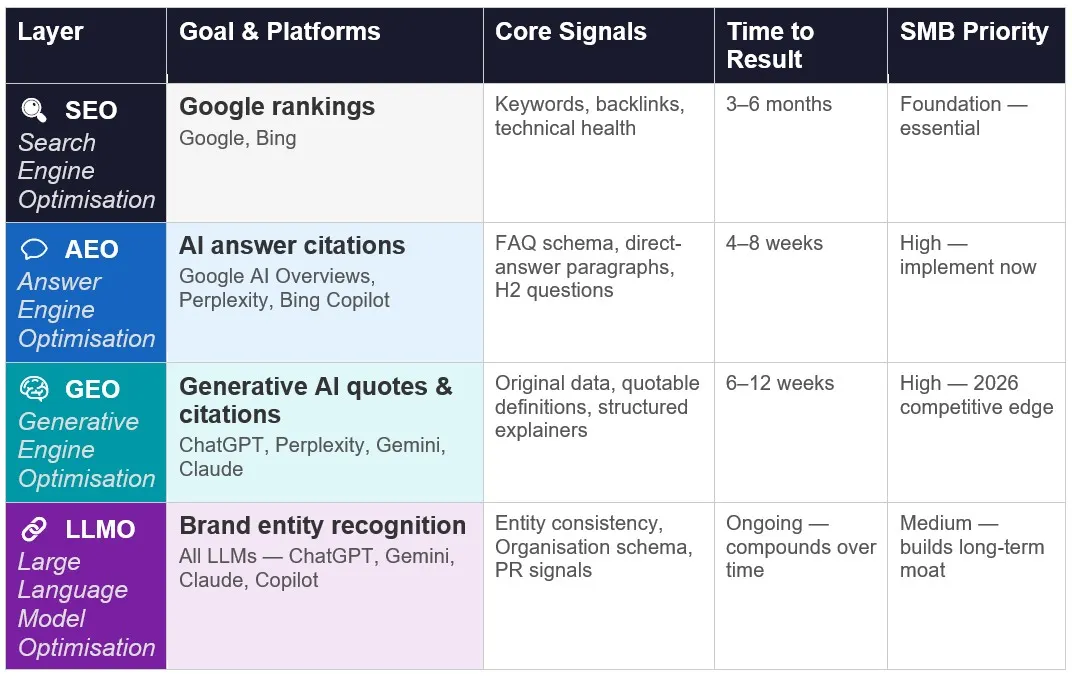
The layers are not alternatives — they are sequential and compounding. Strong SEO makes your pages indexable. AEO makes them extractable. GEO makes them citable. LLMO makes your brand recognisable. Each layer amplifies the others.
SEO: The Non-Negotiable Foundation
Every AI search visibility strategy starts with technical SEO. AI engines cannot cite a page they cannot find, crawl, or parse. Before implementing any AEO, GEO, or LLMO tactics, your site must have correct indexation, fast load times, mobile performance, clean URL structure, and adequate page authority.
SEO alone no longer guarantees visibility. But no AI optimisation strategy will succeed without it. A technically broken site is invisible to both Google and AI engines regardless of content quality.
For the full technical SEO picture, see the ROI-driven guide to AI for SEO.
AEO, GEO, and LLMO: The AI-Specific Layers
The exact differences between each discipline — including which platforms each targets, what content signals each requires, and how to prioritise them — are covered in detail in the dedicated comparison of SEO, AEO, GEO & LLMO.
3. What Content AI Search Engines Extract and Cite
The content that ranks in Google and the content that gets cited by AI search engines are not the same thing. AI engines reward structure, specificity, and originality — not just keyword relevance and domain authority.
These are the five content formats AI engines extract most reliably:
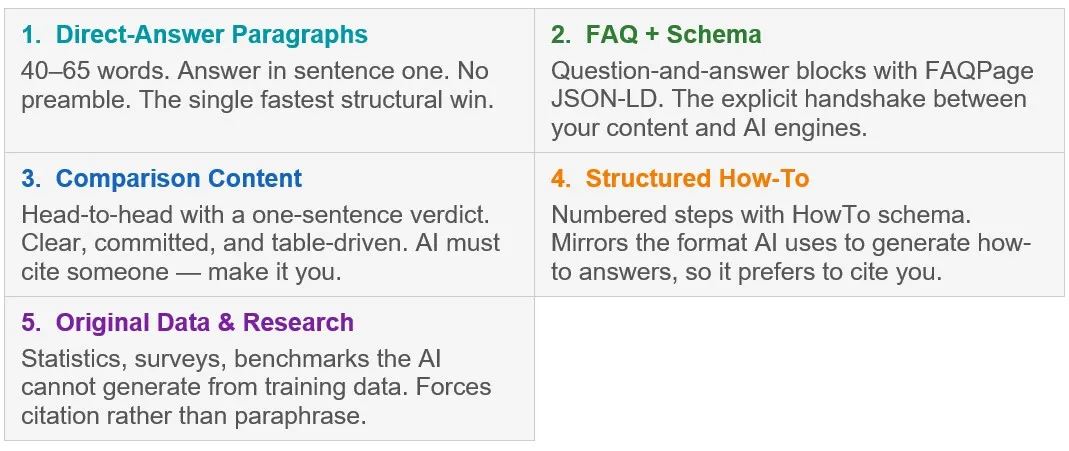
The anatomy rule that determines whether AI extracts your content or skips it
Regardless of content format, every piece of AI-citable content follows the same structural rule: the answer must appear in the first sentence. AI engines read the first 60 words of a section before deciding whether to extract it. If you open with preamble, context, or background, your citation probability drops sharply.
The opening sentence rule:
Every section, every FAQ answer, and every explanatory paragraph should open with a factual, standalone statement of 15–25 words that directly addresses the question implied by the H2 heading above it. If your opening sentence cannot stand alone as a complete answer to a question, rewrite it until it can.
Answer blocks should be 40–65 words for FAQ content and 55–80 words for explanatory body paragraphs. Under 35 words lacks the depth AI engines require. Over 90 words forces the AI to paraphrase rather than extract your text verbatim.
For the complete content signals breakdown, including the do/don’t audit table and 8-point quick-wins checklist, see what content works for AI search engines.
4. How to Implement AEO: The Fast Path to AI Overview Inclusion
AEO (Answer Engine Optimisation) is the fastest path to AI search visibility improvement. Well-implemented FAQ schema and direct-answer content can appear in Google AI Overviews within four to eight weeks. No new pages required — you can start with what you already have.
The 5-step AEO implementation process
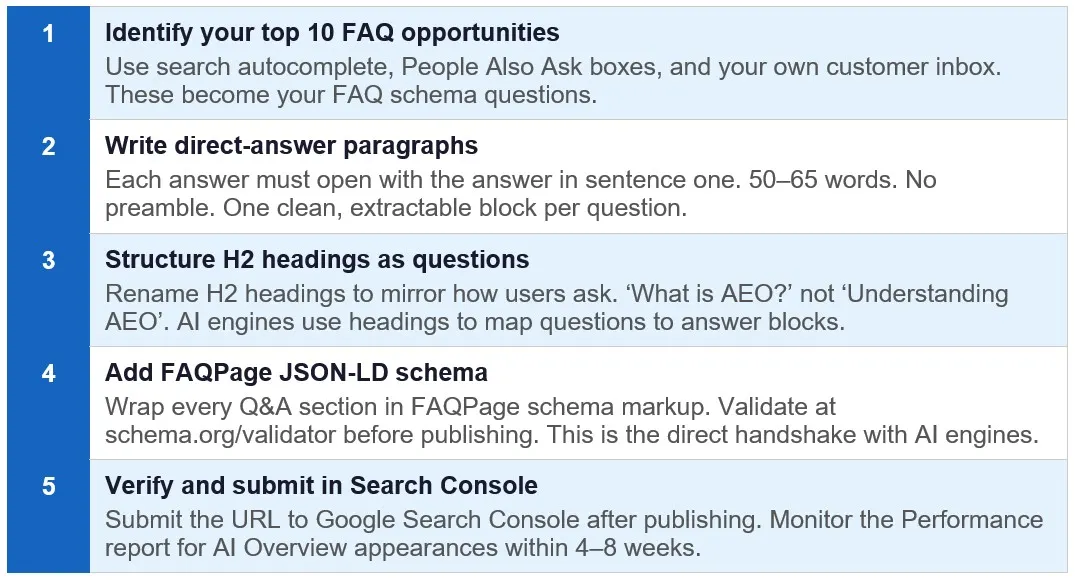
The word count sweet spots that determine citation success
The most common AEO mistake is answer blocks that are either too short or too long. Under 35 words lacks the depth AI engines require for a credible citation. Over 90 words forces the AI to paraphrase rather than extract, which means your specific wording — and your brand attribution — gets diluted. The proven range is 50–65 words for FAQ answers and 55–80 words for explanatory body paragraphs. These lengths are short enough for clean extraction and long enough to signal depth and credibility.
AEO for B2B businesses
B2B buyers use AI search differently from consumers — their queries are more complex, their decision cycles are longer, and the stakes of appearing in AI answers are higher because each citation reaches a decision-maker rather than a casual browser. The AEO approach for B2B businesses requires a specific adaptation. See the dedicated AEO for B2B guide for the full strategy.
Google AI Overviews specifically
Google AI Overviews have their own specific optimisation requirements, appearance patterns, and monitoring approach. For a step-by-step implementation guide focused specifically on AI Overviews inclusion, see the complete Google AI Overviews ranking guide.
Revenue impact: GEO vs SEO
Understanding how AI search visibility translates into revenue — and how it compares to traditional SEO investment — is critical for prioritising your time and budget. See the GEO vs SEO revenue comparison for the full analysis.
Get the Prompts That Implement This System
The SEO Prompt Power AI Toolkit gives you 50+ expert prompts across AEO, GEO, LLMO, and technical SEO — structured, tested, and ready to run in ChatGPT, Claude, or Gemini.
5. GEO: Creating Content That Generative AI Chooses to Quote
GEO (Generative Engine Optimisation) goes a step further than AEO. Where AEO optimises your existing content for extraction, GEO requires you to create content that is so specific, so original, and so well-structured that AI systems actively prefer to quote it rather than paraphrase generic information already in their training data.
The distinction matters because generic explanations of concepts are low-citation content — the AI already knows them and can produce them without citing you. GEO content earns citations by containing information the AI cannot generate from its own knowledge base.
What makes content GEO-ready
• Original data, statistics, or survey findings not available in AI training data
• Quotable definition sentences of 15–20 words: factual, precise, and standalone
• Structured sub-points that AI can extract as clean list items
• Comparison content with committed, one-sentence verdicts
• 2026-forward trend statements that newer models prefer over dated sources
• First-person case study results with specific, named numbers
The citation-grade content standard
Citation-grade content passes a simple test: could an AI engine produce this content from its existing training data without citing an external source? If the answer is yes, the content is generic. If the answer is no — because it contains original data, specific proprietary insight, or novel framing — it is citation-grade.
Every piece of GEO content should contain at least one element that forces attribution. A survey of 50–100 customers with 3–5 named findings is sufficient. A named benchmark, a proprietary framework, or an industry-specific statistic with a source date all qualify. The threshold is lower than most business owners assume.
6. LLMO: Building Your Brand as a Recognised AI Entity
LLMO (Large Language Model Optimisation) operates at the brand level, not the page level. Its goal is for all major AI systems — ChatGPT, Gemini, Claude, Perplexity, and Copilot — to have a consistent, accurate, and favourable understanding of your brand, regardless of which user asks or how they phrase the question.
LLMO is not the fastest discipline — LLM training data updates slowly, and the compounding effects take months to fully materialise. But it builds the most defensible competitive position of the four layers. Brands with strong LLMO signals become AI recommendations; brands without them become invisible to buyers who never reach a search result.
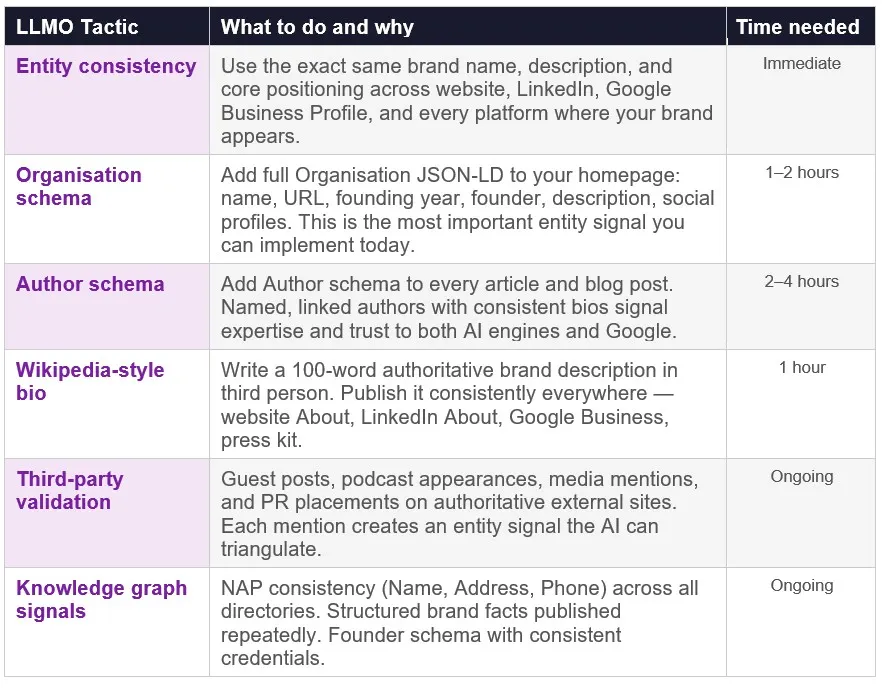
The six LLMO tactics every small business should implement
The Wikipedia-style brand description
The single most important LLMO action is writing a 100-word authoritative brand description in third person and publishing it consistently everywhere. This is the description AI systems will use when asked about your brand. It should state: who you serve, what you do, what makes you different, and when you were founded. It should read like the opening paragraph of a Wikipedia article — factual, neutral in tone, and focused on verifiable claims rather than marketing language.
Publish this description on your website About page, LinkedIn About section, Google Business Profile, and any platform where your brand appears. Consistency across platforms is the core signal that tells AI engines your entity is established and verifiable.
For the full LLMO implementation strategy, including the 60-day entity-building calendar and AI representation audit, see the complete LLMO guide for brand visibility.
7. Schema Markup: The Technical Layer That Accelerates Every Other Discipline
Schema markup is the layer most small business sites ignore — and the layer that delivers the fastest measurable improvement in AI extraction rates. FAQPage schema alone consistently increases AI Overview inclusion for pages that previously received no AI citations.
Schema does not change your content. It wraps your content in machine-readable declarations that tell AI engines exactly what type of content each section contains, who created it, when it was published, and how it fits into your site’s topic architecture. Without schema, AI engines must infer all of this from layout and formatting — a less reliable process that produces lower extraction rates.
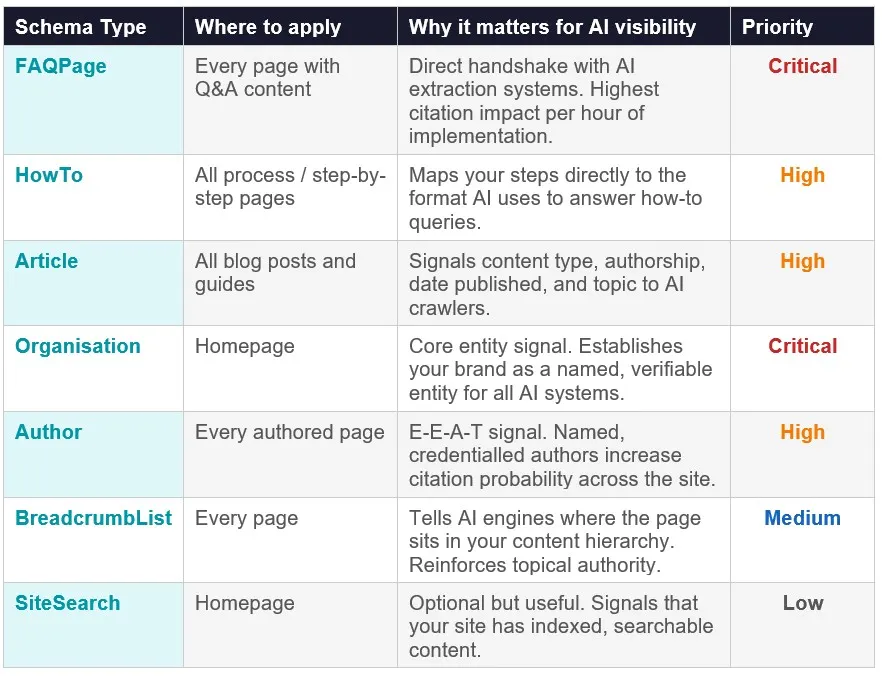
Priority schema types for AI search visibility
Schema implementation rules that prevent silent failures
• Always validate schema at schema.org/validator before publishing. A single malformed character silently breaks the entire schema block.
• Strip all HTML from FAQ answer text before adding it to JSON-LD. Bold tags, links, and bullet points inside schema text cause validation failures.
• Update dateModified in Article schema whenever you edit a page. Stale dates signal potential staleness to AI extraction algorithms.
• Use self-referencing canonical URLs on every page. Duplicate content signals confuse AI engines about which version of a page to cite.
8. Measuring AI Search Visibility: What to Track and How Often
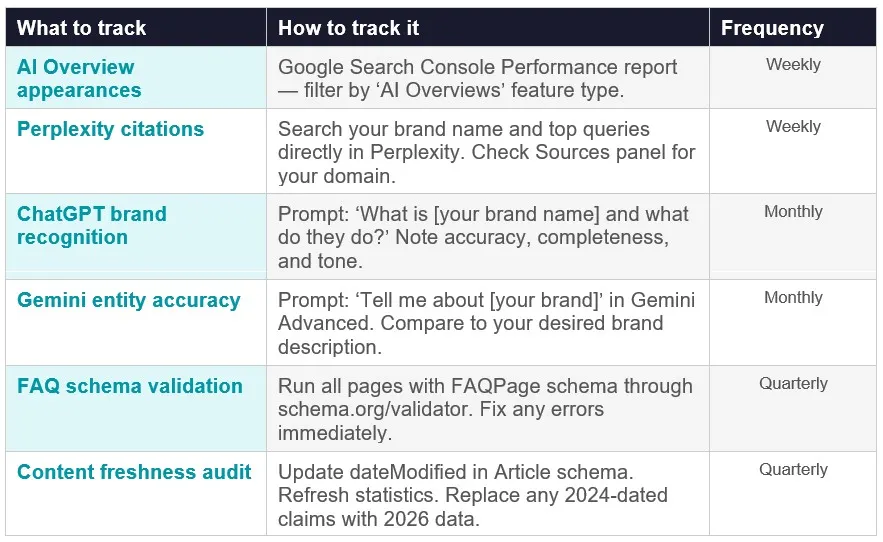
AI search visibility measurement is less mature than traditional SEO measurement — there is no single dashboard that shows you your AI citation share the way Google Search Console shows your organic clicks. But there are reliable methods for monitoring each layer of the system.
Setting realistic timelines
AEO is the fastest-feedback discipline: well-implemented FAQ schema and direct-answer content can appear in Google AI Overviews within four to eight weeks. GEO takes six to twelve weeks for new content to be indexed, evaluated, and cited by AI engines with live web access. LLMO is the slowest: LLM training data cycles vary, but consistent entity signals typically require three to six months to fully influence how AI systems describe your brand.
These timelines mean you should implement all four layers in parallel rather than sequentially. The AEO quick wins provide fast feedback and early momentum while the slower GEO and LLMO work compounds in the background.
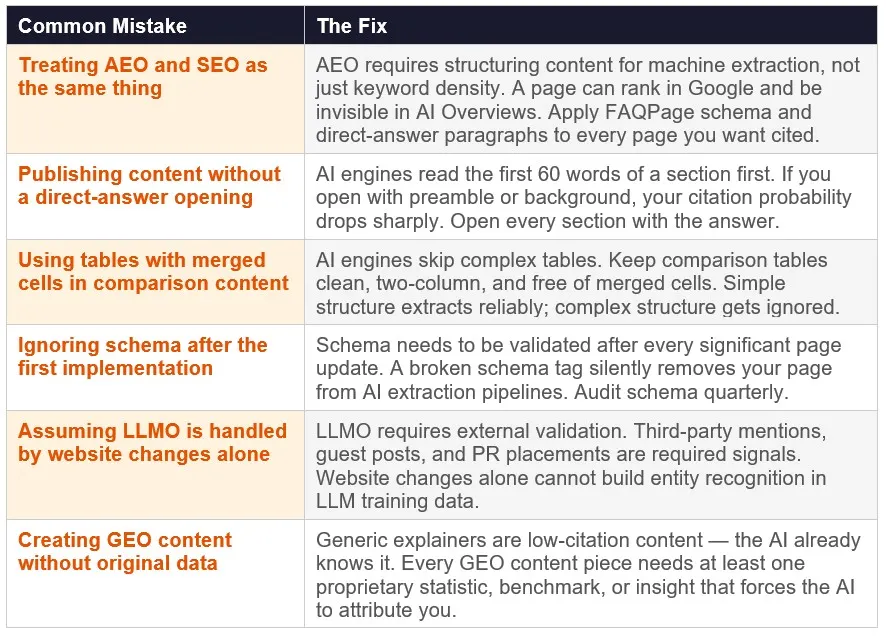
9. The 6 Most Common AI Search Visibility Mistakes (and the Exact Fixes)
10. Your 90-Day AI Search Visibility Roadmap
This roadmap is built for small business owners and solo operators who need to make measurable progress without a dedicated team. Each month builds on the previous one: Month 1 establishes the technical and structural foundation, Month 2 creates the content layer, and Month 3 builds the entity and brand signals that compound over time.
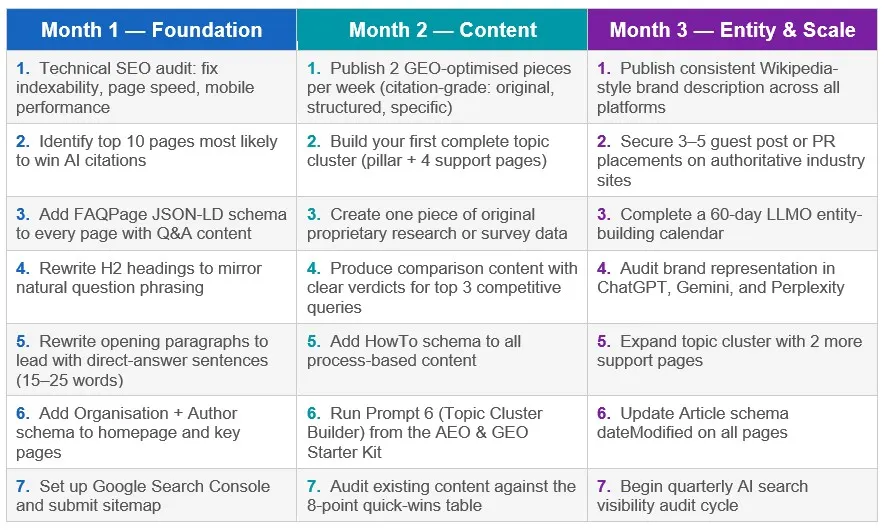
What to expect at each stage
• End of Month 1: First AI Overview appearances for FAQ-structured pages. Baseline measurement established in Search Console.
• End of Month 2: 4–8 new GEO-optimised content pieces indexed and beginning to generate citations. First comparison content appearing in Perplexity results.
• End of Month 3: Brand recognition improving in ChatGPT and Gemini entity queries. Topic cluster establishing domain authority for primary topic area.
• Months 4–6: Compounding. Each additional piece of content reinforces the cluster. Entity signals accumulate. Citation volume increases without proportional additional work.
The key insight that separates businesses that succeed with AI search visibility from those that do not is this: the system compounds. The 10th page in a well-structured cluster is not 10 times more valuable than the 1st — it is 50 times more valuable, because it reinforces the topical authority of every other page in the cluster. Start building the cluster now. The compounding begins immediately.
Free: AEO & GEO Prompt Starter Kit
20 structured prompts to implement this entire system — audit, AEO, GEO, LLMO, and schema. Plug-and-play for ChatGPT, Claude, or Gemini. No technical knowledge required.
Frequently Asked Questions
The following 12-question FAQ block uses FAQPage JSON-LD schema. Each answer is structured for AI extraction: direct answer in sentence one, 55–75 words, factual and specific.
What is AI search visibility?
AI search visibility is the probability that your business appears as a cited source in AI-generated answers from ChatGPT, Perplexity, Google AI Overviews, Gemini, and Copilot. It differs from traditional SEO visibility because AI systems answer questions directly without requiring a click, meaning businesses that are not cited are invisible to a growing segment of buyers before they ever reach a traditional search result.
What is the difference between AEO and GEO?
AEO (Answer Engine Optimisation) structures your existing content so AI engines can extract and display it as a cited answer. GEO (Generative Engine Optimisation) requires you to create content from the ground up that is original, specific, and authoritative enough that LLMs actively choose to quote it rather than paraphrase generic sources. AEO is a structural optimisation of existing pages; GEO is a new content creation standard built for AI citation.
How long does it take to appear in Google AI Overviews?
For pages with FAQPage schema and direct-answer paragraphs already implemented, Google AI Overviews appearances typically occur within four to eight weeks. New pages with no prior authority may take eight to twelve weeks. The fastest path is to optimise your existing highest-traffic pages first — rewrite opening paragraphs, add FAQ schema, and submit to Google Search Console. These structural changes deliver the fastest measurable AI visibility improvement.
Do I need technical SEO skills to implement this system?
No. The core AEO and GEO tactics — rewriting opening paragraphs, restructuring headings, writing FAQ content, and adding schema via a plugin or JSON-LD generator — require no coding knowledge. Schema validation tools like schema.org/validator confirm your implementation is correct before you publish. The free AEO & GEO Prompt Starter Kit provides 20 structured prompts that walk through every step without requiring any technical background.
What schema markup does a small business site need for AI search visibility?
The four most impactful schema types for AI search visibility are: FAQPage (for all Q&A content), Organisation (for the homepage — the most important entity signal), Author (for all blog posts and guides), and Article (for all content pages). HowTo schema should be added to any process-based or step-by-step content. BreadcrumbList reinforces topical authority signals. Implement these six schema types and you will have covered the vast majority of AI citation infrastructure required.
Can small businesses compete with large brands in AI search?
Yes — and this is one of the most significant opportunities AI search creates for small businesses. AI engines prioritise structural quality, specificity, and relevance over domain authority. A small business with well-structured FAQ schema, direct-answer paragraphs, and original data can appear in Google AI Overviews ahead of national brands with far greater domain authority. The structural requirements of AI search level the playing field in a way traditional SEO does not.
What is LLMO and how is it different from SEO?
LLMO (Large Language Model Optimisation) is the practice of building your brand as a recognised, accurately represented entity across all AI systems — ChatGPT, Gemini, Claude, Perplexity, and Copilot. Where SEO focuses on individual page rankings for specific queries, LLMO focuses on brand-level recognition that influences all AI responses about your category or niche. LLMO requires entity consistency, Organisation schema, and third-party validation — not keyword optimisation.
How do I know if AI search engines are citing my content?
The most reliable monitoring approach uses four methods: (1) Google Search Console Performance report filtered for AI Overviews feature type, (2) direct Perplexity searches for your key queries with your domain checked in the Sources panel, (3) monthly ChatGPT brand recognition prompts (‘What is [your brand]?’ and ‘Is [your brand] good for [use case]?’), and (4) Gemini Advanced brand entity queries. Run this monitoring cycle monthly and audit schema quarterly.
What content formats does ChatGPT cite most often?
ChatGPT with Browse enabled consistently cites content that is structured, original, and specific. The formats it cites most reliably are: direct-answer paragraphs opening with a factual statement, comparison content with explicit verdicts, and structured data or research with named statistics. Generic explanatory content that the model can produce from its own training data is rarely cited. The key differentiator is originality: content must contain information the model cannot already generate unattributed.
How is AI search visibility different for B2B businesses?
B2B AI search visibility requires a different content focus. B2B buyers use longer, more complex queries with higher commercial intent, their decision cycles involve more AI-researched validation, and a single AI citation reaching a decision-maker may be worth many times the value of a consumer citation. B2B AEO content should prioritise comparison queries, ROI-focused content, and technical FAQ blocks that map to the specific questions buyers ask at each stage of a long sales cycle.
Do I need to create new content or can I optimise existing pages?
Start with your existing pages — it is faster and often more effective than creating new content. The 8-point quick-wins audit in the Content section of this guide identifies structural improvements — opening paragraph rewrites, H2 heading restructuring, FAQ schema additions, and answer block trimming — that can unlock AI citations from pages that are already indexed and have existing authority. Only once your existing pages are AEO-optimised should you focus on creating new GEO content.
What is the free AEO & GEO Prompt Starter Kit?
The free AEO & GEO Prompt Starter Kit from Expert AI Prompts is a 20-prompt PDF covering all five layers of AI search visibility implementation: AI search audit (Prompts 1–3), AEO content structures (Prompts 4–8), GEO content creation (Prompts 9–12), LLMO brand visibility (Prompts 13–16), and schema & technical signals (Prompts 17–20). Each prompt includes fill-in-the-blank variables and a pro tip. It works with ChatGPT, Claude Sonnet, and Gemini Advanced. Available free at expertaiprompts.com/aeo-geo-prompt-starter-kit .
Ready to Implement the Full System?
The SEO Prompt Power AI Toolkit gives you 50+ expert-crafted prompts for AEO, GEO, LLMO, technical SEO, and content strategy — structured, tested, and plug-and-play across ChatGPT, Claude, and Gemini.
Explore the Full AI Search Visibility Cluster
This pillar guide is the strategic overview. Each support page goes deeper on a specific layer of the system:
• SEO vs AEO vs GEO vs LLMO: exact differences explained → expertaiprompts.com/seo-aeo-geo-llmo-difference-explained
• What content works for AI search engines → expertaiprompts.com/what-content-works-for-ai-search-engines
• AEO for B2B businesses → expertaiprompts.com/aeo-for-b2b-businesses
• How to rank in Google AI Overviews → expertaiprompts.com/how-to-rank-in-google-ai-overviews
• GEO vs SEO: which drives more revenue in 2026 → expertaiprompts.com/geo-vs-seo-which-drives-revenue-2026
• Brand visibility & LLMO: the complete guide → expertaiprompts.com/brand-visibility-ai-search-llmo-guide
• Free AEO & GEO Prompt Starter Kit → expertaiprompts.com/aeo-geo-prompt-starter-kit