US AI Governance Policy Template and Compliance Checklist (NIST AI RMF + TRAIGA)
Seven fill-in documents that turn Texas TRAIGA into owned, dated evidence, mapped to the NIST AI RMF.
Get the full template Free checklist (PDF)This free AI governance policy template gives a US software company a working governance program, not just a policy. It maps every obligation to the NIST AI Risk Management Framework and to Texas TRAIGA, and it produces the evidence buyers, lenders and the Texas Attorney General may ask to see.
The template is aligned with ISO/IEC 42001, the AI management system standard. It is not a certification and not legal advice. It is the companion download to our US AI governance framework.
Why a US-specific AI governance policy template
Most free templates are generic policy text. They state principles but say nothing about which law asks for what, or what evidence proves it. US companies now face specific obligations: Texas TRAIGA has been in force since January 1, 2026, and Colorado and California follow on January 1, 2027.
Texas also wrote NIST into its liability safe harbor. A company that discovers a violation through substantial compliance with NIST AI 600-1, together with an internal review process, is not liable (§ 552.105(e)(2)(D)). A template built on NIST and mapped to TRAIGA turns that provision into a documented control instead of a footnote.
What is in the full AI governance policy template
The full pack is the evidence set from our TRAIGA/NIST crosswalk module:
- AI system register with each system's intended purpose, owner and risk tier.
- Prohibited-use screening record against the Texas prohibitions (§§ 552.052–552.057).
- Risk and profiling assessments, including Texas data protection assessments where profiling triggers § 541.105(a)(3).
- Human-review logs for decisions where people review AI outputs.
- Vendor contract checklist for third-party AI: testing, data use, access controls and incident notice.
- Attorney General inquiry and 60-day cure playbook under § 552.104.
- Crosswalk table linking each obligation to NIST, AI 600-1, an ISO/IEC 42001 clause or Annex A control, evidence, owner and review cadence.
Each document is a fill-in template with guidance notes, so a company can complete it with its own facts rather than starting from a blank page. Teams can keep the pack in the tools they already use, such as a shared drive, a GRC platform or the data room, as long as each artifact has an owner and a review date.
Sample AI compliance checklist (10 items)
Answer yes or no for one company. Every "no" is a gap the template closes. Each item cites the provision it supports, so legal and product teams can see why it matters.
- Inventory. Do we keep a current register of every AI system we develop or deploy?
- Intended purpose. Is each system's intended purpose recorded and approved?
- Prohibited-use screening. Has each system been screened against TRAIGA §§ 552.052–552.057?
- Discrimination review. Is intended purpose and testing documented to show no intent to unlawfully discriminate (§ 552.056)?
- Adversarial testing. Do we run adversarial or red-team testing before major releases (§ 552.105(e)(2)(B))?
- Internal review. Do we have an internal review process aligned with NIST AI 600-1 (§ 552.105(e)(2)(D))?
- Profiling assessment. Where we profile people, have we completed a TDPSA data protection assessment (§ 541.105(a)(3))?
- Biometrics. Where we capture biometric identifiers, do we meet CUBI requirements (§ 503.001)?
- Cure owner. Is a named person responsible for responding to an Attorney General notice within the 60-day cure period (§ 552.104)?
- Vendor terms. Have we reviewed third-party AI vendor terms for testing, data use and incident notice?
Scoring: 8–10 yes, refine and evidence. 4–7 yes, close the gaps this quarter. 0–3 yes, start with the inventory and screening steps below.
Free checklist, no form. Print or share this checklist as a one-page PDF.
Download the free checklist (PDF)Get the full template, free by email. Register, assessments, playbook and crosswalk in one 16-page pack.
Get the US AI governance templateHow the AI governance policy template maps obligations to evidence
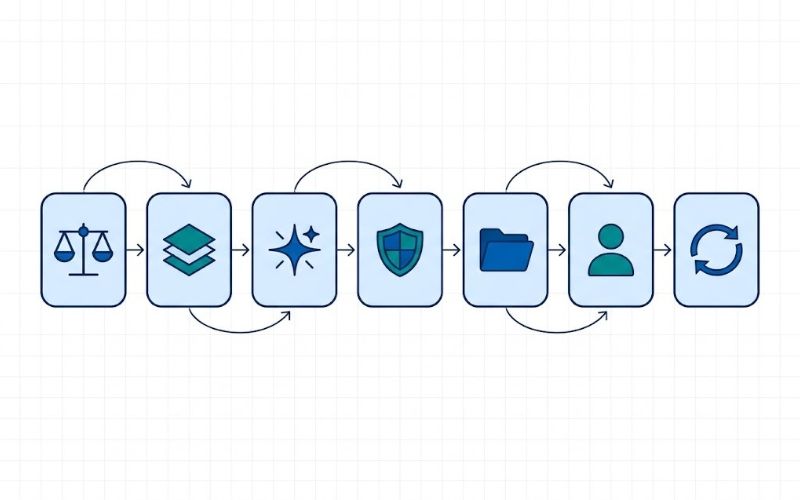
Every obligation follows the same row schema, so the evidence is consistent and easy to audit:
Obligation → NIST AI RMF subcategory → AI 600-1 action → ISO/IEC 42001 clause or Annex A control (aligned with) → evidence artifact → owner → review cadence
Worked Texas example
| Field | Entry |
|---|---|
| Obligation | Liability safe harbor through substantial compliance with NIST AI 600-1 plus an internal review process (§ 552.105(e)(2)(D)) |
| NIST AI RMF | GOVERN 1.4 Risk management process and outcomes established through transparent policies and controls; GOVERN 1.5 Ongoing monitoring and periodic review |
| AI 600-1 action | GV-3.2-001 Independent evaluations or assessments of GAI systems |
| ISO/IEC 42001 | Clauses 9.2.2 Internal audit programme; 9.3 Management review (aligned with, not certified) |
| Evidence | Crosswalk with a dated AI 600-1 version line, AI 600-1 gap assessment, internal review minutes, NIST version-watch log |
| Owner | Executive AI owner |
| Review cadence | Quarterly; annual full review |
Who it is for and how to use it in 30 days
The template is built for PE-backed and growth-stage software companies selling into the US, and for the operating partners who oversee them. It suits a company with AI features in production and no dedicated AI governance function yet.
- Week 1: inventory. List every AI system, its intended purpose and its owner in the register.
- Weeks 2–3: screen. Run the prohibited-use screen and flag systems that need a profiling assessment or biometric review.
- Week 4: assign owners. Name an owner for every crosswalk row, set review dates and nominate the Attorney General notice owner.
At day 30, the company has a working register, a screening record and named owners: the foundation for the rest of the evidence pack. Colorado and California modules follow ahead of their January 1, 2027 dates.
Frequently asked questions
Is this AI governance policy template a legal compliance guarantee?
No. It is a governance template that organizes the evidence a US software company should keep, mapped to the NIST AI RMF and Texas TRAIGA. It does not guarantee compliance with any law and it is not legal advice. Use it to build your program, then have counsel review the policies and assessments against your products and contracts.
Does the template cover ISO/IEC 42001?
The template is aligned with ISO/IEC 42001, the AI management system standard: each row maps to an ISO/IEC 42001 clause or Annex A control. Alignment means the evidence is structured so it can support a later ISO/IEC 42001 program. It is not a certification, and using the template does not make a company certified to the standard.
Does it cover Colorado and California?
Not yet. The current template covers Texas TRAIGA, mapped to the NIST AI RMF and NIST AI 600-1. Colorado's SB 26-189 and California's ADMT regulations both start on January 1, 2027, and modules for each will be added before then. Because they reuse the same register and evidence, adding them extends the program rather than rebuilding it.
What should an AI governance policy include?
At minimum: the scope and owners of the program, an AI system register with intended purposes, rules for prohibited uses, risk assessment and testing requirements, human-review expectations, vendor management, incident response, and a review cadence. In Texas, add a named owner for Attorney General notices and the 60-day cure process. The template covers each of these with fill-in documents.
How long does it take to implement the template?
A company with AI features in production can complete the foundation in about 30 days: inventory in week one, screening in weeks two and three, and owners assigned in week four. Assessments, testing and vendor reviews follow over the next quarter. Timing depends on how many AI systems the company runs and how well they are documented today.
Download the template
Get the full US AI governance policy template, or book a 30-minute strategy session to walk through it for one portfolio company. For Texas detail, read the TRAIGA compliance guide.
Prefer not to sign up? Download the free checklist (PDF).
Governance template only. Not legal advice; counsel review is recommended.