Expert AI Prompts · AI Case Studies
AI Transformation in Practice
Three industries. Three outcomes. One methodology that produces both.
62 Documents · 7 Hours · 1,500 Prompts · 5,291+ Post Impressions · Global Regulation Coverage
AI transformation case studies are the only credible answer to "does this AI methodology actually work?" This hub documents three of them — across civil construction compliance, enterprise prompt architecture, and AI governance implementation — each using the same underlying framework, each producing results that are specific, quantified, and independently verifiable.
What makes an AI methodology credible is not the claim. It is the evidence. Generic AI generates generic output. Sector-specific AI — engineered with the right context layers, regulatory vocabulary, and structured prompt architecture — generates submission-ready documents, governance frameworks, and compliance systems that hold up to professional evaluation. Every case study on this page demonstrates what that distinction produces in practice.
★ FEATURED CASE STUDY ★
From Paper Ceiling to Tier 1 Ready — NQ Civil Construction
Civil Construction · Compliance Documentation · AI Methodology
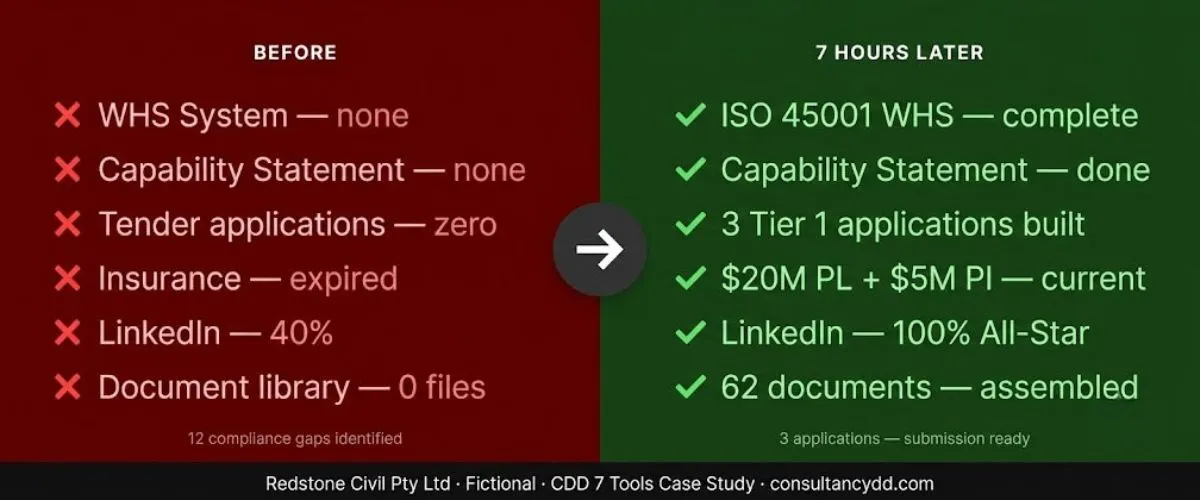
62 Documents · 7 Hours · 12 → 0 Compliance Gaps · 4.875/5 Quality · 3 Tier 1 Applications
The Problem: Invisible to Procurement
Redstone Civil Pty Ltd — a fictional NQ civil earthmoving contractor built to demonstrate the methodology — had the plant, the crew, and the project history to qualify for Tier 1 work. What it did not have was the documentation that procurement managers use to make panel decisions. No WHS management system. Expired insurance. No capability statement. No prequalification registration. Twelve compliance gaps identified at baseline audit.
The Methodology: Context Stacking for Civil Compliance
The CDD 7 Tools system applied the Expert AI Prompts context stacking methodology — building a Business DNA block first, then loading the civil construction regulatory layer (ISO 45001:2018, ISO 45003:2021, CQMS Raize portal requirements, QLD WHS Amendment Regulations 2023) before any document was produced. Three Deep Research workflows — tender, grant, and WHS regulatory — were completed before any application was drafted. Every subsequent session drew from the same verified context block.
The Outcome: Three Tier 1 Applications Assembled Simultaneously
62 documents produced across all seven tools. WHS compliance Code A to Code C. LinkedIn All-Star status: 40% to 100%. Three complete applications: CSQ workforce training grant ($23,440), TCC infrastructure tender (TCW00639), McConnell Dowell prequalification (25 attachments, zero hard blockers). Total AI-assisted work time: approximately 7 hours.
Panel targets this methodology prepares for: Powerlink · CopperString · TMR · McConnell Dowell · John Holland · Fulton Hogan · Mining and Resources panels
★ Redstone Civil Pty Ltd is a fictional practice company. All outcomes are illustrative. ★
Download the Business Overview PDF →
LINK → consultancydd.com/results/redstone-civil/ — Full document library
CASE STUDY 2
1,500 Industry-Specific Prompts — When Structured AI Replaces Generic AI
AI Methodology · Content at Scale · Prompt Architecture
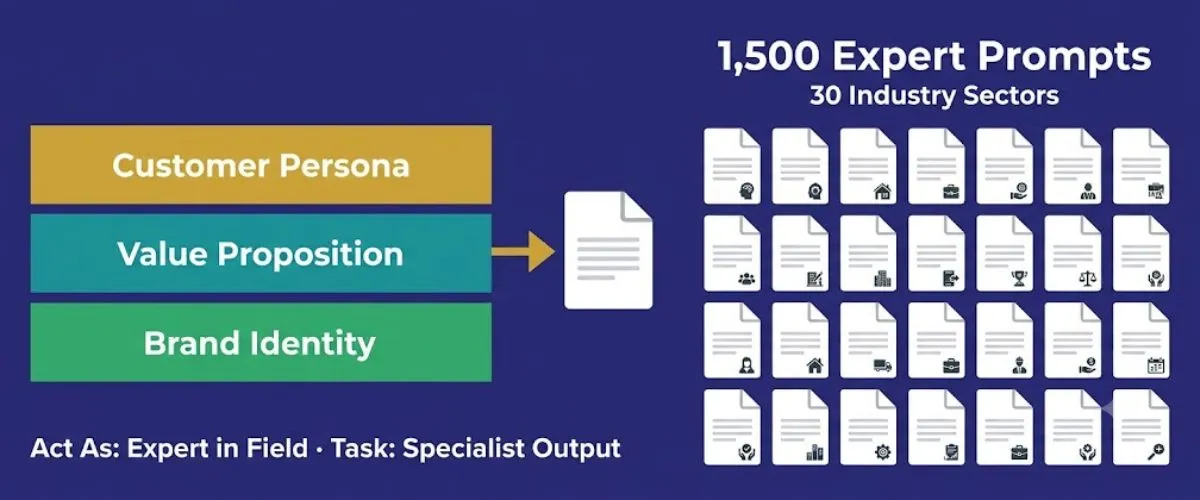
1,500 Expert Prompts · 30 Industry Sectors · 3-Layer Context Stack · 1 Worked Example Per Prompt
The Problem: Generic AI Produces Generic Output
Most AI failures in a business context come from the same architectural mistake: prompting the AI with a role name and a task, then expecting professional-grade output. Without a defined customer persona, a clear value proposition, and a documented brand identity feeding the prompt, the AI has no specific context to draw from. The output sounds like AI because it has nothing to sound like anything else.
The Methodology: Act As Expert + Task Specialist + Context Layers
The Expert AI Prompts system structures every prompt in two dimensions: role (Act As: Expert in the specific field) and task (Task: Specialist at the specific deliverable). This prompt architecture is then wrapped in a three-layer context block — Customer Persona, Value Proposition, and Brand Identity — that provides the AI with exactly the business-specific detail it needs to produce output that sounds like the operator, not a generic AI assistant.
Every one of the 1,500 prompts in the library includes a worked example — the prompt as written, the context layers applied, and the output produced. This makes the system teachable, repeatable, and adaptable across thirty industry sectors without re-engineering the core architecture. Several of the bonus documents in the library were directly adapted into the Redstone Civil CDD 7 Tools case study run — proving the methodology scales from product-level to deployment-level AI work.
The Outcome: Industry-Specific AI That Produces Submission-Ready Output
When every prompt carries verified business context — who the customer is, what the business uniquely provides, how the brand communicates — the output is consistently on-brand, accurate to the business, and structured for the specific audience it needs to reach. That consistency is what separates an AI productivity system from a content novelty.
LINK → expertaiprompts.com/ai-transformation-playbook — The full methodology playbook
CASE STUDY 3
Governance Before the Fine — Eliminating Shadow AI Before Global Regulation Lands
Enterprise · AI Governance · Shadow AI · EU AI Act
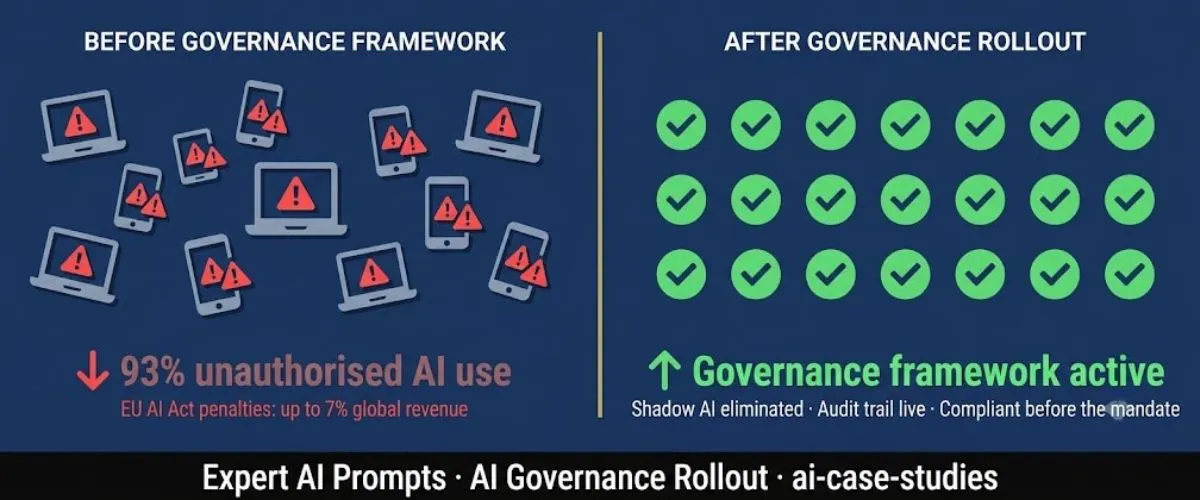
93% Shadow AI Enterprise Rate · €35M Max Penalty (EU AI Act) · Governance Framework Deployed · Audit Trail Active
The Problem: 93% of Enterprise AI Use Is Unauthorised
The most dangerous AI adoption pattern in enterprise organisations is not the AI strategy that fails. It is the AI usage that no one approved. Research consistently shows that the majority of enterprise ChatGPT use runs through personal accounts — outside IT governance, outside data controls, and completely invisible to the compliance frameworks that will soon be legally mandated. That is the shadow AI problem, and the penalties for ignoring it are severe.
The EU AI Act — the world's first comprehensive AI regulation — is already in force across Europe, with full implementation penalties active. The fines for prohibited AI use reach €35 million or 7% of global annual turnover. Australia's AI governance obligations are tightening. Any enterprise organisation that cannot demonstrate documented AI governance, acceptable use policies, and audit trail capability is building regulatory liability with every unsupervised AI session.
The Methodology: Govern From the Inside Before Regulators Force You
The AI Governance Rollout case study demonstrates how the Expert AI Prompts governance framework is deployed inside an enterprise environment — from initial AI maturity assessment through to an active governance architecture. The methodology covers shadow AI identification and elimination, acceptable use policy development, AI risk classification, audit trail implementation, and staff training frameworks aligned to the emerging global regulatory environment.
The Outcome: Compliant Before the Mandate
A governance framework that exists before the regulator requires it is a commercial advantage. It demonstrates to enterprise clients, government partners, and procurement panels that AI use within the organisation is controlled, documented, and professionally managed. For organisations already fielding questions from clients about AI data handling — this case study shows how to answer them with a framework, not a policy statement.
LINK → expertaiprompts.com/ai-governance-framework — Download the framework
Case Studies in Development

Healthcare & Allied Health · AHPRA compliance, clinical documentation, Medicare billing framework
Mining & Resources · Site compliance, environmental documentation, safety management systems
Professional Services · Legal, accounting, consulting deliverables at scale without headcount
Local Government · Tender evaluation, procurement documentation, policy compliance frameworks
Real Estate · REIQ compliance, listing content, property management operational systems
Education & Training · ASQA/NESA compliance, course content, assessment documentation
Apply the Methodology to Your Industry
Every case study on this page used the same four-layer prompt architecture. The sector changes. The methodology does not. Choose your next step: