AI in Private Equity: A Worked Case Study of a 90-Day AI Value and Governance Sprint
How a fictional PE-backed software company goes from Company DNA to a governed AI plan worth +283 bps of EBITDA margin. Plan as approved, not a reported result.
Book a scoping callRead this first. Caprock Workforce Software and its sponsor, Granite Mesa Capital, are fictional. The company, roles and figures were built to run the method end to end. Every number comes from one assumption sheet and is plan as approved, not a reported result. Not legal or tax advice.
Most writing on AI in private equity stays at fund level: deal sourcing, diligence screens, portfolio dashboards. This case study goes inside one portfolio company. It shows the documents that have to exist before AI can move a value-creation plan line, and how each one is made, checked and filed so it holds up when a buyer looks.
It draws on two runs: a full paper run of the 26 value and governance documents, and a live run of the method in the Expert AI Prompts toolset, current to November 28, 2026.
The company and the challenge
| Area | Day 0 |
|---|---|
| Business | Scheduling, shift-matching and credential compliance for outpatient clinics; Austin, Texas; customers 70% Texas, 30% Colorado |
| Financials | $60M ARR; EBITDA $12.0M (20% margin); acquired 2024; exit planned 2028 |
| People | 320 staff across six departments |
| Growth plan | 20 new hires planned in 12 months (12 Support, 8 Operations) to hold service levels |
| AI use | 14 overlapping AI tools; personal AI accounts used with customer data; no AI lead |
| AI risk | Shift-matching ranked clinicians with no documented purpose or human review; a vendor chatbot without zero data retention; a collections model with no data protection assessment |
The sponsor's question was simple: can AI absorb growth instead of hiring at the same rate, without creating a governance problem that a buyer will price in at exit?
Start with the Company DNA
Every document in the Sprint is drafted from the company's own record, never from a blank page. That record is the Company DNA.
AI Value & Governance Sprint →
- Company DNA. Leadership interviews capture the persona, value proposition, value-creation plan lines, the decisions waiting to be made, and every AI system in use with an owner and a risk tier.
- Department DNA. Six department interviews (Operations, Engineering, Customer Support, Finance & Billing, Marketing & Sales, and Leadership & governance) record the roles, volumes, pain points and AI use in each team.
- Level 1, then Level 2. Level 1 is what the interviews record. Level 2 adds the decisions, resolved with evidence: options, pros and cons, quick lookups and Deep Research summaries graded for confidence.
- Need to know. Staff see the shared company sections and their own department only. Exact figures and named people stay on a local model, and references about people never enter AI.
Each area gets its own DNA report, which its department reads and corrects at the quarterly governance review.
A panel drafts every document
Each document is drafted by one structured prompt that seats a seven-member panel: three subject experts chosen for that document type, two quality reviewers who check facts, sources, guardrails and data lanes, and two writers who draft the document and fit it to its reader.
A fresh AI session then runs the Company Quality Checkpoint: 15 checks covering intent, accuracy, audience, tone, structure, depth, sources, consistency with the DNA, guardrail wording, data lane, people and approval readiness. Each failure is fixed, or owned in an appendix and explained in the working paper, before the owner's role signs.
Decisions made along the way are recorded as rulings: the decision, the reason and the role that made it, never a name. One example from Caprock: the Head of Customer Support ruled that response-time targets count within support hours only.
Prompt chaining: Preparation, then Final
Long, defensible documents don't come from a single prompt. The method chains them, and every link is saved.
Preparation promptPreparationFinal promptFinal documentCheckpointApproval and register
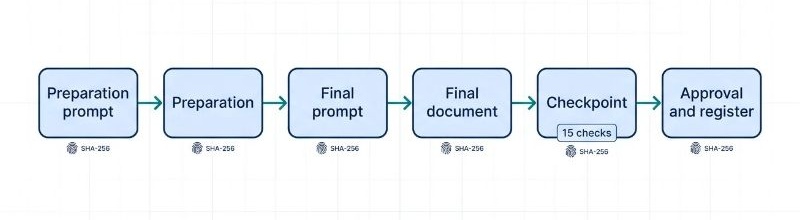
- Preparation. The panel builds a working paper: every figure with its source and version, the DNA facts used, the reviewers' findings, open questions and the facts still to be verified.
- Final. The document itself is built only from the Preparation, with its open items listed at the end.
- Checkpoint. A separate session tests the Final against the 15 checks and records the result.
- Approval. The owner's role signs. The version is stamped and frozen with its Build History.
Each step is saved with its date and a SHA-256 fingerprint, so any copy can be checked against the record. When a document changes, the documents that depend on it are flagged for review, and each flag is closed by a refresh or a recorded ruling.
Three document categories
The toolset organizes 40 document types into three categories. Foundation comes first, because every governance and value document reads from it.
Foundation (10)
How the company sells and serves: target market, positioning and messaging, offer architecture, sales playbook, marketing and social, customer service standards, business model canvas, balanced scorecard framework, customer FAQ and business proposal template.
Public Presence (4)
How the company is found: Google Business Profile, LinkedIn profile, LinkedIn company page, and the customer journey with its keywords.
Value & Governance (26)
How AI creates value and stays governed: from the AI system register and tool sweep, through policy, RACI and the US module evidence pack, to the EBITDA bridge, board presentation, data-room pack and successor hiring profile.
Folders and the Governance Index
The record lives in the client's own Microsoft 365 or Google Workspace folder, not in the toolset. Folder names are fixed, and what each person can see follows folder security.
| Folder | Holds | Who sees it |
|---|---|---|
| 00 Engagement | Engagement identity and release logs | Leadership |
| 01 Leadership (limited) | Level 2 DNA, decisions, local-lane files | Leadership only |
| 02 DNA Reports | The DNA report set for each area | Each department sees its own area |
| 03 Foundation | Approved Foundation documents | As each document's audience names |
| 04 Governance Record | The full set for each version (Final, Preparation or working paper, Checkpoint record, Build History) and the Governance Index | Leadership; an auditor or the board when invited |
| 05 Value and Governance | Approved value and governance documents | As each document's audience names |
| 11 onward: department brief | Documents published to that department | That department, view |
| 21 onward: department updates | Answers, project briefs and corrections | That department, add files |
| 31 onward: department interviews | That department's interview files | That department, view |
| 99 Archive | Superseded versions with dated names | Leadership |
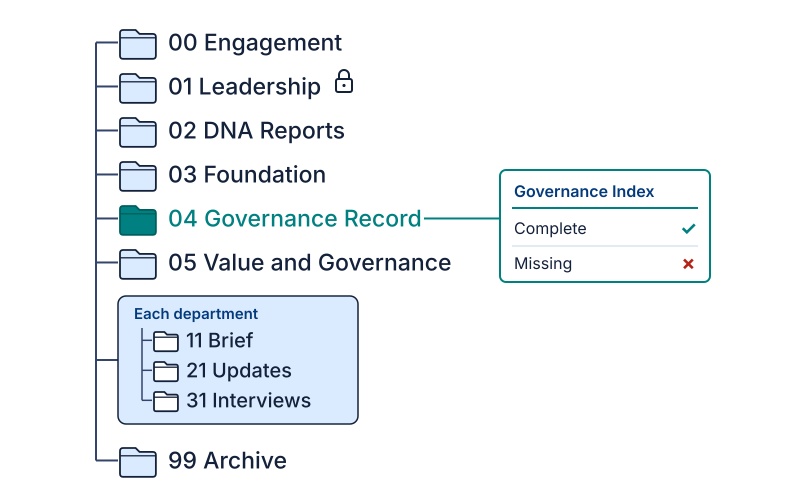
The Governance Index lists every document set as Complete or Missing, with fingerprints a buyer's advisor can check. At Caprock, the map holds 35 folders, with a brief, updates and interviews folder for each department.
The 90 days and three gates
| Point | Deliverable | Sponsor decision |
|---|---|---|
| Day 30 · Gate 1 | Diagnostic report: pathway options, five Gate 1 answers, baselines, evidence index | Continue, redirect or stop |
| Day 60 · Gate 2 | Governance framework in force; two use cases with KPIs and production gates; 12-month roadmap | Approve the use cases and framework |
| Day 90 · Gate 3 | Use cases in production; dashboard; data-room pack; board presentation; successor profile | Retainer, portfolio roll-up or handover |
Caprock's first two use cases are support self-service and finance operations. The collections model waits for its data protection assessment, with a day-60 fallback.
The value plan: an EBITDA bridge
The plan is set from one assumption sheet. Nothing enters the bridge until the sheet changes.
| Lever | How it moves | $M |
|---|---|---|
| 1 Support | Human-approved Customer FAQ absorbs ticket growth: 12 planned hires not made | +0.90 |
| 2 Operations | Client onboarding pack and daily exceptions brief absorb go-live growth: 8 planned hires not made | +0.60 |
| 3 Collections and AP | Bad debt 0.9% to 0.7%; 2 AP roles not backfilled | +0.22 |
| 4 Vendor consolidation | 14 tools to 5; license spend removed | +0.30 |
| 5 AI run costs | Business AI seats, API inference and search data accounts | −0.14 |
| 6 Fractional CAIO retainer | Ongoing governance after day 90 | −0.18 |
| Net | EBITDA $12.0M to $13.70M; margin 20.0% to 22.8% | +1.70 |
Plan as approved, not a reported result. Plan view: +283 bps. Sponsor view: +233 bps (22.3%) until the CFO signs the tool recount behind lever 4.
- Quality of earnings. $1.50M is cost avoided against the sponsor's hiring plan (levers 1 and 2); $0.20M is run-rate change (levers 3 to 6). The split is shown, not blended.
- Downside cases. Collections model deferred: +213 bps. Lever 2 missed at day 90: +183 bps, below the band, so lever 2 is read monthly from day 30.
- Not in the bridge. Freed staff time, faster payment and content capacity sit in a separate capacity view. No exit-multiple uplift is claimed.
Governance a buyer can check
- AI system register. Each entry has an owner, intended purpose, risk tier, human check and review date. Blocked and retired tools are listed with dates.
- Policy, charter and RACI. Three risk tiers, a monthly AI Center of Excellence, and one accountable role for each of 33 governance activities.
- Texas evidence pack. 23 rows of the TRAIGA–NIST AI RMF crosswalk mapped to Caprock's evidence, owners and dates. It is a record of practice, not a guarantee. Not legal advice.
- Colorado. SB 24-205 was repealed and replaced by SB 26-189, effective January 1, 2027. Counsel reviews the shift-matching classification first. Not legal advice.
- ISO/IEC 42001. A gap analysis and draft Statement of Applicability. Aligned with ISO/IEC 42001, not certified; certification stays an option.
- Data-room pack. Eleven folders, ten buyer questions and nine red flags, each with an owner and close date. One gap register of 33 items replaces five separate lists.
Run status
As of November 28, 2026. The outcomes above come from a full paper run of the 26 value and governance documents. The method has since been run in the toolset: documents marked approved were drafted, checked against the 15 quality checks and signed in the tools. The rest follow in the next cycle.
| Category | Approved in the toolset | Next cycle |
|---|---|---|
| Foundation (10) | 9 | 1 |
| Public Presence (4) | 3 | 1 |
| Value & Governance (26) | 6: the diagnostic inputs | 20 (complete in the paper run) |
Who built the method
The method and toolset were designed by Matthew Bulat, founder of Expert AI Prompts: 20+ years of technology leadership, a former CTO for federal government infrastructure, and 8+ years as a CQUniversity lecturer.
Frequently asked questions
How is AI used in private equity portfolio companies?
At portfolio level, AI earns its place when it moves a line in the value-creation plan: absorbing growth without matching hires, shortening cycle times or lowering bad debt. In this example, support self-service and finance operations went first because each had a measured baseline and an owner. Governance was built at the same time, so the AI in use is registered, owned and checked before a buyer asks.
What are the key metrics for measuring AI governance?
Measure coverage and control, not activity. Useful measures include the share of AI systems in the register with an owner, purpose and risk tier; review dates met; incidents logged and closed; training completed; and gaps closed with evidence. In Caprock's plan these are read monthly on a dashboard, with leading indicators reported separately from realized value.
How does maintaining an AI inventory support responsible governance?
An AI inventory, or AI system register, gives every other control something concrete to attach to. Each entry names an owner, intended purpose, risk tier, human check and review date, so policy, vendor review and state-law obligations map to a real system. At Caprock, the register also lists blocked and retired tools with dates, which is the history diligence teams look for.
How do you govern shadow AI?
Find it, offer a better sanctioned option, then block. Caprock's sweep found 14 overlapping AI tools, and the plan consolidates them to 5 sanctioned tools. Personal AI accounts are blocked for company data at day 30, after a business option and an interim acceptable-use policy are in place, and past personal-account use disclosed by day 30 carries no disciplinary action.
What is an EBITDA bridge for an AI program?
It is a lever-by-lever walk from today's EBITDA to the planned figure, with each step tied to a row in one assumption sheet. Caprock's bridge shows six levers, separates cost avoided from run-rate change, includes AI running costs and the retainer, and tests downside cases. It is plan, not results, until measured against the day-30 baseline.
Is Caprock a real company?
No. Caprock Workforce Software and Granite Mesa Capital are fictional, and any resemblance to a real company is not intended. The figures are a worked example from one assumption sheet; benchmarks carry their source and version, and legal references come from a register of primary sources. Not legal or tax advice.
See how this would work in your portfolio company
In a 30-minute scoping call we confirm fit, the value-creation plan lines in play, and where your company's DNA would start.
Book a scoping callRead about the 90-Day Sprint →
See the US AI governance framework →
Caprock Workforce Software and Granite Mesa Capital are fictional. General information only; not legal, tax or insurance advice.